
The Third Kalma of Islam – Meaning, Importance, and Benefits
“The Third Kalma, also known as Kalma Tamjeed, highlights the glory, praise, and greatness of Allah. It reminds Muslims of Allah’s supreme power, encourages gratitude, and strengthens faith through daily recitation and remembrance.”

The Third Kalma of Islam – Meaning, Importance, and Benefits
Introduction
Islam is a complete way of life based on the belief in one Allah and His last Messenger, Prophet Muhammad (ﷺ). One of the most important aspects of Islam is the recitation and understanding of the Six Kalmas, which summarize the core beliefs of a Muslim. Among these, the Third Kalma, also known as Kalma Tamjeed, holds a very special place. It is a declaration of the greatness of Allah, highlighting His attributes of power, glory, and praise.
In this blog, we will explore the Arabic text of the Third Kalma, its English and Urdu translation, the importance of reciting it, and the spiritual benefits it brings into a believer’s life.
The Arabic Text of the Third Kalma
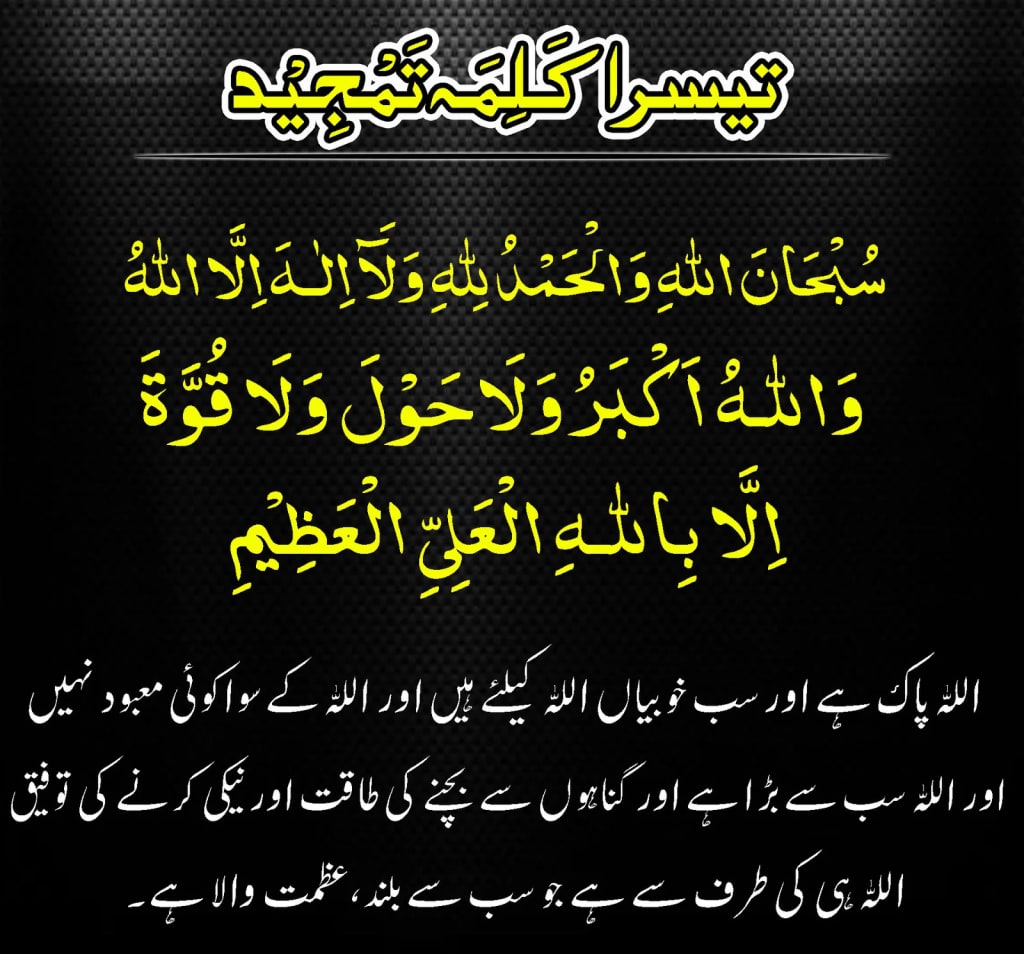
The Third Kalma is called Kalma Tamjeed because it glorifies Allah. Here is the Arabic text
سُبْحَانَ اللَّهِ وَالْحَمْدُ لِلَّهِ وَلَا إِلٰهَ إِلَّا اللَّهُ وَاللَّهُ أَكْبَرُ، وَلَا حَوْلَ وَلَا قُوَّةَ إِلَّا بِاللَّهِ الْعَلِيِّ الْعَظِيمِ
Translation of the Third Kalma
English Translation:
“Glory be to Allah, and all praise is for Allah, and there is no deity except Allah, and Allah is the Greatest. There is no power and no strength except with Allah, the Most High, the Most Great.”
Urdu Translation:
“اللہ پاک ہے، اور سب تعریفیں اللہ ہی کے لیے ہیں، اور کوئی معبود نہیں مگر اللہ، اور اللہ سب سے بڑا ہے۔ اور طاقت اور قوت صرف اللہ بلند و برتر کے ساتھ ہے۔”
Meaning of the Third Kalma
The Third Kalma is a collection of four powerful phrases often known as Tasbeehat:
SubhanAllah (سُبْحَانَ اللَّهِ) – Declaring the perfection and purity of Allah.
Alhamdulillah (الْحَمْدُ لِلَّهِ) – Expressing gratitude and praise for Allah.
Allahu Akbar (اللَّهُ أَكْبَرُ) – Recognizing that Allah is the Greatest above all creation.
La Hawla Wala Quwwata Illa Billah (لَا حَوْلَ وَلَا قُوَّةَ إِلَّا بِاللَّهِ) – Admitting that no one has power or strength except Allah.
These phrases together remind a Muslim of the oneness, greatness, and majesty of Allah.
Importance of the Third Kalma in Islam
The Third Kalma is not only a statement of faith but also a daily reminder for Muslims. Some key points of its importance include:
It strengthens Tawheed (belief in the Oneness of Allah).
It reminds Muslims that Allah is free from all shortcomings.
It builds a strong habit of gratitude and humility.
It is a form of Dhikr (remembrance of Allah), which purifies the heart.
It provides inner peace and spiritual satisfaction.
Benefits of Reciting the Third Kalma
1. Spiritual Purification
Reciting the Third Kalma helps in cleansing the heart and soul. It keeps a believer connected to Allah and strengthens Imaan (faith).
2. Protection from Evil
When Muslims recite La Hawla Wala Quwwata Illa Billah, they acknowledge that all strength comes from Allah. This brings protection from the whispers of Shaytan (Satan).
3. Gaining Allah’s Mercy
Every phrase of the Third Kalma is beloved to Allah. The Prophet Muhammad (ﷺ) encouraged the remembrance of SubhanAllah, Alhamdulillah, Allahu Akbar, and La Hawla Wala Quwwata Illa Billah, as they bring great rewards in the Hereafter.
4. Peace of Mind
In times of difficulty, reciting the Third Kalma gives peace of mind and reminds us to rely on Allah’s power rather than our own.
5. Unlimited Rewards
The Kalma Tamjeed contains words of praise and glory for Allah, and each recitation adds to the believer’s record of good deeds.
The Third Kalma and Daily Lif
Muslims are encouraged to recite the Third Kalma not only during prayers but also throughout the day. It can be recited
After Salah (Namaz) as part of Tasbeeh.
In times of stress and worry, to seek Allah’s help.
During moments of happiness, to thank Allah.
Before starting any task, acknowledging that all power comes from Allah.
This regular practice builds a close relationship with Allah and keeps a believer mindful of His greatness.
Connection with the Other Kalmas
The Six Kalmas of Islam are a summary of faith. While the First Kalma (Tayyab) emphasizes belief in the Oneness of Allah, and the Second Kalma (Shahadat) is about bearing witness to faith, the Third Kalma (Tamjeed) focuses on praising and glorifying Allah.
Together, they create a complete foundation of a Muslim’s belief system.
The Role of Dhikr in Islam
The Third Kalma is part of Dhikr, which means remembering Allah. The Qur’an and Hadith highlight the importance of Dhikr:
Allah says in the Qur’an:
“Remember Me; I will remember you.” (Surah Al-Baqarah 2:152)
The Prophet Muhammad (ﷺ) said:
“Shall I not tell you of the best words of remembrance? They are: La ilaha illallah.” (Tirmidhi)
Thus, reciting the Third Kalma is one of the most rewarding acts of worship in Islam.
Conclusion
The Third Kalma (Kalma Tamjeed) is a beautiful collection of words that glorify Allah and remind us of His greatness. By reciting it regularly, a Muslim gains peace of heart, protection from evil, and countless rewards from Allah.
It is not just a set of words but a powerful declaration of faith, gratitude, and humility. Every Muslim should make it a habit to recite the Third Kalma daily, teaching it to children and reminding family members of its importance.
In a world full of distractions and difficulties, the Third Kalma serves as a spiritual anchor that keeps us connected to Allah and strengthens our Imaan.
About the Creator
Bisma
✨ Faiz-e-Islam is a platform dedicated to spreading the true spirit of Islam. We strive to promote Islamic values, organize educational and spiritual programs
Five Modern Conveniences That Are Making Us Miserable.
Modern life sells ease as progress. One click. One tap. Instant access. These tools promise time savings and comfort. Many deliver the opposite. They reduce effort while quietly eroding focus, health, and meaning. Misery grows through convenience, not despite it.
By Wilson Igbasi5 days ago in Humans
How to Succeed at the Benson Directory®
Congratulations and welcome to the Benson Directory® employee #22391! As our newest call handler, you will have the privilege of speaking with dozens of unique and interesting people on a daily basis as well as the opportunity to earn bonuses for high performance. Contained within this handbook you will find a set of ease to follow instructions designed to help you settle in to your new role and begin paving the way to success.
By S. A. Crawford2 days ago in Fiction



Comments
There are no comments for this story
Be the first to respond and start the conversation.