
The Song Beneath the Silence
A poetic tale of love, loss, and rediscovery between a father and son—woven with silence, memory, and the timeless music of nature.

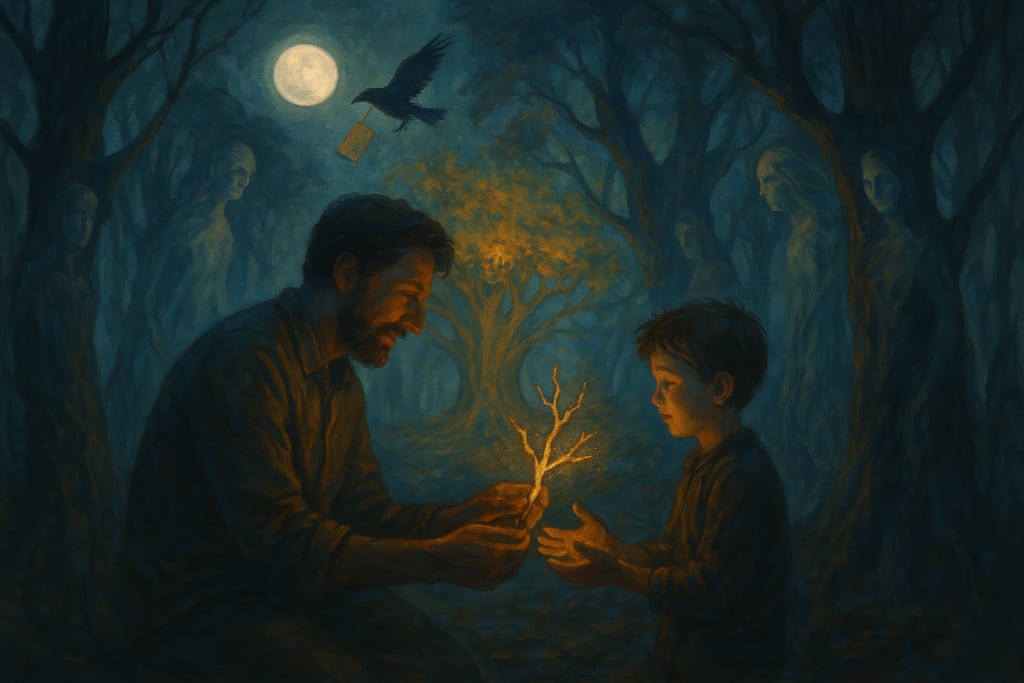
There is a silence in every man that sings a forgotten song. A song he hummed once in the arms of a father, beneath the banyan tree of his childhood, where the wind was wiser than men and the sky, like a canvas, listened. I write this not as a writer, but as a son who once listened—before time began to erase the music.
My name is Elias.
And once, I belonged to a small village that had more birds than people, more trees than truths, and a river that whispered secrets louder than the villagers dared speak. My father, Aadam, was the only man I knew who could talk to trees. He’d press his ear to their bark and nod slowly, as if in agreement with some ancient leaf-bound wisdom.
They say a father is a mirror—and a son, a reflection. But mirrors crack. And reflections forget.
I. The Memory of Rain
My earliest memory is not of my mother, nor of my name, but of rain. Aadam had carried me through it, my tiny fists clutched to the folds of his kurta, his voice humming a song that had no words—only breath, wind, and feeling.
"The rain is your godfather," he used to say. "It baptizes the soul before the world corrupts it."
He would let me play barefoot in the mud while he painted the sky with his thoughts. His thoughts were birds—unpredictable, wild, lovely. Once, he told me:
“Elias, if ever the world forgets your voice, sing it into a river. The river remembers.”
I never understood what he meant until years later, when the world forgot me. But I remember that moment. And I remember the way he looked at me as if I were more than his son—as if I were his future unspoken.
II. The Day He Disappeared
Love is a kind of blindness. You hold someone so close, you forget they’re fading.
The morning he vanished, the house was unusually quiet. No boiling chai, no crackling fire, no hum from his lungs. I walked into his room and found only a note, folded into the shape of a crow, lying on the pillow where his head used to rest.
“I will return when the moon forgets her name. Until then, become the man I dreamed.”
That was it. No reason. No goodbye. Just mystery, and silence shaped like sorrow.
I was twelve.
III. The Village of Echoes
They called him mad, you know. “That man who hears trees.” The villagers said he wandered off into the forest, perhaps claimed by madness, perhaps eaten by it.
But I knew better. He wasn’t mad. He was musical. And music doesn’t die—it hides in silence.
I searched for him for years. Through forests that whispered his name. Through rivers that carried his song. I grew into a man of bones and books, my heart still tethered to a banyan tree and a boy’s unanswered question.
“Where does a father go when he disappears without dying?”
IV. The Return of the Crow
It was the 20th spring since his vanishing when it came back.
A crow.
Not ordinary. Its wings shimmered like oil in moonlight. It didn’t caw—it whistled, like a flute with feathers. And it carried another note.
“I have seen the future, Elias. It weeps in your hands. Come to the place where the earth sings.”
He had written again. After twenty years of silence.
V. The Forest Beyond Time
The path was not on any map, but I remembered his words.
“The trees remember.”
I followed sounds instead of signs. The rustle of leaves. The hush of wind. The drumming of my own hope. It led me to the very forest where he used to speak to trees.
There, I found something impossible.
A clearing. In the middle of it, an old man sat cross-legged, whispering to a stone.
“Father?” I gasped.
He looked up slowly. His eyes were not old. Not broken. But eternal.
“You found me,” he said.
I fell to my knees. “Why did you leave?”
He touched the ground. “To plant something.”
“What?”
He smiled. “You.”
VI. The Garden of Forgotten Men
There are places the world pretends do not exist.
The garden my father had built was one of them—hidden deep in the woods, carved from earth and grief and years of solitude. It was neither wild nor tame. Flowers bloomed in broken teacups. Vines curled around rusted spoons. There was no order, but everything had purpose.
“This,” he said, opening his arms to the chaos, “is where broken men become seeds.”
He walked slowly, like a ghost anchored by wisdom.
“You were angry with me,” he said, as if reading my mind.
“Yes,” I whispered. “I needed you.”
He plucked a wilting flower. “You needed to grow.”
“But I was only a boy.”
He sighed. “And boys who do not face their night never become stars.”
VII. A Father’s Silence
That night, beneath the sky littered with orphaned stars, we sat beside a fire that crackled like old letters burning.
He began to speak—not in words, but in memories.
He showed me a picture of my mother. Her eyes were woven with storms. Her smile, an unfinished sentence.
“She didn’t die,” he said. “She left.”
My breath froze. “But you told me—”
“I lied.”
“Why?”
His voice trembled. “Because the truth would’ve killed the boy you were.”
I stared into the fire. Flames danced like memories trying to break free. “So you left too?”
“I had to find forgiveness in the forest. I had to unlearn rage.”
My heart cracked like dry wood. The truth was heavier than the lie. But also softer. Warmer.
VIII. The Mirror of the Moon
On the third night, he handed me a mirror—cracked, clouded, strange.
“Look.”
I did.
And I saw not myself. But him. Not the him in front of me. The him I remembered—the younger father, strong, smiling, carrying me through rain.
Then the image shifted.
I saw myself.
Not as I am.
But as I was—lost, weeping, waiting by the window for a door that would never open.
Then something moved.
A third figure.
My son.
Eyes like mine. Hands like his.
“I haven’t had a son,” I murmured.
“Yet,” he whispered.
IX. The Test of Fire
He handed me a burning branch.
“Now burn this garden.”
“What?!”
“It must end for it to begin.”
I hesitated. This place was him. His madness. His healing. His song. And mine.
“But why?” I asked.
“Because love must not become a cage. Even when gilded.”
Tears welled in my eyes. “But this is beautiful.”
He touched my hand. “So was my love for your mother. But it became a prison. For me. For you.”
So I did it. I lit the branch and dropped it into the garden’s heart. The flames rose—not angry, but graceful, like a ballet of farewells.
And in the smoke, I saw every version of us—father, son, silence, song—fade into ash and become sky.
X. The Morning After the End
When the fire died, he was gone.
Not buried.
Not vanished.
Just… gone.
In his place stood a tree.
Not old. Not young.
Just... becoming.
Its bark shimmered slightly in the sun, and when the wind blew, it hummed a song I hadn’t heard in twenty years.
I knew then—he had not died. He had transformed.
And me?
I walked home.
Alone.
But not empty.
I returned to the world of names and news and noise—with a pocket full of silence that sang.
XI. A Letter to My Son
Today, I write this for the boy I do not yet have. The son I will one day carry through rain.
“My child,
If ever I go silent,
remember: silence is never empty.
It is the soil in which our love becomes immortal.
Do not search for me in names.
Find me in birdsong.
In firelight.
In the stories trees tell on windy nights.
And if you must cry, let the earth drink it.
She will grow something beautiful from it.
Perhaps... another father.”
Closing Lines
And so, the boy who lost his father in the silence of a morning now lives as a man who plants songs in the hearts of his own silence. My name is Elias. My father was Aadam.
He is not gone.
He is every metaphor that loves.
And every silence that remembers.
About the Creator
Muhammad Abdullah
Crafting stories that ignite minds, stir souls, and challenge the ordinary. From timeless morals to chilling horror—every word has a purpose. Follow for tales that stay with you long after the last line.
Keep reading
More stories from Muhammad Abdullah and writers in Humans and other communities.
A Historic Declaration
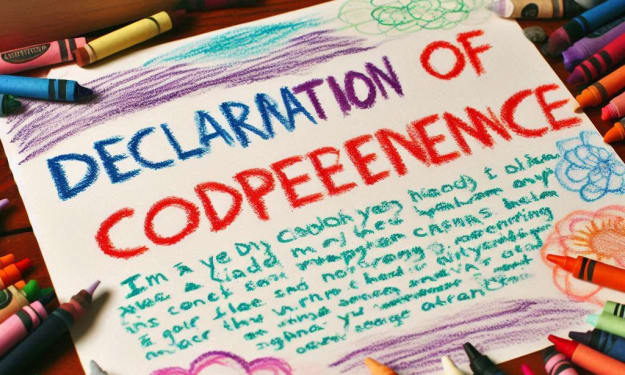
We the People of the Husbands of the United States of America, in Order to form a more perfect Union, and I mean you...with me...establish Justice, insure domestic Tranquility, provide for the common defence, promote the general Welfare, and secure the Blessings of Liberty to ourselves, after Puberty, do ordain and establish this Declaration of Co-Dependence.
By Gerard DiLeo7 days ago in Humans
When the Shelter Closes
The first night I saw him, I thought he was waiting for someone. He sat across the street from my apartment building on a metal bench that had lost most of its green paint. A grocery cart stood beside him, overflowing with plastic bags, a torn blanket, and what looked like an old photo frame wrapped carefully in cloth. At his feet lay a dog — thin, golden-brown, ribs visible, but loyal in the way only dogs can be.
By imtiazalam4 days ago in Humans
This Is What I Do When People Throw Rocks At Me
Rocks have been thrown at me for a greater part of my life. Some have been small and missed hitting me. When people don't get a reaction from me, they throw bigger rocks with a better aim. Many have been hurled at me with precision over the years. For a long time, I thought my only options were to dodge them or be crushed by them.
By Margaret Minnicks7 days ago in Confessions


Comments
There are no comments for this story
Be the first to respond and start the conversation.