
The Six Kalmas of Islam – A Complete Guide with Meaning and Importance
The Six Kalimas – Foundations of Faith and Remembrance in Islam

Introduction to the Six Kalmas of Islam
The Six Kalmas hold a special place in the heart of every Muslim. They represent the core beliefs and fundamental teachings of Islam, focusing on faith, repentance, and devotion to Allah Almighty. These Kalmas are recited by Muslims around the world as expressions of belief in Tawheed (oneness of Allah) and submission to His will.
Learning and understanding the Six Kalmas not only strengthens one’s faith but also deepens spiritual connection with Allah. Each Kalma has its unique meaning, significance, and purpose, forming the foundation of Islamic faith.
What Are the Six Kalmas?
The Six Kalmas (الستة كلمات) are a collection of six important Islamic declarations that summarize the essence of a Muslim’s belief and values. These Kalmas are derived from the teachings of the Holy Quran and Hadith, and are memorized by Muslims from a young age.
Each Kalma highlights an essential aspect of Islam — faith, testimony, glorification, unity, repentance, and seeking forgiveness.
Let’s explore each Kalma in detail with its meaning and importance.
1. First Kalma – Kalma Tayyabah (Word of Purity)
Arabic:
لَا إِلٰهَ إِلَّا اللّٰهُ مُحَمَّدٌ رَّسُوْلُ اللّٰهِ
Translation:
“There is no God but Allah, and Muhammad (PBUH) is the Messenger of Allah.”
Meaning and Importance:
The First Kalma is the foundation of Islam. It declares monotheism and affirms the Prophethood of Muhammad (peace be upon him). This statement separates a believer from disbelief. By reciting the Kalma Tayyabah, a Muslim affirms complete faith in Allah alone and accepts the message of the Prophet Muhammad (PBUH).
It is the first step toward entering Islam and is recited daily in prayers and supplications.
2. Second Kalma – Kalma Shahadat (Word of Testimony)
Arabic:
أَشْهَدُ أَنْ لَا إِلٰهَ إِلَّا اللّٰهُ وَحْدَهُ لَا شَرِيْكَ لَهُ وَأَشْهَدُ أَنَّ مُحَمَّدًا عَبْدُهُ وَرَسُوْلُهُ
Translation:
“I bear witness that there is no God except Allah, the One without any partner, and I bear witness that Muhammad (PBUH) is His servant and Messenger.”
Meaning and Importance:
The Second Kalma is a testimony of faith. By reciting it, a Muslim declares belief in the oneness of Allah and confirms that Prophet Muhammad (PBUH) is His final Messenger.
It is often recited during conversion to Islam, daily prayers, and times of reflection to renew faith.
3. Third Kalma – Kalma Tamjeed (Word of Glorification)
Arabic:
سُبْحَانَ اللّٰهِ وَالْـحَمْدُ لِلّٰهِ وَلَا إِلٰهَ إِلَّا اللّٰهُ وَاللّٰهُ أَكْبَرُ وَلَا حَوْلَ وَلَا قُوَّةَ إِلَّا بِاللّٰهِ الْعَلِيِّ الْعَظِيْمِ
Translation:
“Glory be to Allah, all praise be to Allah, there is no god except Allah, and Allah is the Greatest. There is no power and no strength except with Allah, the Most High, the Great.”
Meaning and Importance:
The Third Kalma teaches Muslims to praise, glorify, and thank Allah in every situation. It reflects gratitude and humility before the Creator.
Reciting this Kalma helps in developing a peaceful heart, reminding believers that all strength and success come only from Allah.
4. Fourth Kalma – Kalma Tauheed (Word of Unity)
Arabic:
لَا إِلٰهَ إِلَّا اللّٰهُ وَحْدَهُ لَا شَرِيْكَ لَهُ لَهُ الْمُلْكُ وَلَهُ الْـحَمْدُ يُحْيِيْ وَيُمِيْتُ وَهُوَ حَيٌّ لَا يَمُوْتُ أَبَدًا أَبَدًا ذُو الْجَلَالِ وَالْإِكْرَامِ بِيَدِهِ الْخَيْرُ وَهُوَ عَلٰى كُلِّ شَيْءٍ قَدِيْرٌ
Translation:
“There is no god but Allah. He is One and has no partner. His is the kingdom, and for Him is all praise. He gives life and causes death. In His hand is all good, and He has power over everything.”
Meaning and Importance:
The Fourth Kalma emphasizes the oneness, power, and majesty of Allah. It reminds Muslims that life and death are under His command, and everything that happens is by His will.
Reciting this Kalma strengthens belief in Tawheed (monotheism) — the cornerstone of Islam.
5. Fifth Kalma – Kalma Astaghfar (Word of Repentance)
Arabic:
أَسْتَغْفِرُ اللّٰهَ رَبِّيْ مِنْ كُلِّ ذَنْبٍ أَذْنَبْتُهُ عَمْدًا أَوْ خَطَأً سِرًّا أَوْ عَلَانِيَةً وَأَتُوْبُ إِلَيْهِ مِنَ الذَّنْبِ الَّذِيْ أَعْلَمُ وَمِنَ الذَّنْبِ الَّذِيْ لَا أَعْلَمُ إِنَّكَ أَنْتَ عَلَّامُ الْغُيُوْبِ وَسَتَّارُ الْعُيُوْبِ وَغَفَّارُ الذُّنُوْبِ وَلَا حَوْلَ وَلَا قُوَّةَ إِلَّا بِاللّٰهِ الْعَلِيِّ الْعَظِيْمِ
Translation:
“I seek forgiveness from Allah, my Lord, for every sin that I have committed knowingly or unknowingly, secretly or openly. I turn to Him in repentance from the sins I know and the sins I do not know. Indeed, You are the Knower of the unseen, the Concealer of faults, and the Forgiver of sins.”
Meaning and Importance:
The Fifth Kalma teaches Muslims the importance of seeking forgiveness (Istighfar). Every believer is encouraged to turn to Allah with a sincere heart and repent for mistakes.
It helps purify the soul and bring peace to the heart. Reciting this Kalma regularly brings one closer to Allah’s mercy and forgiveness.
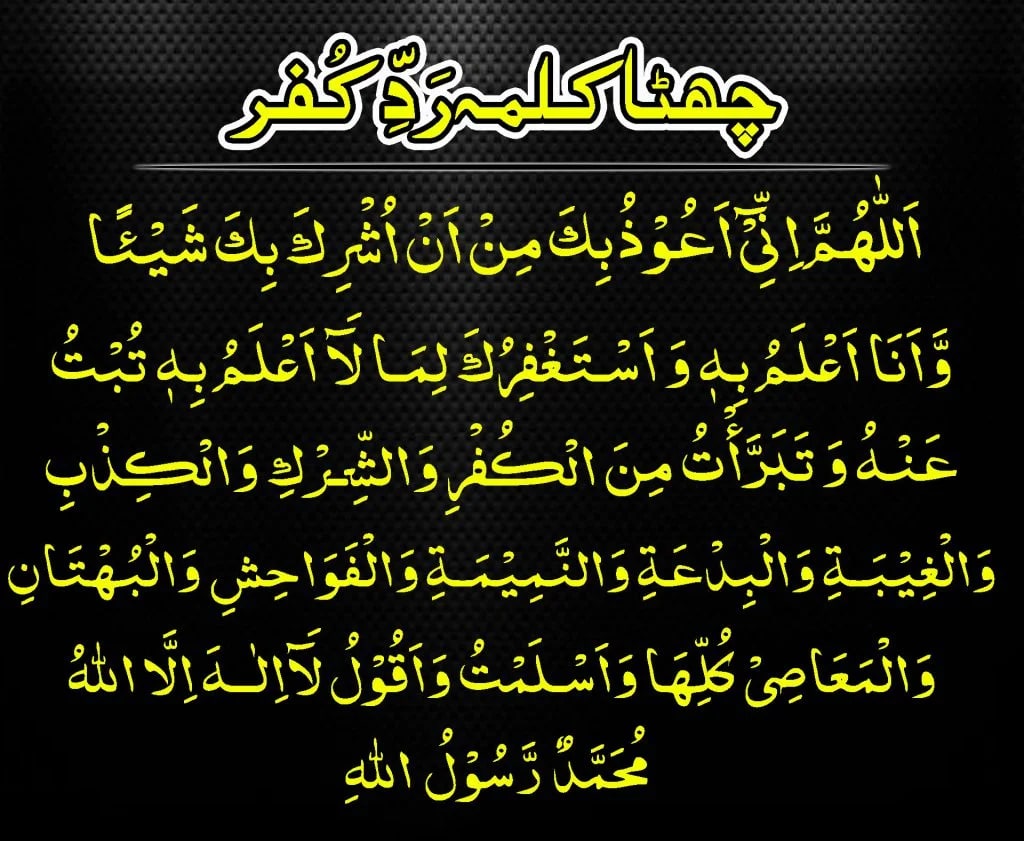
6. Sixth Kalma – Kalma Radde Kufr (Word of Rejecting Disbelief)
Arabic:
اللّٰهُمَّ إِنِّيْ أَعُوْذُ بِكَ مِنْ أَنْ أُشْرِكَ بِكَ شَيْئًا وَأَنَا أَعْلَمُ بِهِ وَأَسْتَغْفِرُكَ لِمَا لَا أَعْلَمُ بِهِ تُبْتُ عَنْهُ وَتَبَرَّأْتُ مِنَ الْكُفْرِ وَالشِّرْكِ وَالْكِذْبِ وَالْغِيْبَةِ وَالْبِدْعَةِ وَالنَّمِيْمَةِ وَالْفَوَاحِشِ وَالْبُهْتَانِ وَالْمَعَاصِيْ كُلِّهَا وَأَسْلَمْتُ وَأَقُوْلُ لَا إِلٰهَ إِلَّا اللّٰهُ مُحَمَّدٌ رَّسُوْلُ اللّٰهِ
Translation:
“O Allah! I seek refuge in You from associating anything with You knowingly. I seek Your forgiveness for what I do unknowingly. I repent from it and reject disbelief, polytheism, falsehood, backbiting, innovation, slander, and all sins. I accept Islam and declare: There is no god but Allah, Muhammad (PBUH) is the Messenger of Allah.”
Meaning and Importance:
The Sixth Kalma represents protection from disbelief and shirk (associating partners with Allah). It expresses a Muslim’s complete rejection of falsehood and reaffirmation of faith in Islam.
Reciting it regularly helps purify faith and reminds believers to remain steadfast on the path of Islam.
Importance of Reciting the Six Kalmas
The Six Kalmas are not just words — they are spiritual declarations that shape a Muslim’s heart and actions.
Here are some key benefits of reciting them:
Strengthens faith and belief in Tawheed.
Purifies the soul from sins and worldly attachments.
Increases spiritual awareness and gratitude.
Encourages repentance and forgiveness.
Protects from disbelief and wrongdoing.
Teaching these Kalmas to children helps them build a strong Islamic foundation from an early age.
Conclusion
The Six Kalmas of Islam are a roadmap to understanding the essence of faith — belief in Allah, His power, and His mercy. By reciting and reflecting upon these Kalmas, Muslims renew their commitment to Islam and strengthen their connection with their Creator
Let us strive to not only memorize the Six Kalmas but also understand their meanings and apply their lessons in our daily lives. For indeed, true success lies in living according to the words we recite — with faith, sincerity, and devotion.
About the Creator
Bisma
✨ Faiz-e-Islam is a platform dedicated to spreading the true spirit of Islam. We strive to promote Islamic values, organize educational and spiritual programs



Comments
There are no comments for this story
Be the first to respond and start the conversation.