
The Silent Flame
The Forgotten Pashtun Resistance Fighter Who Challenged the Empire Without a Gun

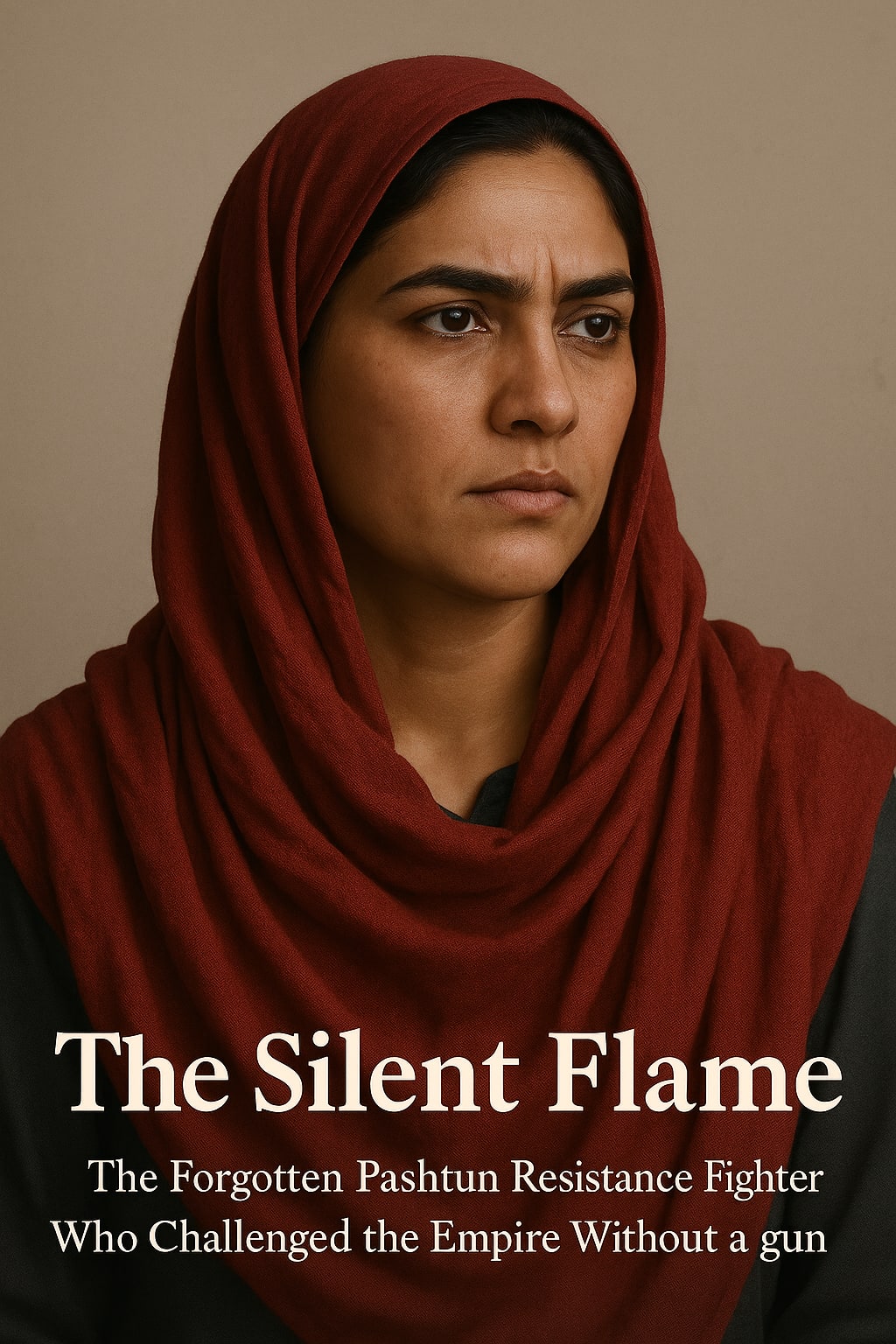
In the shadowed valleys of British-occupied India, amid the roaring tide of revolution and resistance, history forgot her name. No textbook mentions her. No photograph captures her defiance. But once, in the heart of the Pashtun lands, Zainab Gul set the ground beneath the empire’s feet on fire — not with weapons, but with courage, silence, and unmatched resolve.
Born in 1912 in a remote village near Kohat, present-day Khyber Pakhtunkhwa, Zainab came into a world defined by tradition, patriarchy, and imperial rule. In her village, girls didn’t go to school. Speaking against elders was forbidden, and the British Raj was an untouchable authority. Yet, something within Zainab stirred — a quiet rebellion, a flame too stubborn to be extinguished.
She was 18 when she first witnessed brutality firsthand. It was April 23, 1930 — the Qissa Khwani Bazaar Massacre. Hundreds of peaceful protestors were gunned down by British forces. Among the chaos, the screams, and the blood, Zainab rushed in — not away. She wasn’t a trained nurse, nor a soldier, but she tended to the wounded, tore her dupatta into bandages, and helped carry the dead.
But her resistance didn’t stop there.
Zainab began organizing women from nearby villages into a secret communication network. Under the guise of social gatherings and sewing circles, she built a chain of female couriers who carried vital information to resistance leaders — British troop movements, local collaborators, messages from the underground freedom fighters. Where British spies couldn't reach, Zainab’s network moved freely — unseen, unsuspected.
She became known in whispers as “Khamosh Aag” — the Silent Flame.
---
One night in 1933, Zainab was captured. An informant had betrayed her. She was taken to the British military post in Kohat and interrogated. The officer in charge couldn’t believe that this slender woman with determined eyes was the one orchestrating such a vast chain.
“You are a woman,” he said mockingly.
“You never fired a gun. You’ve never been on the front line. What makes you dangerous?”
Zainab didn’t raise her voice. She looked him in the eye and answered:
“Words, when carried by the brave, are deadlier than bullets. I never needed a gun.”
What followed was months of solitary confinement. Physical beatings. Starvation. Still, she didn’t break. Not one name, not one location did she betray. Eventually, under public pressure and fear of backlash, the British released her quietly. No charges were filed. No apology was given. She returned home — not to fame, but to silence.
Her own community, afraid of British attention, distanced themselves. She was discouraged from speaking. “Forget the past,” they said. “Stay quiet. It’s over.”
But the fire within Zainab never truly dimmed.
Though she never rejoined open resistance, she spent her later years teaching local girls to read and write — an act still considered rebellious in her region. She told them stories of strength, of truth, and of rising without permission. They never knew she had once stood against the empire. She never told them.
She died in 1981, her grave unmarked. No biography. No memorial. Not even a faded black-and-white photograph remains.
---
Yet her story lived — passed secretly from grandmother to granddaughter in hushed tones around the fireplace. One such granddaughter, now a historian, pieced together fragments, letters, and whispered memories. She tried to find official records, but there were none.
History had burned the page.
---
Why Her Story Matters Today
Zainab’s story is not just about colonial resistance — it’s about how power fears silence, especially when it is purposeful. While history glorifies battles and names of men, it often erases the quiet contributions of women — the healers, messengers, organizers — who made revolution possible.
Her defiance is not in what she did, but in how she did it:
No loud slogans.
No weapons.
No fame-seeking.
Just unshakable belief and the courage to act when everything told her to stay still.
---
Final Words
“The Silent Flame” was never meant to be famous. She was meant to be forgotten. But some flames, even when unrecorded, keep burning in the winds of memory.
Zainab Gul may never enter school textbooks. She may never receive medals or statues. But if we can remember her, even briefly — if her courage can echo into one more life — then the page that history tried to burn, is rewritten at last.
About the Creator
Autonomy Is The Real Privilege
Good morning, freedom-seekers! Today we’re gonna be looking at autonomy. A strange word, I know; one many would probably look at blankly and run away from on sight. We’re gonna figure out what it actually means, consider how it’s achieved, and decipher just how deeply most of us are tangled up in dependence without realising it.
By That ‘Freedom’ Guyabout 10 hours ago in Humans
The Sound of Rain
The first thing I noticed was the sound. Not the gentle, polite drizzle that whispers against windows, but a persistent, almost stubborn rainfall that seemed determined to be heard. It filled the room with its insistent rhythm, a sound both familiar and strange, as if it were trying to tell me something I had long forgotten. I sat on the edge of my bed, laptop abandoned on my knees, and let it wash over me.
By Salman Writesabout 5 hours ago in Humans




Comments
There are no comments for this story
Be the first to respond and start the conversation.