
The Seeds of Faith
A grandson discovers his grandfather’s quiet wisdom — and learns that barren lands and barren hearts can both bloom again with patience, love, and faith.

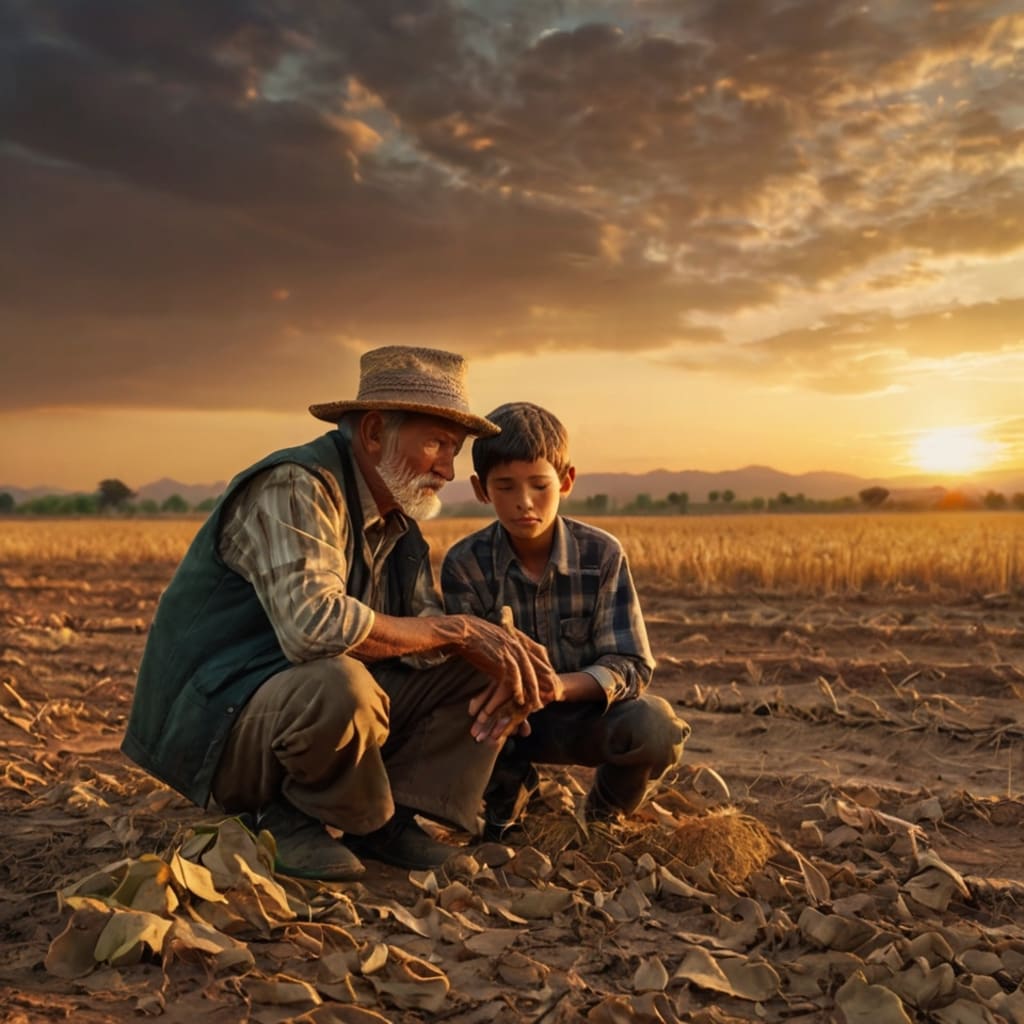
The Seeds of Faith
By Tabeer Ali — English Adaptation
The old farmer worked every day under the sun, his wrinkled hands digging deep into the soil that had long turned barren. Though the land yielded nothing, he refused to give up.
His ten-year-old grandson, Hasan, often watched in confusion. His father, Aamir, always worked in the fertile fields—the ones that actually bore fruit. Yet his grandfather, Hakim, spent his days toiling on the dry, lifeless earth.
“Why does he work there?” Hasan would wonder silently. “That land gives nothing back.”
One afternoon, Hasan’s mother handed him a small meal and said, “Take this to your grandfather, dear.”
When Hasan reached the fields, the old man was still at work. His shirt was soaked with sweat, but his face carried a calm satisfaction. After finishing his task, he sat beside Hasan, and together they began to eat.
“Grandpa,” Hasan asked hesitantly, “may I ask you something?”
Hakim smiled. “Of course, my boy. What is it?”
“Why do you keep working on this barren land? Father says it’s useless. He works where crops grow—where we get food. You work where nothing grows. Isn’t that a waste of effort?”
The old man chuckled softly, the kind of laugh that carries both patience and memory. “Ah, Hasan,” he said gently, “when I was your age, my father and I migrated here. We had nothing but hope. Back then, all of this—” he waved his hand toward the green fields nearby—“was just as barren as this patch you see today.”
“Really?” Hasan asked in surprise.
“Yes,” Hakim nodded. “My father was a man of great faith. He believed that no land is truly barren if you work it with love and patience. Every evening, after his day’s labor, he would come to this wasteland and pour his sweat into it. People laughed at him. They said he was foolish, wasting his strength. But he never stopped. And then, one day, the soil answered his faith—it began to bloom. That barren land gave us life.”
Hakim paused, looking at the ground as if seeing his father’s hands still working there. “So, you see, Hasan, I’m only continuing his devotion. Maybe one day this land will bloom again too.”
“But Grandpa,” Hasan protested, “we already have good fields. Why buy more barren land? Why not use your strength to make the green ones even better?”
Hakim smiled again. “If your great-grandfather had thought the same, do you think your father would have inherited these green fields?”
Hasan fell quiet.
After a moment, the old man asked, “Do you know when land becomes truly barren?”
Hasan shook his head. “When, Grandpa?”
“When we stop believing in it,” Hakim replied softly. “When we stop caring for it, stop looking at it with hope. That’s when the soil dries and the heart hardens. You see, Hasan, hearts are not so different from the earth. They too grow barren when left unloved.”
He smiled, his eyes distant but kind. “Those who love the earth don’t look for profit—they look for promise. The land is like a mother. She shelters us, feeds us, and bears our burdens. Even after we die, she takes us back into her arms. Shouldn’t we love her the same way she loves us?”
Hasan listened in silence, his young mind trying to hold onto every word.
“Some people, too,” Hakim continued, “are like barren land. Their hearts have gone dry. They’ve forgotten how to give love, how to feel kindness. But we must never give up on them either.”
“But Grandpa,” Hasan asked softly, “what if such people never change? What if no matter how much kindness you give, they stay barren?”
Hakim smiled again—the same wise smile Hasan would remember all his life. “Then, my boy, we keep sowing goodness. We keep watering their hearts with patience, feeding them with compassion, and waiting with hope. Even barren soil cannot resist forever. One day, it will bloom again.”
Hasan frowned slightly. “But Grandpa, your hands get hurt. You bleed sometimes. Why go through so much pain for this?”
Hakim looked down at his calloused palms. “Ah, Hasan,” he said softly, “when the hands that have labored in love finally hold the fruit of their effort—the first bloom after years of faith—the joy is beyond pain. These wounds are the price of miracles.”
Later that day, Hasan walked home carrying the empty meal box, his mind echoing with his grandfather’s words. Something inside him had changed. It was as if a seed had been planted—one that would take years to sprout.
---
Years Later
Time passed. The old man’s grave now rested beneath a tree that overlooked the green fields he had once nurtured.
Hasan, now a grown man, stood with his own son, Irfan, surveying a stretch of dry land he was about to purchase.
“Father,” Irfan said, puzzled, “why are we buying this? It’s barren. Everyone knows nothing grows here.”
Hasan smiled—the same patient smile his grandfather had worn. “Come,” he said, placing a hand on his son’s shoulder. “Let me tell you a story.”
As they walked, Hasan told Irfan about his grandfather, about faith, and about the barren land that had once bloomed.
By the time they reached home, Irfan looked at the surrounding fields differently. The green crops swaying in the breeze now looked like living prayers — the harvest of hope that had survived generations.
That night, before sleeping, Irfan whispered to himself:
> “If everyone cared for their share of barren land — in the world or in their hearts — maybe neither the earth nor humanity would ever stay barren again.”
About the Creator
Writing To Succeed
If you want to find something that will help readers find your writing, possibly expand your audience, and maybe even get you noticed for other things, then you’re not alone. But how can you get it done in a world full of want-to-be writers? Look less at what you’re writing now, and more at what other writers have used to boost their views and reads.
By Jason Ray Morton 6 days ago in Writers



Comments
There are no comments for this story
Be the first to respond and start the conversation.