
The Navigation Lattice of Civilization
A philosophical reflection on the ethical architecture that allows humanity to remain stable

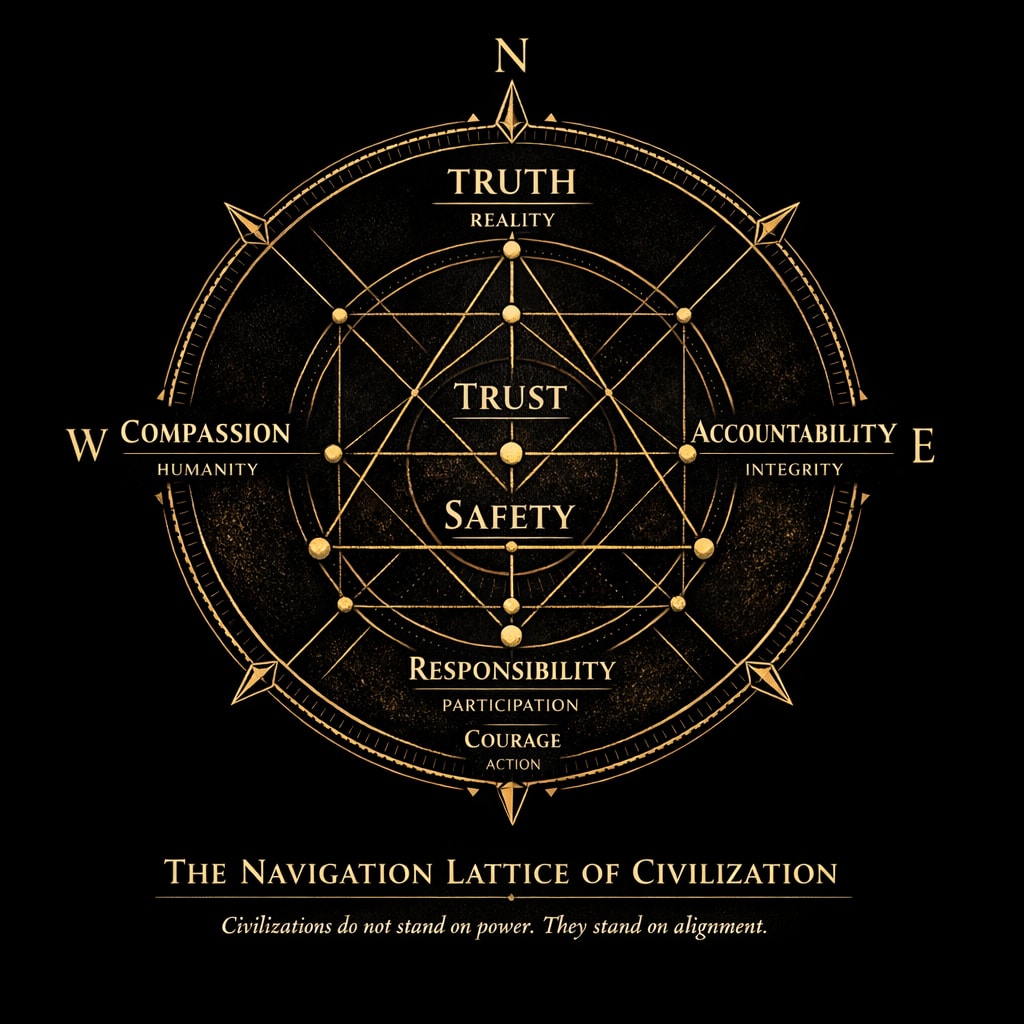
The Navigation Lattice of Civilization
A philosophical reflection on the ethical architecture that allows humanity to remain stable
A philosophical exploration of the ethical lattice that stabilizes civilizations, revealing how truth, trust, safety, and responsibility function as the hidden architecture beneath human societies.
Most people imagine civilization as something built from governments, laws, and institutions. Cities. Economies. Systems of authority and control. But these visible structures are not the true architecture of civilization. They are only its surface. Beneath them lies something far more fundamental: an ethical lattice that allows human beings to coordinate life together without collapsing into chaos. Civilization is not sustained primarily by force. It is sustained by alignment. Every functioning society depends on a set of invisible principles that act like the structural beams of a building. When those beams remain intact, cultures can endure centuries. When they fracture, collapse begins long before anyone recognizes what is happening. These principles form something we might call a Navigation Lattice—a grid of ethical orientation points that guide human behavior within shared space. Without such a lattice, civilization becomes disoriented. Truth becomes negotiable. Trust becomes fragile. Safety disappears. And once those three foundations destabilize, every other structure begins to shake. Truth is the axis that keeps reality coherent. Without truth, a society loses its ability to agree on what is real. Decisions become distorted, memory becomes unreliable, and collective direction dissolves. Trust is the connective tissue between individuals. Without trust, cooperation becomes impossible. Every interaction must be guarded. Every agreement must be enforced through control rather than relationship. Safety is the condition that allows the human nervous system to remain regulated. Without safety, people cannot think clearly, create freely, or collaborate meaningfully. The body becomes preoccupied with survival rather than participation in shared life. These three principles form a stabilizing triangle within the navigation lattice. Truth aligns perception. Trust aligns relationship. Safety aligns the nervous system. When these three are present, a society can move forward with clarity and coordination. But civilization requires more than stability. It requires orientation. This is where additional ethical coordinates emerge. Accountability ensures that actions remain tethered to consequence. Without it, power drifts toward corruption. Compassion ensures that strength does not become cruelty. Without it, systems harden into indifference. Responsibility ensures that individuals recognize their participation in shaping the collective environment. Together, these principles create a structural grid—a lattice through which human behavior can navigate complexity without losing coherence. Philosophers throughout history have tried to describe pieces of this structure. Some spoke of virtue. Others spoke of natural law, moral foundations, or social contracts. But beneath the different language lies a shared recognition: civilizations survive not because they are powerful, but because they are aligned. When alignment holds, cultures become resilient. People can disagree without destroying one another. Communities can repair conflict rather than fracture permanently. Institutions can adapt without collapsing. When alignment fails, even the most sophisticated systems become unstable. History shows this pattern repeatedly. Empires rarely fall because of external enemies alone. They fall because their internal lattice erodes. Truth becomes propaganda. Trust becomes suspicion. Safety becomes fear. Once the ethical architecture weakens, collapse becomes a matter of time. This realization leads to an important philosophical shift. Civilization is not something that governments maintain. It is something people embody. Every conversation contributes to it. Every promise strengthens or weakens it. Every act of honesty or deception changes the stability of the shared structure. In this sense, being human is not simply a matter of existing within civilization. It is a matter of participating in its architecture. Each person acts as a living node within the lattice. When individuals align with truth, trust, safety, accountability, compassion, and responsibility, the structure becomes stronger. When those principles are abandoned, the lattice begins to fracture. The stability of the whole is always emerging from the behavior of the parts. This means the ethical architecture of civilization does not exist somewhere far away in institutions or theories. It exists in the daily decisions of ordinary people. The way we speak. The way we listen. The way we treat the vulnerability of others. Civilization is not something we inherit once and keep forever. It is something we rebuild continuously through alignment. A living lattice that either strengthens or weakens depending on how we choose to inhabit the shared space of being human. And every day, whether we recognize it or not, each of us participates in shaping the structure that will hold the future.
TRUTH
(Reality Alignment)
COMPASSION ─ TRUST ─ ACCOUNTABILITY
(Humanity) (Relational) (Integrity)
SAFETY ─ RESPONSIBILITY ─ COURAGE
(Nervous System) (Participation) (Action)
The Vertical Axis — Reality
The top and bottom positions anchor the system in reality. Truth The orientation point for perception. If truth collapses, society cannot agree on what is real. Responsibility The grounding point for participation. It ensures individuals recognize their role in shaping outcomes. Between them sits Trust, which connects perception to relationship. Truth → Trust → Responsibility This becomes the axis of coherence.
The Horizontal Axis — Human Relationship
Across the center we find the stabilizers of human interaction. Compassion Prevents strength from becoming cruelty. Trust Allows cooperation and vulnerability. Accountability Ensures power remains tethered to consequence. Compassion → Trust → Accountability This becomes the axis of relational integrity.
The Structural Base — Stability
At the lower level are the conditions that make civilization sustainable. Safety The nervous system must feel secure enough to think, create, and collaborate. Responsibility Individuals must carry their part of the shared system. Courage Change and protection of truth require moral bravery. Safety → Responsibility → Courage This becomes the axis of action.
What Makes This a Lattice
The power of a lattice is interdependence.
Each principle stabilizes the others.
For example: • Truth without compassion becomes cruelty. • Compassion without accountability becomes enabling. • Safety without responsibility becomes stagnation. • Courage without truth becomes recklessness.
A civilization remains stable only when the whole grid remains balanced. This is why societies destabilize when certain values disappear. History repeatedly shows the pattern: Truth erodes → Trust collapses → Safety disappears. Or: Accountability vanishes → Power corrupts → Compassion fades. Once enough nodes of the lattice weaken, the entire structure begins to shake.
The Philosophical Shift
The deepest insight of the lattice is this: Civilization is not maintained by institutions alone. It is maintained by millions of individuals orienting themselves within this grid every day. Every honest conversation strengthens truth. Every kept promise strengthens trust. Every act of courage strengthens the ability of society to defend its values. Each person acts like a node inside the ethical lattice. And the stability of the whole emerges from the behavior of the parts.
Why This Matters
Most philosophical systems attempt to answer the question: How should humans live together? The Navigation Lattice answers differently. It doesn't prescribe behavior from above. Instead it reveals the structural coordinates that allow shared life to remain coherent. Truth anchors reality. Trust anchors relationship. Safety anchors the nervous system. Compassion humanizes strength. Accountability disciplines power. Responsibility stabilizes participation. Courage protects alignment. Together they form a navigation grid for civilization itself. Not a rigid rulebook. But a living architecture. A structure that becomes stronger every time a human chooses alignment over chaos.
Author Note
This piece explores the ethical geometry that allows civilizations to remain coherent across time. The Navigation Lattice is not a rigid doctrine, but a philosophical map for orientation—reminding us that the stability of the whole emerges from the alignment of its parts.
— Flower InBloom 🌸
About the Creator
Flower InBloom
I write from lived truth, where healing meets awareness and spirituality stays grounded in real life. These words are an offering, not instruction — a mirror for those returning to themselves.
— Flower InBloom
Keep reading
More stories from Flower InBloom and writers in Humans and other communities.
Real-Time Advice For Local Singles Experiencing Relationship Frustrations
The frustrations of relationships usually seem overwhelming at the time and particularly to the local singles who are trying to manoeuvre within the known social circle. You can constantly run into old boyfriends or girlfriends at community events, parties of people you know or frequent local restaurants. This closeness may enhance situations that remain unsolved and enhance disappointment. Take a moment to simplify the situation by discovering the real cause of frustration before acting rashly. Is it disapproval, unfulfilled expectations, ambivalence, or comparison to others? When this emotion is named correctly, it becomes less intense and leads to the correct responses. The initial real-time strategy that would help to regain emotional balance and make thoughtful decisions in the future is self-awareness.
By Olivia Smith6 days ago in Humans



Comments
There are no comments for this story
Be the first to respond and start the conversation.