
The Role of Blockchain in Decentralized Autonomous Organizations (DAOs)
Introduction

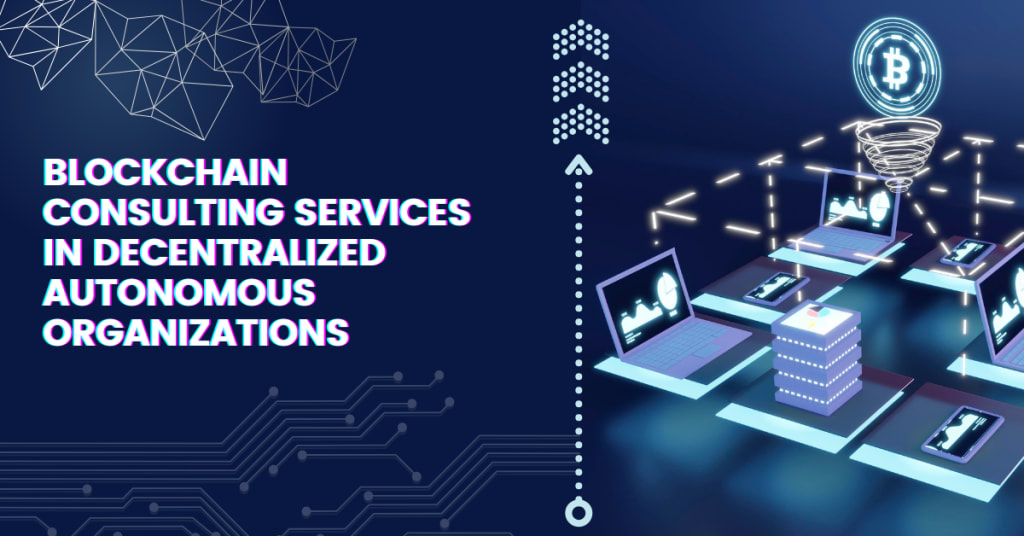
The world is going through a never-seen-before transformation thanks to revolutionary technologies that have recently come into play. It includes technologies like artificial intelligence, data science, machine learning, metaverse, virtual reality, and, of course, the famous blockchain consulting services.
In this post, we are focusing on the last service mentioned, that is, blockchain consulting along with its role in Decentralized Autonomous Organizations, that are changing the ways of governance, collaboration, and transparency.
What is Blockchain Technology and DAO?
What is Blockchain Technology
It is the decentralized and distributed digital ledger technology aimed at recording transaction across several computers in a manner that ensures security, transparency, and immutability. The key aspects of blockchain technology are decentralization, transparency, improved security, immutability, and a consensus mechanism.
What are the Applications of Blockchain?
Cryptocurrencies
Smart Contracts
Supply Chain Management
Voting Systems
What is A Decentralized Autonomous Organization (DAO)
DAO is the short form for Decentralized Autonomous Organization. It is an organization represented by rules encoded as a computer program that is transparent. They are controlled by organization members, and no central government holds any influence on it. The key features of a decentralized autonomous organization are decentralization, autonomy, transparency, member driven, and smart contracts.
What are Some Use Cases of DAOs:
Investment DAOs: Members pool funds to invest in projects and share profits.
Social DAOs: Communities that come together to support a common cause or interest.
Protocol DAOs: Governing decentralized protocols (like DeFi platforms) through collective decision-making.
Both blockchain technology and DAOs share common factors. Moreover, their vast acceptance represents a shift towards decentralized and transparent systems that could revolutionize various industries by reducing the need for intermediaries and increasing trust and efficiency.
What are Some Potential Applications of DAO in Various Sectors?
Decentralized Autonomous Organizations have a variety of applications in various sectors, listed below:
In nonprofit organizations, DAOs can help improve transparency and trust by ensuring the appropriate usage of donations with all transactions and decisions available on the blockchain.
The corporate world can benefit from DAO as it can democratize decision-making, ensuring that shareholders and employees have a direct impact on policies and strategies.
In the creative industries like music and art, DAOs offer fair and transparent revenue distribution among artists and contributors.
What is the Role of Blockchain Technology in DAO?
The hired blockchain company has a huge role to play in the function as well as the success of decentralized autonomous organizations. Since total market capitalization of DAOs was $21 billion in 2022, it is a technology picking up pace.
Here is how blockchain companies help DAO:
1. Decentralization
Blockchain technology provides a distributed ledger for keeping track of all transactions and operations of DAO. As the ledger is available to every DAO member, it ensures transparency while reducing the need for central authority.
Additionally, the decentralized nature of blockchain technology helps companies operate on peer-to-peer networks. Hence, all the decisions and actions are made collectively by the members.
2. Transparency and Trust
To ensure transparency and trust, all transactions, rules, and decision made within the organization are recorded on the public blockchain, creating an ecosystem that is verifiable. It helps increase trust among the members. As the data is also immutable, meaning that it cannot be deleted or altered without consensus of networks, integrity of the system is continuously ensured.
3. Smart Contracts
Smart contracts are self-executing contracts, which means that they are directly written into the code. The rules are automatically enforced without the need of intermediaries. It creates a trustless operation that ensures all actions within DAO are executed as intended.
4. Consensus Mechanisms
Blockchain has a consensus mechanism like proof of work or proof of stake to help members achieve agreements. It helps validate transactions, execute smart contracts, and make collective decisions. Additionally, the technology allows for token-based voting systems for every proposal.
5. Security
Blockchain technology employs cryptographic techniques to secure transactions and data. These security measures ensure that the DAO’s operations are protected from tampering and unauthorized access. The decentralized and consensus-driven nature of blockchain makes it resilient to attacks and failures, as there is no single point of failure.
6. Tokenization
Many DAOs issue governance tokens that give holders voting rights and a say in the decision-making process. These tokens are tracked and managed on the blockchain. Furthermore, the blockchain technology allows for the creation and distribution of tokens to incentivize participation and contributions from members. This can help in aligning the interests of the members with the goals of the DAO.
7. Interoperability
Blockchain technology enables DAOs to interact with other blockchains and decentralized applications (dApps). This interoperability expands the potential use cases and collaborations for the DAO.
DAOs can integrate with decentralized finance (DeFi) protocols to access financial services such as lending, borrowing, and trading in a decentralized manner.
About the Creator
MoogleLabs
MoogleLabs leverage AI/ML, Blockchain, DevOps, and Data Science to come up with the best solutions for diverse businesses.
Keep reading
More stories from MoogleLabs and writers in Humans and other communities.
Top 9 Ways to Use Generative AI Services in Education Industry
Generative Artificial Intelligence services are a new avenue to revolutionize almost all industries around the globe. While there are some sectors that must adapt quickly to stay relevant, others can take their time incorporating the new technology into their existing systems. Education is one department that will always be among the early adopters of such technologies. Today, we understand human psychology better, giving us insights into how different children have different needs. The technological advancements in education, including generative AI services, are giving the sector a makeover that is more personalized and effective.
By MoogleLabs2 years ago in Education
The Psychology Behind Indigo Children: Myth or Hidden Truth?
The term "Indigo Children" was first popularized in the 1970s, largely attributed to Nancy Ann Tappe, a parapsychologist who claimed she could see auras. Tappe identified individuals with a distinctive deep indigo color in their aura, which she associated with a new type of spiritually advanced children. This concept garnered significant traction in various spiritual communities and popular culture, giving rise to a belief in a specific group of children characterized by unique traits and abilities.
By Wilson Igbasiabout 9 hours ago in Humans


Comments
There are no comments for this story
Be the first to respond and start the conversation.