

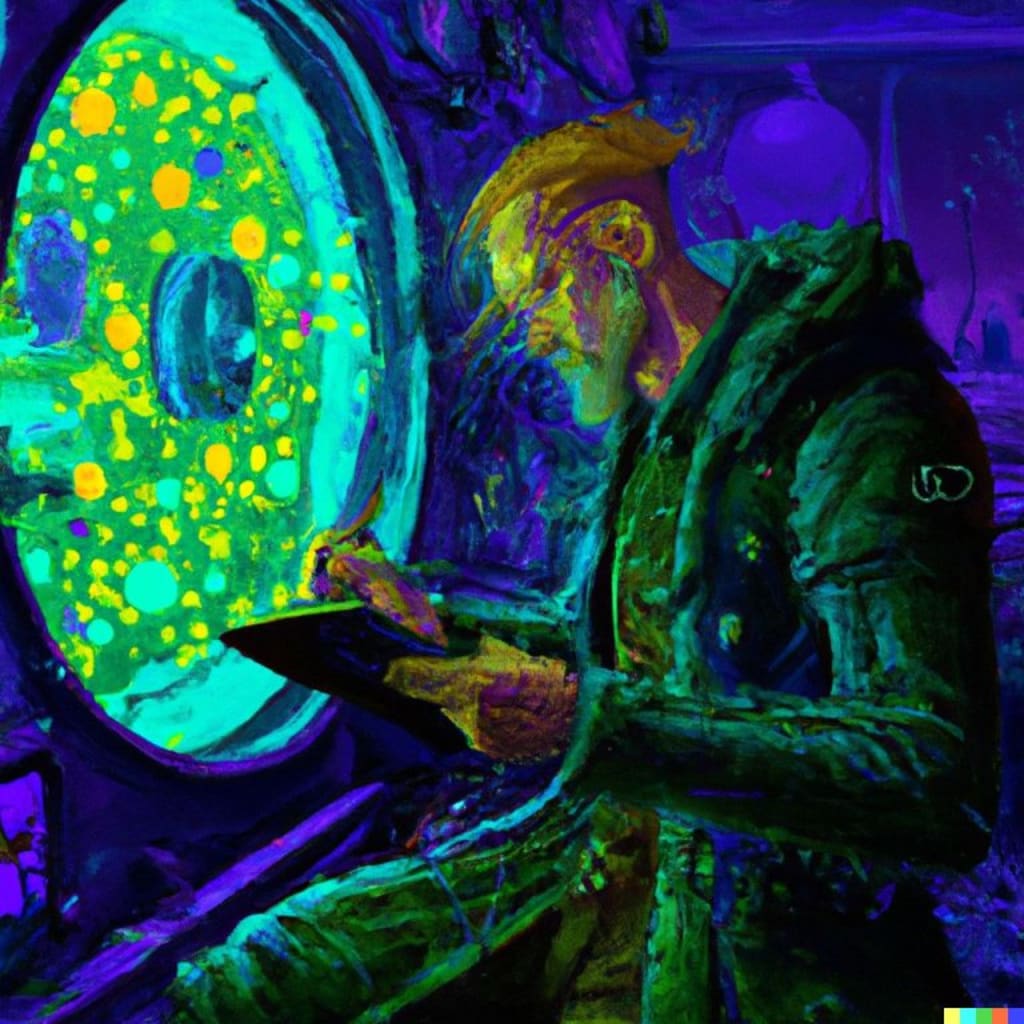
Art and science, often seen as disparate realms, converge in the fascinating world of quantum physics. The quantum canvas, a concept where particles are the medium and the laws of physics the brushstrokes, offers a unique perspective on the interplay between the seen and the unseen. This article delves into the captivating intersection of quantum mechanics and artistic expression, exploring how particles can be used to create a new form of art.
The Quantum World Unveiled
Quantum mechanics, the branch of physics that studies the behavior of particles at the smallest scales, reveals a universe that defies classical intuition. Particles like electrons and photons exhibit dual characteristics, behaving both as particles and waves. This duality allows them to exist in multiple states simultaneously, a phenomenon known as superposition. Additionally, particles can become entangled, meaning their states are interconnected regardless of distance.
These bizarre properties offer a unique canvas for artistic expression. By harnessing the principles of quantum mechanics, artists can create works that reflect the complexity and beauty of the quantum world.
Quantum Art: A New Frontier
Quantum art is an emerging field where artists use quantum principles to inform and inspire their creations. This fusion of science and art results in pieces that challenge perceptions and provoke thought. One approach to quantum art involves visualizing quantum phenomena through digital mediums, transforming abstract concepts into tangible experiences.
For example, an artist might use a computer simulation to model the behavior of entangled particles. The resulting visualization, a mesmerizing dance of intertwined particles, can be rendered into a stunning digital painting or animation. These artworks provide a glimpse into the quantum realm, making the invisible visible and the incomprehensible approachable.
Painting with Light: Photonic Art
Photonic art, a subset of quantum art, leverages the properties of photons—particles of light—to create dynamic and interactive pieces. Photons, with their wave-particle duality, can be manipulated in ways that traditional mediums cannot.
One technique involves using lasers to create intricate light patterns. By adjusting the phase and amplitude of the laser beams, artists can produce interference patterns that change with the observer’s perspective. This interaction between the artwork and the viewer mirrors the quantum principle of observer effect, where the act of observation alters the state of the system.
Another approach is quantum holography, where quantum information is encoded into holographic images. These images, when illuminated by a laser, produce three-dimensional representations of quantum states. The resulting holograms are not only visually striking but also rich in scientific significance, bridging the gap between art and quantum information science.
Entangled Creations: Collaborative Quantum Art
The concept of quantum entanglement, where particles become interconnected, extends beyond physics to the realm of collaborative art. Artists and scientists can work together, combining their expertise to create pieces that are both scientifically accurate and artistically compelling.
For instance, a physicist might provide data from a quantum experiment, which an artist then interprets into a visual or auditory piece. This collaboration can result in installations that respond to quantum events in real-time, using live data to drive visual changes or soundscapes. These entangled creations exemplify the synergy between art and science, showcasing the potential for interdisciplinary innovation.
Quantum Art and Public Engagement
One of the most significant impacts of quantum art is its ability to engage the public with complex scientific concepts. Art has a unique power to communicate and evoke emotion, making it an effective medium for science education and outreach. Through exhibitions, interactive installations, and digital platforms, quantum art can spark curiosity and inspire a deeper appreciation for the quantum world.
By transforming abstract theories into tangible experiences, quantum art helps demystify the science and make it accessible to a broader audience. It invites viewers to explore the beauty and wonder of the quantum realm, fostering a sense of connection between the microscopic and macroscopic worlds.
Conclusion
The quantum canvas, where particles serve as the medium and the principles of quantum mechanics the brushstrokes, represents a thrilling frontier in both art and science. By exploring the interplay between these fields, artists can create works that challenge perceptions, provoke thought, and inspire wonder. As quantum art continues to evolve, it holds the potential to bridge the gap between the seen and the unseen, illuminating the mysteries of the quantum world through the lens of artistic expression.
About the Creator
Sazeeb Chowdury
Passionate writer with a knack for crafting engaging content. Experienced in marketing, mental health, and tech reviews. Always curious, always learning. Let’s connect and create something amazing together!
Keep reading
More stories from Sazeeb Chowdury and writers in Humans and other communities.
Sparks and Serenades
In the realm of romance, a perfect date is more than just a series of activities—it’s an experience that creates lasting memories and deepens the connection between two people. Whether it’s your first date or your fiftieth, the elements of surprise, thoughtfulness, and genuine connection are the key ingredients to crafting an unforgettable romantic experience. This article explores creative ideas and tips to help you plan the perfect date that ignites sparks and serenades the heart.
By Sazeeb Chowduryabout a year ago in Humans
A Historic Declaration
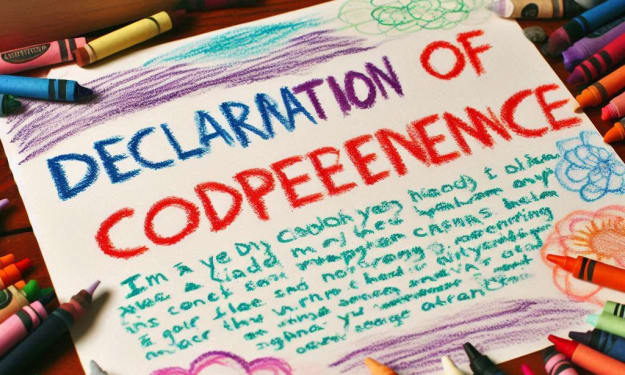
We the People of the Husbands of the United States of America, in Order to form a more perfect Union, and I mean you...with me...establish Justice, insure domestic Tranquility, provide for the common defence, promote the general Welfare, and secure the Blessings of Liberty to ourselves, after Puberty, do ordain and establish this Declaration of Co-Dependence.
By Gerard DiLeo5 days ago in Humans
Lying On a Prayer
Deepak Chopra is one of the most acclaimed spiritual gurus of our generation. While I have never followed or studied his teachings, many people, upon hearing about my psychological issues or my interest in yoga and meditation, have asked me to check out his teachings.
By Avocado Nunzella BSc (Psych) -- M.A.P 6 days ago in Humans



Comments
There are no comments for this story
Be the first to respond and start the conversation.