
The Psychology of Having Two Lives Inside One Body
How identity splitting, hidden selves, and silent internal conflicts shape the way we live, love, and survive in a complicated world.


We all live two lives — one that the world sees, and one that we keep hidden. This long-form deep-dive explores the psychology of dual identities, why they develop, and how modern life pushes us to split ourselves into multiple versions just to survive emotionally, socially, and mentally.
Introduction: The Silent Duality Within
Most people never admit it, but almost everyone carries two separate lives within one body.
There is a version you present to the world — steady, composed, functioning.
And another version that stays hidden — vulnerable, quiet, overwhelmed, or questioning.
One performs.
The other feels.
One speaks.
The other watches.
One survives.
The other remembers.
Psychologists call this identity splitting, self-fragmentation, or simply dual selves. But beyond the terminology, the reality is simple:
The human mind often learns to divide itself to make life bearable.
This is not about a psychiatric disorder.
This is about everyday people, ordinary struggles, and the extraordinary psychological tricks the mind uses to cope with pressure, pain, and expectations.

Section 1: Why We Become Different People in Different Environments
Most people believe they have one personality.
But psychology says differently.
Human identity is contextual — meaning we adapt who we are depending on:
the environment
the people around us
the expectations placed on us
the emotional safety available
There is a version of you at work.
Another with friends.
Another with family.
Another when alone.
These are not lies.
They are adaptations.
The brain doesn’t change your personality to manipulate others — it changes it to keep you emotionally safe.
It adjusts, shapes, softens, or hardens depending on what the moment demands.
Much like water takes the shape of the container it is poured into, the human self shifts to survive each emotional container it enters.
Same essence.
Different expression.
And this is where the first “two lives” begin:
the outer persona and the inner one.

Section 2: The Hidden Self — The One That Lives Behind the Eyes
The hidden self is the version of you that rarely appears in public.
It is the one that:
absorbs unprocessed emotions
remembers the things you try to forget
holds your insecurities
mirrors your most honest feelings
stays awake when the external world thinks you’re fine
It is the “backstage self.”
When the world sees composure, the backstage self may be quietly struggling.
When the world sees confidence, the backstage self may be trembling.
When the world sees indifference, the backstage self may be deeply affected.
This backstage identity watches everything — silently.
It becomes the emotional storage room of the psyche.
And over time, if ignored, it becomes the louder of the two lives.
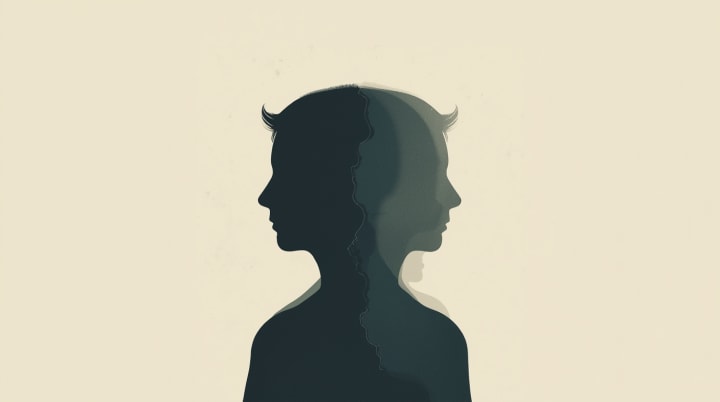
Section 3: When Both Selves Start to Clash
Internal conflict begins when the outer identity and inner identity stop agreeing with each other.
One wants honesty.
The other wants acceptance.
One wants peace.
The other wants to appear strong.
One wants solitude.
The other wants connection.
When the two selves pull in opposite directions, the mind experiences:
anxiety
overthinking
emotional numbness
restlessness
confusion
exhaustion
Psychology calls this self-conflict — a state where the public self and private self no longer align.
This conflict is not a sign of weakness.
It is a sign that the mind is trying to reconcile two emotional realities at the same time.
A person living “two lives inside one body” is not pretending.
They are navigating a world that doesn’t always accept the unfiltered truth of who they are.
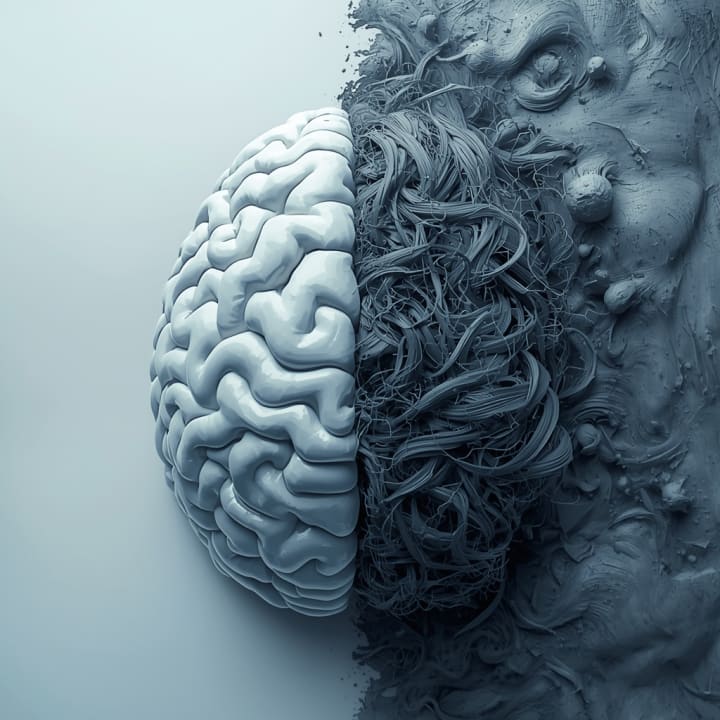
Section 4: Cognitive Dissonance — The Brain's Survival Trick
Cognitive dissonance is the psychological discomfort that arises when behavior and inner feelings are in conflict.
It appears when someone:
hides sadness behind a calm face
downplays feelings to avoid vulnerability
acts strong while struggling internally
forces positivity when the emotional reality is heavier
To reduce this discomfort, the brain often creates two identities:
1. The Performing Identity
The version shaped to meet expectations, responsibilities, and social norms.
2. The Authentic Identity
The unfiltered, emotionally true version beneath the surface.
The bigger the gap between these two, the heavier the mental load.
This is why emotional burnout often comes from pretending to be okay for too long.
Dual identity forms not from deception, but from emotional survival.

Section 5: Trauma and the Birth of the Second Self
Many people do not develop a second inner life because they want to — they develop it because their original environment was not safe enough.
Psychological research shows that trauma, especially early-life trauma, can naturally create:
protective identities
emotional shields
coping roles
withdrawn selves
hyper-independent personas
conflict-avoiding personas
These are not separate personalities.
They are adaptive layers.
When the mind senses emotional danger, it divides responsibilities:
One version deals with the world.
The other absorbs the emotional weight.
This is how the “two lives” become deeply rooted.
One life becomes the survivor.
The other becomes the storyteller of everything that hurt.

Section 6: The Modern World Forces Us Into Multiple Selves
Today’s world has intensified this psychological split.
Most people now maintain:
an online identity
an offline identity
a social persona
an emotional persona
a private inner life
a filtered digital presence
Social media encourages perfection, confidence, and aesthetic stability — often the opposite of real human emotion.
Modern society rewards the polished outer self while ignoring the inner one.
This structural pressure pushes people into maintaining two parallel lives:
The life they display.
And the life they actually experience.
It is not a mental illness — it is a consequence of the digital age.

Section 7: How to Integrate Both Selves Without Falling Apart
The goal is not to destroy one of the selves.
The goal is integration.
Harmony.
Understanding.
1. Accept that both selves are real.
Every person has layers; accepting this reduces internal conflict.
2. Recognize the purpose of each identity.
The hidden self exists for protection.
The outer self exists for functionality.
3. Reduce the pressure to appear perfect.
The wider the gap between outer and inner identity, the heavier the psychological cost.
4. Give the inner self space to speak.
Silencing your emotional reality only magnifies it.
5. Build a life that doesn’t require two extremes to survive.
The healthiest life is one where the public and private selves are not opposites.
Integration is not the erasing of layers — it is the merging of them.
Conclusion: Becoming Whole Again
If it feels like two lives exist inside you, you are not alone.
You are not pretending.
You are not broken.
You are a layered, evolving human being living in a world that demands emotional armor.
The outer self is the version that moves through society.
The inner self is the version that feels deeply, quietly, honestly.
Both are important.
Both are valid.
Both are part of one complex, intelligent mind.
The goal is not to choose one life over the other —
the goal is to become whole enough that both lives can breathe in the same space.
If this story spoke to you, consider leaving a ❤️ heart on the article.
Your support helps more readers discover these ideas.
Feel free to subscribe if you’d like to read more long-form pieces on psychology, identity, and the hidden parts of the human mind.
Every follow motivates me to keep creating deeper, better work.
Thank you for being here — truly.
About the Creator
F. M. Rayaan
Writing deeply human stories about love, heartbreak, emotions, attachment, attraction, and emotional survival — exploring human behavior, healthy relationships, peace, and freedom through psychology, reflection, and real lived experience.
Keep reading
More stories from F. M. Rayaan and writers in Humans and other communities.
When Two Souls Recognize Each Other: The Science and Spirituality of Soulmates
Some people enter your life and it feels like you've known them forever. Explore the science, psychology, and spiritual mystery behind soulmates — and why your heart knows before your mind does.
By F. M. Rayaan5 months ago in Humans
I Fell in Love with My Best Friend’s Darkest Secret (Part 20)
The Breaking Point The night had never felt heavier. The park, once a refuge of quiet serenity, now seemed transformed into a labyrinth of shadows, each corner hiding unseen threats. Liam and I moved cautiously, senses on high alert, hearts pounding in tandem. Every step we took felt like a gamble, every breath measured against the tension that gripped the night.
By Ahmed aldeabella5 days ago in Humans
Standing While Falling
Quotation from Friedrich Nietzsche "He who wrestles long with monsters should beware lest he himself become a monster. And if you gaze long into an abyss, the abyss also gazes into you. Man is not destroyed by suffering, but by the meaning he makes of it."
By LUCCIAN LAYTH5 days ago in Critique




Comments (1)
That's deep brother. After a long time. @F. M. Rayaan