
The Original Mabel
Little Black Book Challenge
The lockbox hung as a black mark on Auntie’s front door. Mabel grabbed the hateful thing and punched in the combination, popping the box open to claim the key, shiny and newly minted from within. She opened the door and stepped into her beloved Auntie’s house for the last time. No longer alive with her presence, it stood as a tomb to be raided by those who don’t believe in curses. Mabel dropped her sleeping bag and went back to her car to get the dozen collapsed boxes before closing the door to the outside world. She had been given the weekend, reluctantly, by her great-aunt’s daughter Corrine to take the books she had been left in the will with the caveat not to touch anything else, as everything had been cleaned, recorded and priced. Corrine would hate it if she had to call Mabel’s parents about something that was missing or broken.
Mabel walked through the house, trying to capture some scent or aura of the past, but everything had been stripped of old smells, replaced with Lysol and Febreeze. All items, large and small had been bequeathed a small sticker of value, right down to Auntie’s nightgowns and tea kettle. While upstairs, Mabel carefully wiggled open the knots in a plastic bag whose sticker proclaimed 10 full sets of double bedding ($20), found the flower sheets and pillow cases she always used for her visits, then carefully tied the package again. She made the bed ($800) she had slept on since she was five, opened her sleeping bag on top, then went to see about her inheritance.
When Mabel had moved with her parents from California to her dad’s home town in Ontario, Canada almost fifteen years ago, the winter slapped her southern temperament with a shockingly cold back hand. Moving from the only place she had ever lived that had seemed to overflow with cousins and palm trees, this new, frozen town had the feeling of being buried alive. With no furniture or friends to play with, she had dragged a teddy in funereal procession past her parents attempting to get the house ready before the moving truck came with a look that said, “You. You did this.”
Finally, having had enough of her interrupting important scrubbing and painting activities with no intention to help, an intervention was arranged. She would spend the day with a great-aunt, already old and widowed, facts that came out as unfortunate descriptors as her father attempted to outline the visit under his little girl’s accusatory glare. Everything he said only supported Mabel’s growing certainty that under the cheery disposition was a pathetic plan to leave her in the care of an old lady that probably smelled bad and hated children. Mabel would not fall for it. If she was being abandoned, she would walk into it eyes wide open.
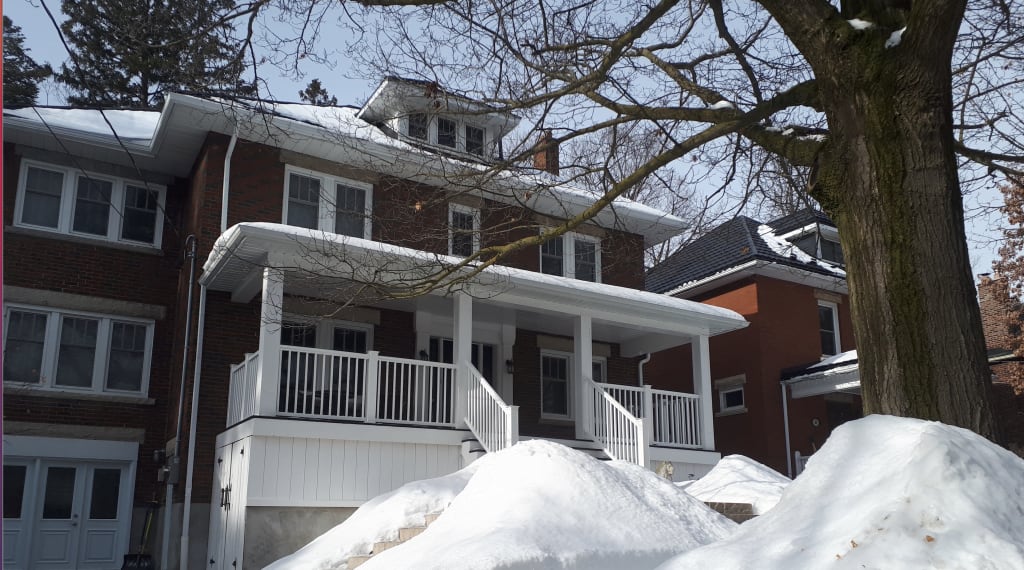
Mabel had followed her father from the car, trudging over the snowbank to the shovelled path and up the steps of the large house. The red brick structure was a solid presence in the snow, having settled its bones into the ground over a hundred years ago and still it showed no inclination to bow under storm or gale. Its big, white porch was windswept, a snow-covered swing hanging in the corner, waiting patiently for better days. Mabel copied her dad’s stomping to clean her boots, then followed him into this stranger’s house without knocking. In spite of her determination to stay angry, she was at once mesmerised by the wild, colourful lady, rushing down the steps of the wooden staircase. In a world robed in snow and cold, the home and its inhabitant were bright with colour and warmth. Already getting too warm inside, Mabel gave her new and bulky winter coat to this woman dressed in mismatched patterns of flowing materials, large earrings that pulled her lobes towards the earth, and a feather clip in her white, frizzy hair. “Hello’s” and “good to see you’s” volleyed back and forth between her dad and the lady, both hugging tightly and smiling like Christmas. Then the lady sat on a chair in the foyer to look at Mabel eye-to-eye.
“They tell me you are a Mabel,” the old lady said with a deep rumbling voice that was as surprising as everything else about her. Mabel nodded.
“Guess what? So am I. It is a wonderful name that is only given to special girls with large minds and exceptional futures, you know. You and I are very lucky, and I am extra lucky that you moved here so I can meet you.” Old Mabel narrowed her eyes in serious thought, “Would it be awkward to call each other our own name? Would you like to call me something else?”
Mabel the younger had shrugged her shoulders noncommittally.
“What do you call your mother’s sister?”
“Auntie.”
“Oh, that sounds very special! I would love to be called Auntie, but it is completely up to you. If you would rather call me…” Old Mabel waved her hand through the air, “Lady Stuff’n’fluff, or something else, that’s all right too.”
The title of ‘Auntie’ was judiciously approved. Soon, Mabel became a much frequent guest, taking on the nickname, Little Mabel.
Irreverent: adjective.
Not showing the expected respect for official, important, or holy things.
An irreverent comment/attitude.
Example: Auntie.
Over time the rest of the family grew to call them “The Mabels”, as in: “Where did The Mabels go?”, usually with the exasperated air of someone caught in the thick of unwanted work, while just realising someone else has slipped the shackles — again. Auntie had the habit of sneaking away from chores, predictably with Little Mabel following close behind. As Auntie’s house was the biggest and Auntie being the oldest, hers became the de-facto Christmas, Easter, and family reunion house. Having provided the venue, Auntie felt justified to not provide anything else.
“I’m too old to play those reindeer games.” Auntie confided in dramatic whispers, “Let’s see what we can get up to!” Then off they would go, to the garden, the attic, anywhere that could feed imaginations, returning adorned randomly with dust, dirt or costume jewellery. If they were caught roaming or engrossed in some object of interest, the Mabels developed a habit of turning their heads in unison to stare at the intruder — silently — until that person left. Sometimes, if it was Corrine that found them, dressing up in tinsel garlands or sculpting with mud, she would grumble, “Why can’t you just act your age?”
“Never!” Auntie would bellow.
“I am!” Little Mabel would cry.
Peals of laughter would follow Corrine’s retreat from their presence.
*****
Pizza delivered and partially eaten, Mabel sat on her favourite sofa ($600) and looked at the bookcases (set of three, $150) that held her inheritance. One would think inheriting the house and all its contents (except these books) would make someone gracious, but the way Corrine relished telling Mabel that Auntie had only left her the books was meant to sully the intended tenderness. Her voice had dripped with the vindication of an ill-favoured child, a highly unpleasant persona for a pensioner.
Mabel stared hard at the shelves and mined the memories of the evenings they represented. On the numerous weekends, summer and holiday visits, The Mabels would make hot drinks or sweet snacks in the evenings and choose a book to read together. In the beginning, Auntie had read all the parts, but her husky, deep voice — “I was strung up by pirates! I may sound like a crow, but I escaped with their treasure!” — made any young or flighty character sound ridiculous. As soon as she could, Little Mabel had read the parts her child’s voice was suited for, and as time progressed, she would read more and more. From the beginning, the two of them would curl up, Little Mabel’s legs over Auntie’s lap, elderly arms cradling her skinny body, sharing tales of adventure and magic. Over the years, Little Mabel grew long and tall, taking after her mother’s kin, yet still she would curl herself around her slowly shrinking Auntie, a tree growing around the rock. The books had been found in thrift shops, the free bin from the library, and passed to them by friends and family. If ever a story failed to delight (as was often, given their selection process), it would be hurled across the room, Auntie yelling something akin to, “Begone, Satan! You will not waste one more precious minute left to me on this Earth!” where it would lie until the fireplace was lit, then it was ceremoniously fed to the flames for its failure to entertain. Once the sacrifice was made, they would rewrite the story together, a task that might take weeks, the two keeping notes of inspiration when apart, then debating the merits of each point until they came to a story they both approved, committing it, handwritten, to an ever growing collection of notebooks. The notebooks took over the shelves amid a smattering of the favoured few that met The Mabels’ discerning tastes and had been spared the flames.
Mabel dropped the crust of her pizza back into the box, squeezing her eyes tight to quell the sadness growing in her throat, the memories linked too strongly to the losses these past few weeks held. She blew out her breath, reopened eyes tracing the carpet’s colourful patterns until the wave had fully passed. Once her emotions were safely back in the box in her belly, Mabel stood with purpose and inspected the books with a critical eye — which one should she choose to keep her company tonight? She zeroed in on a little, black book, mysterious in its anonymity, yet still managing to hold the aura of that heady process of world making. She pulled it out and flipped through the scribbled pages until a flutter of paper escaped to the ground, where it unfolded in lazy repose. She picked it up and scrutinised the hundred-dollar bill. She flipped a bit more through the book and two more bills fluttered after their captured counterpart. Three hundred dollar bills — one of which had “Adventure Awaits!” written in Auntie’s handwriting. Mabel took down another book and more bills fluttered from their hiding spots. Mabel looked at the shelves of books and laughed through tears.
Monday morning, Mabel had two boxes containing nondescript notebooks, some novels, a memoir, and one rather large, ancient dictionary — the cream of this weedy crop. The rest of the shelves were emptied into the other boxes, ready to be sold or chucked. The sheets were hidden in her sleeping bag balanced on top of the stacked boxes. Mabel was just grabbing her backpack when she hears the lockbox open and the key open the front door. Corrine walks in, appraising the foyer, the room beyond, the slight pizza flavour of the air, and Mabel, all with one swivel of her withered, yet well-groomed head.
“Is that it?” She indicates the boxes, leaning ever so slightly, to peer inside.
Mabel pauses for a moment, considering the various ways to respond.
“Yes, these are the ones I want. You can sell the rest.”
“Really? Don’t you want to try selling them yourself?” The smirk triggers the bewildered question (again) how this person could be her Auntie’s child.
Mabel pretends to think deeply about her options, “No, it’s not worth it,” Mabel keeps her eyes downcast and dejected, the last gift she will ever give to this bitter woman.
“Well, tell your parents the Estate sale is on Saturday. If they want to buy anything, they should come early.”
Mabel nods and leaves the house. She places her treasures: the boxes of books, a set of stolen sheets, and $20,000 in the hollowed-out dictionary in the backseat of her car. She even returns the wave Corrine gives before driving down the street.
About the Creator
Keep reading
More stories from writers in Humans and other communities.
The CEO of Everything
They say "jack of all trades, master of none," but they forgot to mention the part where the jack of all trades is also the camera woman, the makeup artist, and the person currently yelling at a tangled Wii microphone cable in a her own bathroom while recording herself singing and trying to make it look realistic and professional. (As professional as you can make it with nothing but a cell phone camera and a mic that doesn't work)
By Sara Wilson7 days ago in Humans
How Dual Diagnosis Treatment in North Carolina Helps Recovery
Recovery from substance use is rarely a one dimensional process. Many individuals struggling with addiction also face underlying mental health conditions that complicate treatment and increase the risk of relapse. When these conditions are treated separately or ignored altogether, recovery becomes far more difficult to sustain. This is where dual diagnosis treatment plays a critical role.
By Jordan Blakeabout 19 hours ago in Humans
Thoughts on Vocal and the way the world is
"Death cannot stop true love, only delay it." – Wesley in The Princess Bride. I decided to come back to Vocal on a very cold and dark night at the end of December. I had been, and still am, convalescing from a horrible staph infection that had gone misdiagnosed for months. This, paired with the increasing challenges of being healthy, making the best choices for my co-parented child, being a wife, and being a director at a new job, was a lot to manage.
By Jazzy 6 days ago in Confessions


Comments
There are no comments for this story
Be the first to respond and start the conversation.