
The Normalization of Racism and the Mockery of Marginalized Communities in Social Media
The Historical Roots of Racist Stereotyping How Racism is Disguised as Comedy in Social Media The Broader Trend: Mockery of Other Marginalized Groups Why This Normalization is Dangerous
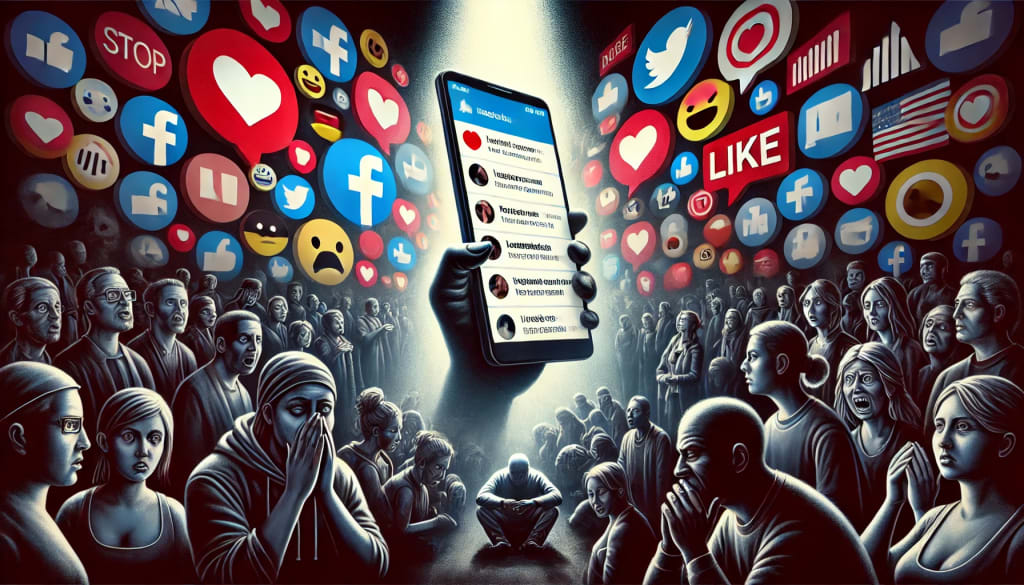
The Normalization of Racism and the Mockery of Marginalized Communities in Social Media.
Racism has long been one of humanity’s most persistent and deep-rooted injustices. For centuries, marginalized communities, particularly Black people, have suffered from discrimination in every aspect of life, from legal systems to social interactions. While overt racism has been widely condemned in many societies, a subtler and perhaps even more dangerous form has emerged in modern times—one that disguises itself as humor.
Social media platforms such as Instagram, TikTok, and YouTube have become breeding grounds for content that perpetuates racial stereotypes under the guise of comedy. These so-called jokes, often targeting Black people, trivialize historical oppression and reinforce damaging narratives that have plagued generations. What makes this even more concerning is that these jokes are not met with widespread condemnation, but with laughter and acceptance. The comment sections of such videos often reveal a shocking lack of awareness, as audiences casually engage with humor that dehumanizes entire communities. Instead of recognizing the deeply harmful nature of these jokes, people contribute to their spread, further entrenching racist ideologies into mainstream culture.
This issue extends beyond racism. The normalization of mockery has spread to other marginalized groups, including individuals with disabilities, those with genetic conditions, and other socially vulnerable communities. Videos that ridicule these groups have become viral entertainment, reducing human struggles to comedic relief for the privileged majority. Social media, which once had the potential to unite and educate, has instead become a tool for reinforcing prejudice in a way that appears harmless but is anything but.
The Historical Roots of Racist Stereotyping
The laughter that echoes through the digital landscape at the expense of Black people is not a new phenomenon. Racist stereotyping has been systematically embedded in Western culture for centuries, often serving as a justification for subjugation. During the era of slavery, Black people were portrayed as inferior, unintelligent, and subhuman, rationalizing their forced labor and lack of rights. These portrayals were carefully constructed through literature, theater, and political rhetoric to ensure that the dominant class viewed them as less than human.
Even after the abolition of slavery, the damaging caricatures evolved rather than disappeared. Black men, in particular, were depicted as inherently violent, aggressive, and predisposed to criminal behavior. These images were used to justify segregation, discrimination, and the over-policing of Black communities. The infamous Jim Crow-era depictions of Black people as either brutes or simpletons laid the foundation for stereotypes that persist today. The same tropes that were once used in racist propaganda posters now find their way into digital comedy sketches and memes, proving that the legacy of these stereotypes is far from over.
The evolution of racist humor into mainstream media became particularly evident in early American cinema. Black characters in films and television were often either portrayed as criminals or comedic relief, rarely depicted as complex or fully realized individuals. The media reinforced the idea that Black people existed either to be feared or laughed at, and this perception seeped into public consciousness. Today, the digital world replicates these same portrayals, albeit in a form that is more covert but equally harmful.
Social media has made it easier than ever for these stereotypes to flourish under the guise of harmless comedy. What was once blatant racism has now been repackaged as "just a joke," allowing harmful ideas to spread without consequence. The reach of social media has amplified these messages, making them more accessible and accepted. This is why it is crucial to dissect specific instances of this modern phenomenon and understand how humor has been weaponized to reinforce racial biases.
How Racism is Disguised as Comedy in Social Media
One of the most troubling examples of how racist stereotypes are normalized through humor can be found in viral reels and short videos. These pieces of content, often appearing harmless at first glance, are carefully crafted to reinforce damaging narratives about Black people while making them palatable to mass audiences.
In one particular reel, a man recounts an incident in which he saw a Black man riding a bicycle. Upon seeing him, the man immediately felt the need to check if his own bicycle was still in his garage, assuming without reason that the Black man was a thief. The so-called joke takes an even darker turn when the narrator says that he found the Black man inside his garage—asking for food. The underlying message here is clear: Black people are presumed to be criminals before they are seen as individuals, and their struggles—such as poverty and food insecurity—are used as the punchline.
This type of humor is not new, but what makes it especially alarming is how widely it is consumed without question. Instead of being challenged, this joke is met with amusement. The comments section, filled with laughing emojis and casual remarks, reveals a shocking level of desensitization to racial prejudice. What should be an opportunity for discourse instead becomes a celebration of stereotypes, further entrenching harmful beliefs into the cultural fabric.
A similar instance can be found in a stand-up comedy performance where a comedian ,whose name I will not mention—not to protect him, but to emphasize that this is not about one individual but rather a larger cultural issue, makes a joke about internalized racism. In his set, he discusses the concept of internalized racism, claiming that it is passed down through generations. He recounts a personal story where he was walking alone at night and suddenly saw a Black person approaching. Instinctively, he grabbed his purse—despite logically knowing that "he is not for sale." The audience laughed, failing to recognize the layers of racism within the joke. The comedian then followed up with, "He did steal my purse though," reinforcing the very stereotype that he initially seemed to mock. The audience bursts into laughter, completely overlooking the racist implications behind the joke.
Another viral example involves a classroom setting where a teacher asks students what the most sold item in the 1800s was. Before any of the Black students can answer, the teacher cuts them off and says, “Right answer.” The dark implication is that Black people themselves were the most sold commodity during that time due to the transatlantic slave trade. This type of humor trivializes the immense suffering endured by enslaved Black individuals, reducing one of history’s greatest atrocities to a mere punchline.
What makes these jokes particularly dangerous is the lack of pushback they receive. In an ideal world, offensive content like this would be met with widespread criticism, but instead, it is met with viral success. The normalization of these jokes ensures that racism remains an undercurrent in everyday interactions, subtly reinforcing harmful ideologies rather than challenging them.
The Broader Trend: Mockery of Other Marginalized Groups
The issue of using humor to dehumanize people is not limited to racism. Another troubling trend on social media involves making fun of individuals with disabilities or genetic conditions. Short people, particularly those with dwarfism, are frequently the subject of cruel jokes in viral reels.
A particularly disturbing trend involves taking clips from the Paralympics or sports competitions featuring athletes with disabilities and repurposing them into comedic edits. One common format involves showing a short athlete making a jump in a sporting event, only for the screen to cut to an object, such as food, falling into a frying pan. This dehumanizing comparison reduces the achievements of disabled individuals to mere physical comedy, completely disregarding the hardships they have overcome.
These jokes are not only cruel but deeply damaging. They send the message that individuals born with disabilities or genetic differences exist for the amusement of others, further isolating them from mainstream society.
Why This Normalization is Dangerous
When offensive jokes become widely accepted, they reshape cultural norms in ways that reinforce discrimination. The constant exposure to racist and ableist humor desensitizes people, making them less likely to recognize or challenge harmful narratives. As these jokes become more widespread, they influence real-world interactions, affecting how people of different races and abilities are treated in everyday life.
The laughter that accompanies these jokes is not harmless; it is an affirmation of prejudice. It tells marginalized communities that their struggles are insignificant, their histories irrelevant, and their identities something to be ridiculed rather than respected.
The need for critical media consumption has never been greater. If society continues to accept humor that relies on dehumanization, the cycle of discrimination will only persist. The challenge is not just to call out these issues when they arise but to foster a culture that values dignity, respect, and true inclusivity.
About the Creator
Mohammed Ajmal
I dive into social issues, media impact, and the struggles of marginalized communities, sparking conversations that challenge norms and inspire change.
Keep reading
More stories from writers in Humans and other communities.
The CEO of Everything
They say "jack of all trades, master of none," but they forgot to mention the part where the jack of all trades is also the camera woman, the makeup artist, and the person currently yelling at a tangled Wii microphone cable in a her own bathroom while recording herself singing and trying to make it look realistic and professional. (As professional as you can make it with nothing but a cell phone camera and a mic that doesn't work)
By Sara Wilson7 days ago in Humans
Who am I?
I’m in a crowd of people, all I hear is noise surrounding me. Words echo like rolling thunder. Facial expression are vast like waves in the ocean. Im battling to drown out the chaos. This is me, and this is what daily life looks like for me. I am a woman, daughter, sister, mother, partner, friend, confidant, and every single title a woman can carry in a world that we need to be identified in with a word. Do I know who I am? Do these words that describe me, make me who I am? Or do the opinions and perception of others and maybe one. Make me who I am?
By Deana Cabison3 days ago in Humans
📢 Raise Your Voice Thread: 01/22/2026
Our “Raise Your Voice Threads” are hosted most alternating Thursdays at 12PM ET to offer creators more avenues to uncover exceptional stories on Vocal. As we are continuously searching for fresh creators and inspiring stories, this thread provides an opportunity to exchange and discuss the stories that have moved and motivated us on Vocal.
By Raise Your Voice by Vocal3 days ago in Resources



Comments
There are no comments for this story
Be the first to respond and start the conversation.