
The Myth of Being Smart: It’s All About Experience
Success isn’t about being born smart, but about learning, failing, and gaining experience. Discover why experience matters more than intelligence.

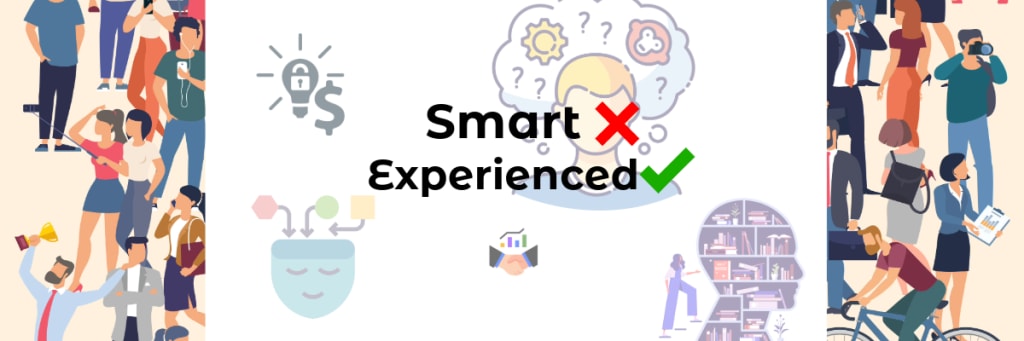
In today’s world, we often hear people being labeled as “smart” or “not smart.” But is intelligence really what separates individuals? The truth is, intelligence alone doesn’t define success it’s experience that makes the real difference. People aren’t born with an extraordinary ability to solve problems; they develop their skills over time through learning, practice, and exposure to challenges.
Experience Over Intelligence
Many times, we assume that someone who quickly solves a problem or makes the right decision is naturally intelligent. But in reality, that person has likely encountered a similar situation before and learned from it. Their ability to respond efficiently comes from past experiences, not from some special, inborn intelligence.
Imagine two individuals starting a new job. One adapts quickly, while the other takes longer to understand the tasks. Does this mean the first person is smarter? Not necessarily. They might have had prior experience in a similar field, making it easier for them to adjust. Meanwhile, the second individual, given enough time and exposure, could perform just as well, proving that experience is what truly builds competence.
This concept extends far beyond the workplace. Think about sports, cooking, or even social interactions. A seasoned chef can whip up a dish effortlessly, while a beginner follows a recipe meticulously, afraid of making mistakes. Does that mean the chef is inherently more intelligent? No, they’ve just spent more time in the kitchen, refining their skills. Likewise, a skilled driver reacts instinctively in traffic, while a new driver hesitates. The difference isn’t intelligence; it’s experience and confidence built over time.
Learning Through Mistakes
Experience is not just about being exposed to something it’s about learning from mistakes and continuously improving. People who have faced failures and overcome them naturally develop better judgment and problem-solving skills. They appear “smarter” not because they were born that way, but because they’ve built knowledge and resilience through trial and error.
This principle is evident in entrepreneurship. Many successful business owners failed multiple times before reaching success. They weren’t necessarily smarter than others, but they analyzed their past mistakes, refined their strategies, and gained valuable insights along the way. The ability to persist, reflect on past failures, and make better decisions stems from experience, not an innate intellectual advantage.
Albert Einstein: A Perfect Example
A great example of this is Albert Einstein. He is often regarded as one of the greatest minds in history, but what made him seem so intelligent wasn’t just his natural abilities it was his relentless curiosity, experimentation, and dedication to learning. Einstein didn’t simply wake up one day with the theory of relativity fully formed in his mind. Instead, he spent years questioning existing scientific beliefs, conducting experiments, making mistakes, and refining his ideas.
His famous equation, E=mc², wasn’t a random stroke of genius. It was the result of years of research, persistence, and learning from failures. In fact, many of his early theories were met with skepticism, and he faced rejection from the scientific community. But instead of giving up, he kept refining his ideas until he had concrete proof. His success was built on experience, persistence, and a deep curiosity about the world around him—not just raw intelligence.
The Role of Effort and Curiosity
While experience plays a major role, effort and curiosity accelerate the process. Some people gain experience faster because they actively seek knowledge, take on challenges, and constantly look for ways to improve. This mindset helps them grow and develop skills faster, making them appear more capable.
For example, someone who reads regularly, experiments with new skills, or asks questions constantly will acquire knowledge faster than someone who passively waits for experience. This is why continuous learning is so important. People who remain curious and open to new experiences gain expertise more quickly, which makes them seem “smarter” than others.
Another important factor is adaptability. Those who embrace change and step out of their comfort zones expose themselves to different situations, allowing them to tackle challenges with greater ease. This is why well-traveled individuals often have a broader perspective because they have encountered diverse cultures, problem-solving approaches, and ways of thinking.
The Importance of Time and Patience
Many people feel discouraged when they struggle to grasp something new, especially when they see others excelling. However, it’s important to remember that experience takes time. If you see someone performing exceptionally well at something, don’t assume they are naturally gifted consider how much time and effort they’ve invested.
Take language learning as an example. Someone fluent in multiple languages isn’t necessarily more intelligent than a monolingual person; they’ve simply spent more time practicing and immersing themselves in different linguistic environments. The same applies to skills like coding, playing a musical instrument, or public speaking. The more effort and exposure a person has, the better they become.
Rather than categorizing people as smart or not smart, we should focus on their level of experience and willingness to learn. Everyone has the potential to improve the key lies in practice, exposure, and perseverance.
So, the next time you see someone excelling, remember it’s not about intelligence, it’s about experience. If you want to improve at something, keep exposing yourself to it, learn from mistakes, and stay curious. Over time, what once seemed difficult will become second nature, and you, too, will be perceived as highly capable in that area.
About the Creator
Smit Parmar
Passionate storyteller crafting authentic narratives about life's beautiful complexities. My words explore human connections, creative resilience, and unexpected beauty in everyday moments. Join my journey of discovery and inspiration.
Keep reading
More stories from Smit Parmar and writers in Humans and other communities.
What If Life Had Only Happiness? The Hidden Problem of Endless Joy
Imagine a world where you are always happy. No stress, no sadness, no pain. Just pure joy, every single moment. Sounds like a dream, right? But would it really be? While happiness is something we all want, a life with only happiness might not be as perfect as it seems. In this blog, we’ll explore why we need both happiness and challenges to truly appreciate life.
By Smit Parmar10 months ago in Humans
Whiskey At Dusk
Guess the whiskey was more important to you in the end, wasn’t it? It was more than the well-being of your friends; more vital than showing up to the places you promised you would and could come to; more critical of a matter than fulfilling your damn responsibilities and getting the press off your back.
By Snarky Lisa3 days ago in Humans
9 Ways People Read Your Emotional Intelligence in Public Spaces.
People form judgments fast. Public spaces amplify signals. Your body language, tone, and reactions speak before words. Social scientists study these cues to assess emotional intelligence. You reveal awareness, control, and empathy through ordinary behavior. Here are nine ways observers read you in shared spaces.
By Wilson Igbasi5 days ago in Humans


Comments
There are no comments for this story
Be the first to respond and start the conversation.