
The mystery of the phenomenon of sudden aging and rejuvenation in pilots
This phenomenon is caused by G-force, which makes the pilots' faces visibly age, but can also make them younger in just a few seconds.

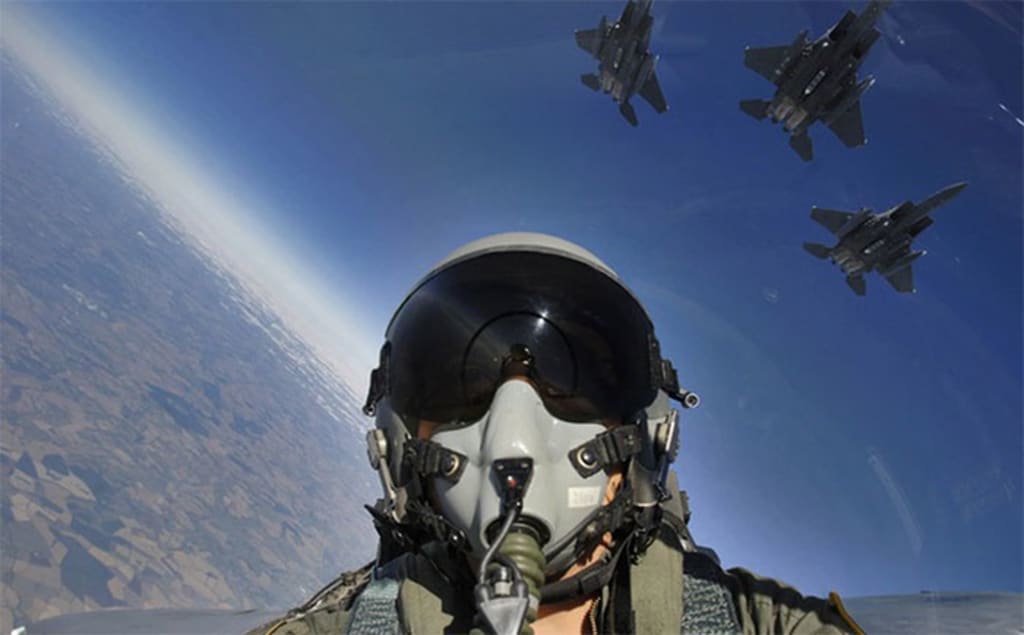
This phenomenon is caused by G-force, which makes the pilots' faces visibly age, but can also make them younger in just a few seconds.
From a young girl's face, to an old woman's, and back again. The effects of G-forces on the human face can mostly be seen in the muscles and temporary changes in appearance, but they actually do much more to our bodies.
Acceleration is measured in units of gravitational force, abbreviated in English as G-force (gravity) . Normally on the ground, people experience a gravitational force of 1G. When flying in circles, diving or doing vertical loops, the upper limit of G-force that a pilot can experience is 7.5 to 8G, when launching a parachute, it even exceeds 10G, exceeding the endurance limit of a pilot with abundant physical strength and good training. During the parachute escape of jet pilots, the phenomenon of unconsciousness (fainting) often occurs even though the pilot's overload time is only about 1 - 2 seconds. This is also the reason why many fighter pilots flying over the sea in an emergency situation where they need to parachute to escape often encounter many dangers when in this case of temporary fainting.
Gravity is an accelerating force . This means that it acts on objects to change their velocity. All objects exert a gravitational force on each other, and this force is unique because it can act over very large distances. On and near planet Earth, our planet's gravitational force is so large because the Earth has such a large mass that all other gravitational forces are essentially negligible. This force has been calculated to be approximately 9.82 m/(s^2) , and is commonly referred to as 'g', as you may recall from high school physics class.
It is important to note that according to Newton's Second Law of Motion, F = ma, the gravitational force is tied to an object's mass and varies in direct proportion to that value. For example, the gravitational force on the moon (a much smaller object than Earth) is only 1.62 m/(s^2). Gravity is the reason why objects fall to the surface of the Earth, and it is also the force that an airplane's wings must resist to create lift. When an airplane's lift is greater than the force of gravity, controlled flight becomes possible, as the Wright brothers demonstrated to the world in 1903.
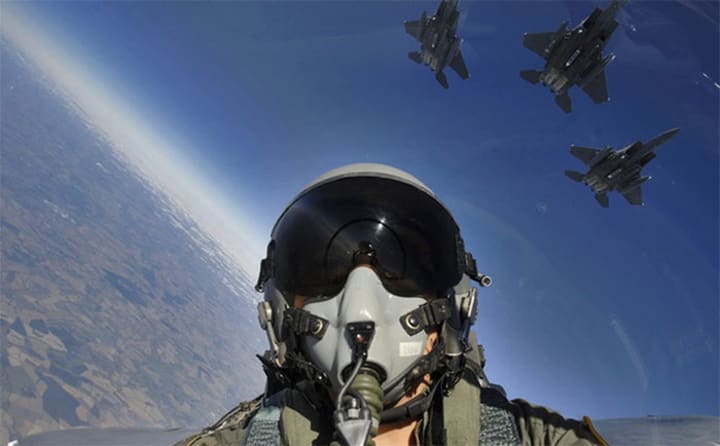
The physiology of the human body will all be affected and react to changes in G-force.
The human body, like the rest of life on Earth, is adapted to life on land, where we are constantly exposed to the Earth's gravitational force (g). For simplicity, let's call this standard Earth gravity (9.82 m/s^2 ) 1G. However, during flights, pilots may encounter situations that are more or less than this constant 1G.
Accordingly, their body's physiology will all be affected and react to the change in G-force. When an airplane is flying towards the Earth and applying a thrust force to that path, it is accelerating at that speed plus 1G (9.82 m/s^2). When the same airplane accelerates away from the Earth's surface, the sum of the acceleration forces will be the difference between the thrust force and 1G.
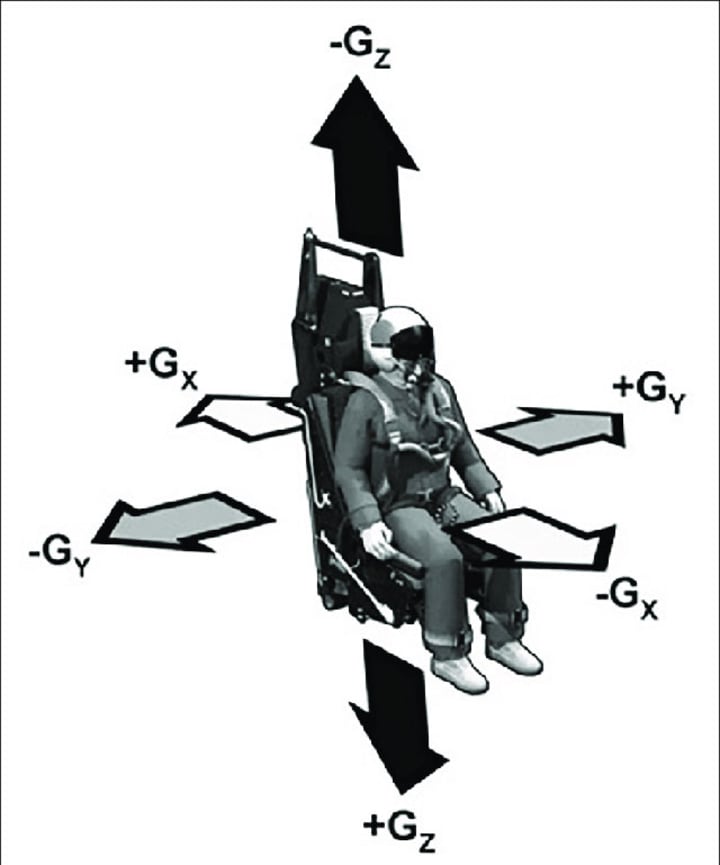
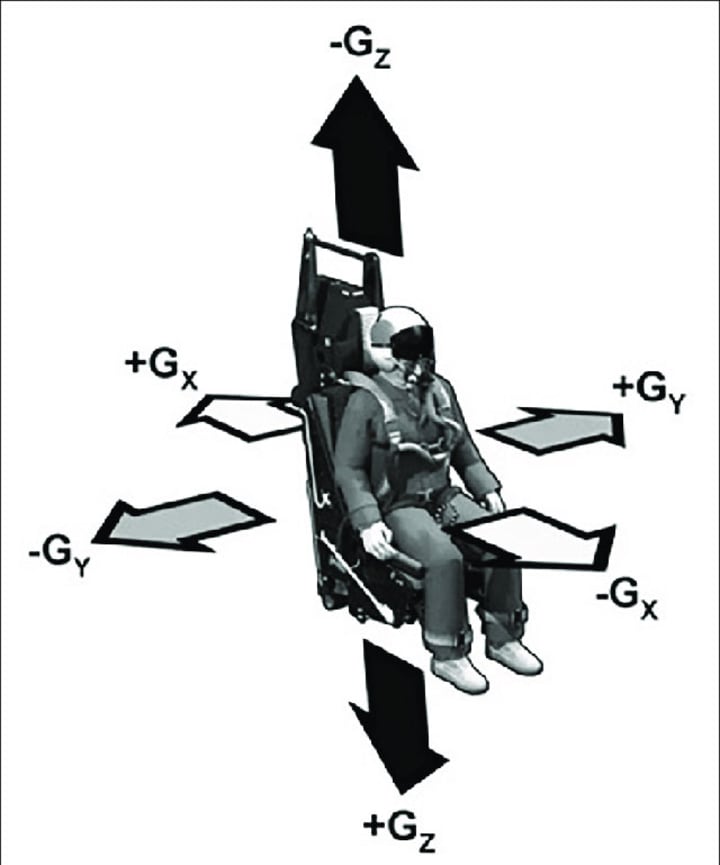
Accordingly, G-forces act on the human body along different axes (or directions). They are often described as the x, y, and z axes. Each has a positive (+) or negative (-) direction, with the positive direction being downward in the same direction as the Earth's gravitational pull and vice versa.
Gx is described as the force acting on the body from the chest back; Gy is a force acting from shoulder to shoulder, and is encountered during an aileron roll (an aerobatic maneuver in which the aircraft performs a 360° turn). Aerobatic pilots regularly encounter this type of G-force and are still able to control the aircraft safely and accurately. Gz is the gravitational force acting on the vertical axis of the object - parallel to the spinal cord.
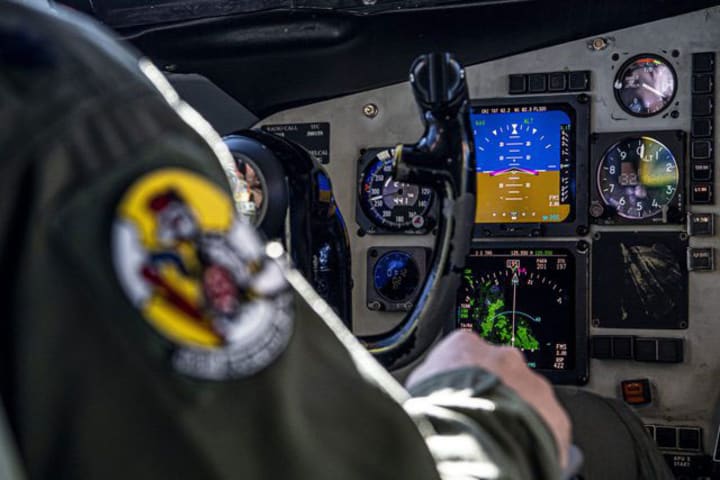
Aerobatic pilots encounter this type of G-force on a regular basis.
So how do these forces affect the body's ability to function? The axis most relevant to this is Gz, as the G-forces transmitted along this axis occur most frequently during flight and have a significantly greater physiological impact. Acceleration along the Gx axis is commonly experienced by astronauts during space shuttle launches. Gy acceleration is less relevant, but is also receiving more attention due to the development of newer generation fighters with multi-directional thrust such as the F-22 and F-35. For simplicity, the term 'G' in the remainder of this article will only apply to forces in the Gz axis.
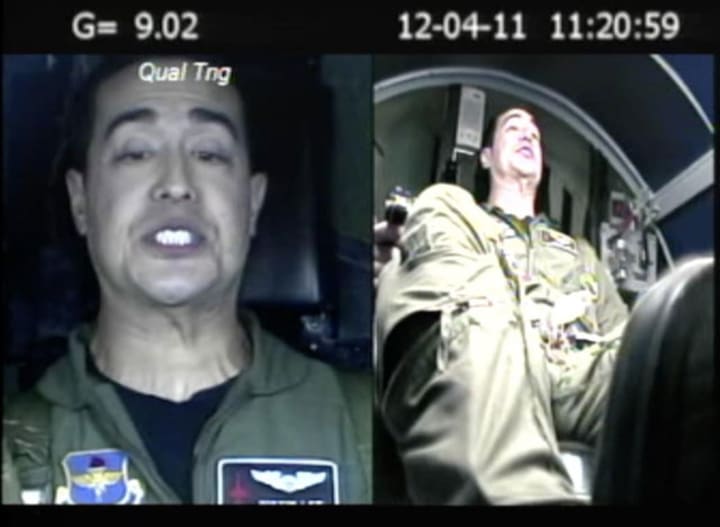
Gx-axis acceleration is commonly experienced by astronauts during space shuttle launches.
The circulatory system is most significantly affected by the increased G-forces during flight. Even at 1G, blood pressure in a person in a straight line will be highest in the lower extremities (legs) and lowest in the brain (cranium) due to gravity. Because our bodies have adapted to a 1G environment, we have developed mechanisms to compensate for this difference. And as G-forces increase, the above physiological phenomenon is magnified and the blood pressure difference between the cranium and the lower body becomes greater, leading to significant cerebral hypoxia (no blood = no oxygen). The end result is unconsciousness.
The circulatory system is most significantly affected by the increased G-forces during flight.
In aviation, this is known as G-LOC , or G-induced loss of consciousness, and it remains a major cause of loss of control in both military fighter aircraft and civilian aerobatic aircraft. During the 1990s, for example, the US Air Force lost about one aircraft per year due to G-LOC.
In addition to the circulatory effects, increased G-forces disrupt respiration by diverting blood to the bottoms of the lungs, collapsing small air sacs (called alveoli) and creating a general ventilation/pumping mismatch as air remains in the upper part of the lungs where there is very little blood flow.
Other less serious effects of G-forces include musculoskeletal pain (usually limited to the back and neck) and small bruises called petechiae caused by broken capillaries. These often occur in gravity-dependent areas of the body and are called Geasles.
Other less serious effects of G-forces are musculoskeletal pain.
To somewhat limit the impact of G-forces, pilots are often required to wear special protective suits as well as oxygen masks. In addition, they often undergo high-G acceleration training to prevent unconsciousness during a flight.
About the Creator
HK Decor
Telling stories my heart needs to tell <3 life is a journey, not a competition
If you like what you read, feel free to leave a tip,I would love some feedback
https://s.shopee.vn/7fFUMxnnBx?share_channel_code=8
Anne Frank, Can We Talk?
Dear Ann Frank, I never thought I would write to you, but I am certain you would understand all that I will pen to you today. Today’s society probably looks a lot like the days you witnessed. Being a Native American, I am a minority and repressed more than many cultural communities. Even though the Hispanics and illegal immigrants are the target right now, Native Americans are now being detained too. I know you had seen the same social disorder happening around you as I am seeing in my world today.
By Sheila L. Chingwa6 days ago in Humans


Comments
There are no comments for this story
Be the first to respond and start the conversation.