
The Mirror of Many Colors
Celebrating the true beauty of humanity — beyond mirrors, colors, and appearances.

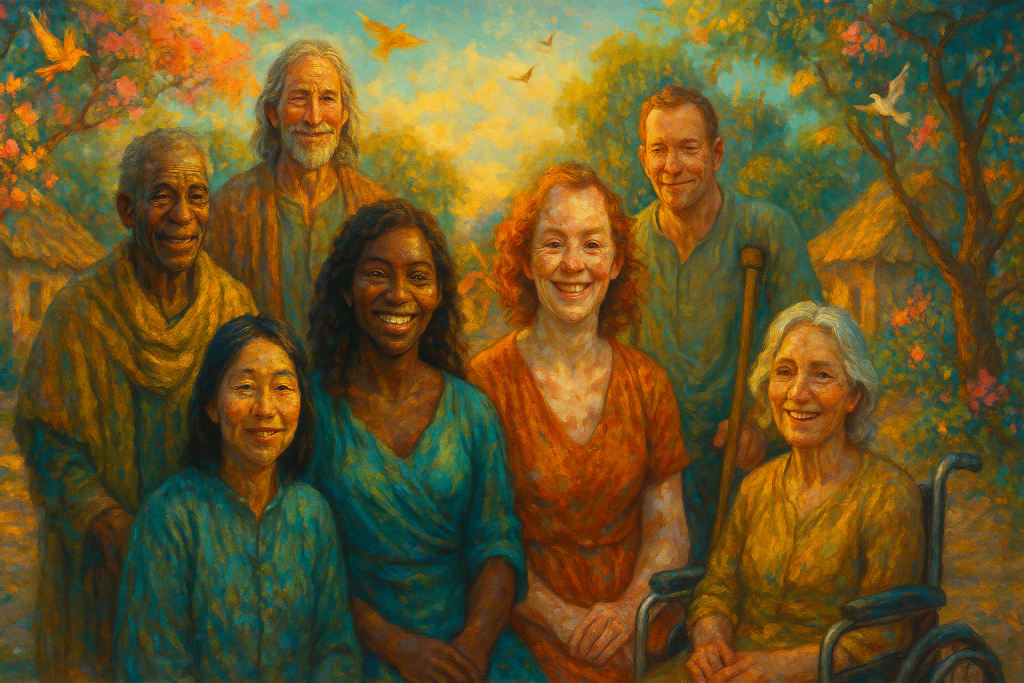
In a forgotten corner of the earth, hidden behind mountains that kissed the heavens and valleys that held ancient whispers, there existed a village known only as Aloria. It was not found on any map, for Aloria was not made of land but of a spirit—an idea that floated beyond borders. The villagers were artists, but not of brush and canvas. They painted with their hearts.
Every soul in Aloria was different—some had skin like night, smooth and deep; others, like moonlight poured into milk. Some eyes sparkled like desert stars, and others held the melancholy of winter oceans. But none cared to measure beauty, for in Aloria, beauty was not a competition—it was a celebration.
One day, a traveler arrived. His name was Vanith, and he came from the city beyond the hills where advertisements hung like fog, and beauty was bottled, priced, and sold on magazine covers. He wore a suit too tight for dancing and shoes too stiff for kindness. His eyes were mirrors, reflecting not the soul but the surface.
“Who is the most beautiful in this land?” he asked.
The villagers laughed, not mockingly, but tenderly.
“The most beautiful?” echoed old Mira, whose wrinkles folded into stories. “That depends on what you call beauty. Is it skin that glows or hands that heal? A smile of symmetry or a soul that sings?”
Vanith was puzzled. He opened his suitcase filled with creams, filters, and artificial lashes.
“I have brought the elixirs of beauty!” he declared. “I shall make you all perfect.”
A child named Noor stepped forward. Her skin was the color of burnt sienna, her hair a chaotic crown of curls, and her laughter bubbled like a hidden spring.
“Perfect?” she giggled. “But we’re already art.”
And it was true.
An old man named Eli, dark as the soil that fed the fields, rose from his wooden chair. He carried stories in his gait, and his back was bent by blessings.
“Beauty, son,” he said, “is not symmetry, nor the tone of skin. It is kindness wrapped in flesh. It is the courage to give when your hands are empty. It is truth whispered in a world screaming with lies.”
Vanith frowned. “But how does that sell?”
And therein lay the satire.
The villagers decided to show Vanith the truth, not by argument, but by experience. They gave him no mirrors. Instead, they offered him time.
Days passed. He saw a woman named Ada, fair as snow but with scars on her arms like lightning bolts. “Each scar,” she said, “is a story of survival, and every survivor is beautiful.”
He met Zubaida, whose hijab wrapped her like a petal, and whose eyes spoke with galaxies. “My beauty is not what I show,” she smiled. “It’s the light I protect.”
He met Malik, tall and radiant, whose skin shone like bronze under the sun. Malik’s laughter healed silence. “I was told once,” he said, “that I was too dark to shine. So I became a sun.”
He met Hana, born with one leg, who danced with crutches like they were wings. “I don’t need two feet to be a masterpiece,” she said. “I just need a reason to move.”
Each soul he met chipped away at the glittered mask he wore. In time, Vanith began to forget the language of products and learn the poetry of presence. He looked into eyes, not screens. He listened to hearts, not trends. He felt a blooming where there had once been cement.
But one night, he cried. Under the banyan tree, he wept for all the years he’d chased false gods—of shapes, shades, and sizes—and for all the people he had taught to hate their own reflections.
Mira found him there.
“Truth hurts before it heals,” she said.
He looked up. “Why do we hide this beauty? Why is the world obsessed with masks?”
She touched his chest. “Because we have forgotten the mirror within. We rely on glass, not grace.”
And in that moment, Vanith remembered.
He remembered the boy in the city who was mocked for his vitiligo. The girl who bleached her skin to fit in. The young man who hated his nose. The old woman who erased her lines with knives. All victims of a myth—a monstrous lie that whispered: You are not enough.
That lie, Mira said, was sold in billion-dollar bottles. It was whispered in ads, enforced in films, glorified in galleries, and even preached in some pulpits. The lie made kings out of skin tones, tyrants out of trends.
“But truth,” said Eli, who joined them, “truth makes equals out of differences. It turns strangers into siblings.”
And truth, it seemed, was the original form of beauty.
For beauty was not pale or dark, slim or full, short or tall. It was not filtered or framed. Beauty was how a person made another feel—how they brought warmth to a room, comfort to a wound, hope to a heart.
Beauty was empathy that dressed as a smile, strength that hid behind kindness, courage that spoke softly.
It was a mother’s touch, a father’s sacrifice, a sibling’s loyalty. It was in silent prayers and loud laughter. It was in planting trees one would never sit under. It was in apologies and forgiveness, in meals shared with strangers, in tears wiped from a stranger’s face.
Vanith stayed in Aloria, not because he had to, but because he wanted to remember.
He opened a school—not of style but of spirit. Children of every hue learned together. They studied stories of people who turned pain into poems, flaws into flames, and wounds into wisdom.
On the walls, they painted their hands with colors and wrote above:
“WE ARE THE ART, AND THE ARTIST.”
Back in the city, rumors began to spread.
They said a village existed where the mirror did not judge. Where children did not know shame. Where no one asked “Fair or dark?” but “Kind or cruel?”
Some called it a myth. Others mocked it. But those who went in search often came back changed.
One such traveler, a woman named Ava, returned with tears in her eyes and said:
“I saw a child who had no legs but could outrun the sadness in my soul.”
And another said:
“I met a man whose skin was night itself, but he carried the sun in his heart.”
And yet another:
“I met a woman whose face had been burned in youth, but when she spoke, the flowers turned to face her.”
The stories grew, as all true stories do, for truth is a seed, and beauty is the rain that makes it bloom.
As years passed, the world began to shift—not overnight, but slowly. The advertisements changed. The magazines softened. Schools began to teach kindness as a curriculum. Filters were replaced by feelings. And slowly, the masks began to fall.
The beauty industry became the human industry. It learned to sell not insecurity, but celebration. Campaigns featured scars, stretch marks, wrinkles, wheelchairs, and wonder. Beauty salons became places of affirmation, not alteration.
And the children of Aloria grew up and traveled far and wide, each carrying a mirror not made of glass but of grace. Wherever they went, they told others:
“You are a masterpiece, not because of how you look, but because of how you love.”
And the world began to reflect that truth.
No longer did people whisper “She’s too dark” or “He’s too short”—they said, “He’s so generous,” “She’s so strong,” “They make people feel safe.”
And in this new world, beauty was no longer something to chase—it was something to share.
So, dear reader, if you find yourself staring into a mirror that tells you you’re not enough—break it. Not with fists, but with faith. Replace it with a mirror made of memory—the smiles you’ve sparked, the lives you’ve touched, the hearts you’ve healed.
And remember Aloria, where beauty was not a mold, but a mosaic.
Because black, white, dark, scarred, bent, bruised, broken, vibrant, wrinkled, crooked, large, lean—
It was all beautiful.
And the only ugliness that remained?
Was the lie that said otherwise.
About the Creator
Muhammad Abdullah
Crafting stories that ignite minds, stir souls, and challenge the ordinary. From timeless morals to chilling horror—every word has a purpose. Follow for tales that stay with you long after the last line.
Keep reading
More stories from Muhammad Abdullah and writers in Humans and other communities.
The Bloomed Years: A Nature of Me
I was once a boy who didn’t know he loved nature—until it whispered to him in silence. I grew up in a small village where the morning came not with alarms, but with the chatter of sparrows and the hush of golden winds. Eighteen years passed in that Eden, and yet I did not count them. They moved through me like rivers: without resistance, without questions. I didn't know I was blooming. I only knew I was alive.
By Muhammad Abdullah7 months ago in Humans
The Process of Strategic Planning: A Step-by-Step Guide That Actually Works
Strategic planning isn’t just a corporate buzzword—it’s the backbone of long-term success for any business, startup, or even personal brand. Without a clear strategy, you’re not moving forward; you’re just staying busy.
By M Yawer Yousaf5 days ago in Humans
Center Stage with Paul Stewart
*** I'm keen to republish the interviews I did for my series with Vocal creators. It's been a few years and I thought it might be nice to revisit these wonderful conversations. I'll be releasing them one at a time for a few weeks/months.
By Heather Hublerabout 2 hours ago in Interview



Comments
There are no comments for this story
Be the first to respond and start the conversation.