
The MEANING OF LIFE & Finding Wisdom Through MEDITATION
"Unlocking the Essence: Discovering Life's Meaning and Cultivating Wisdom through Meditation"
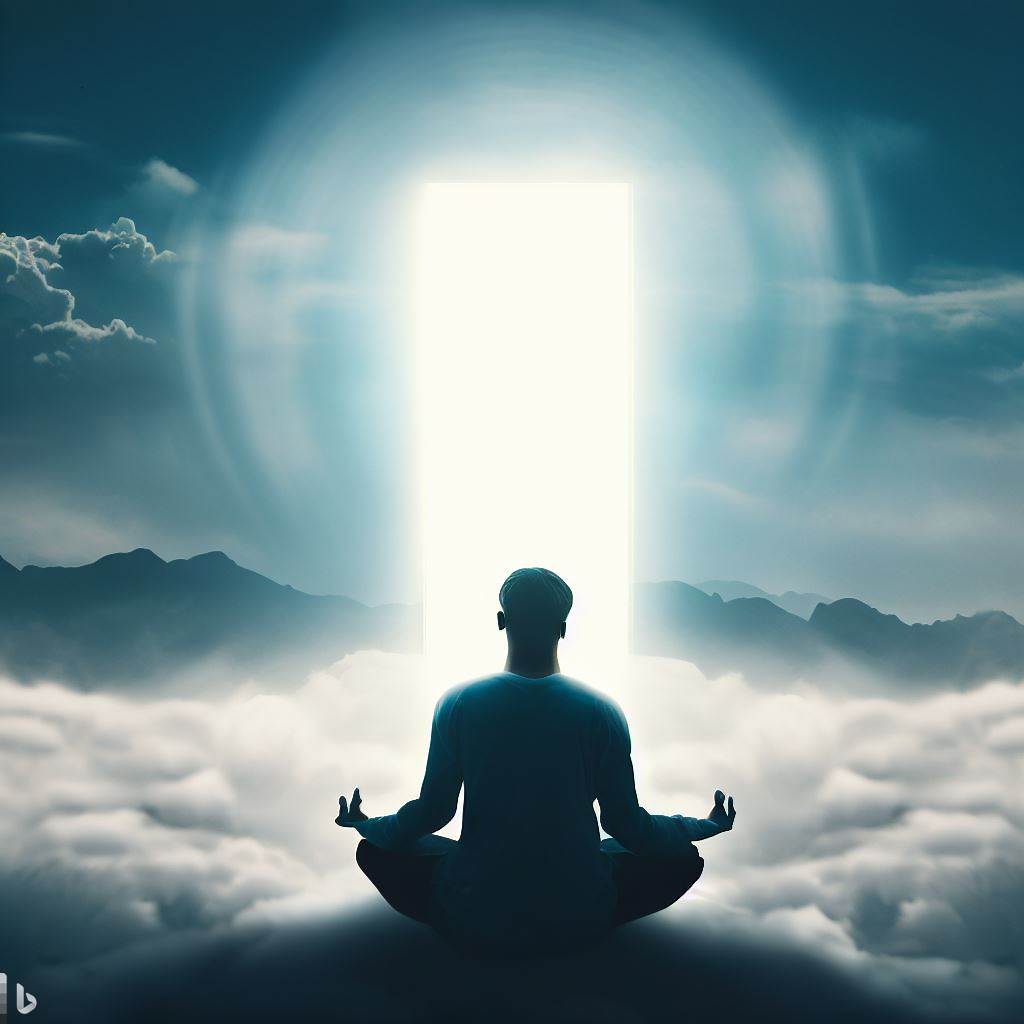
Tension Between Being and Becoming
There is a tension between being and becoming. On some level, being isn't enough because life is an unending series of problems to be solved. We all know that we're going to die, so we have to find some mode of being at peace with impermanence.
Being vs. Becoming
The tension between being and becoming is a constant in our lives. The spiritual domain focuses on the being part, which means finding fulfillment in the present moment amidst the flux of life. It's about recognizing a type of fulfillment that isn't predicated on the next good thing happening. However, becoming is also an important part of our lives. It involves subsuming our ethical lives and doing what is good, positive, and prosocial. Becoming is about making the world a better place and raising our kids to be wise, honest, and content.
The Peace Part
The peace part comes when you recognize that your happiness is not predicated on achieving any of your goals. You have to learn to love the process and recognize the goals themselves as valid. The experience of achieving them is brief and has a mirage-like quality where it recedes. To be at peace with impermanence, the contemplative life comes in.
Defining Spirituality and Religion
Spirituality is a word that is used with scare quotes because people have associations with it that are not helpful. A 21st-century conversation about human wisdom and human happiness is needed. We have a common inheritance of wisdom and insight, and we can use whatever works. The religion piece cannot be dogmatically attached to a specific religion as though it were the one true way of seeing everything. Spirituality names an approach to well-being that isn't predicated on seeking happiness but paying attention to the present moment so as not to suffer unnecessarily.
hey explain that consciousness has qualities that are peaceful and free of problems, but we fail to recognize this due to our identification with our thoughts. The speaker also talks about the need for a modern version of spirituality that can provide structure and guidance in a world where organized religion has its pitfalls. While some spiritual beliefs can be superstitious, there are important spiritual claims that are supported by science, such as the illusion of separateness and the possibility of unconditional love. The speaker acknowledges that there is a lot of bogus information in the spiritual section of bookstores, but we must become wiser curators of human conversation to find what is truly valid. They also discuss the challenges we face in navigating ethical and moral choices in a world where technology is advancing rapidly. We are faced with the question of whether we should modify our own genomes and are struggling to have conversations about basic facts due to the prevalence of misinformation on social media. Overall, the speaker emphasizes the need for contemplation and mindfulness in making choices that will shape our future.
The challenge of getting 8 billion strangers to cooperate peacefully requires massive coordination. Human conversation plays a crucial role in navigating this shifting landscape. However, our legacy thought structures are not well-suited to this task. Being a fundamentalist Christian, Buddhist, or Hindu is not the best operating system for the mind when facing new opportunities and challenges. Instead, we need to be more eclectic, nonsectarian, and open to the best evidence and arguments.
We need to be persuadable, open to better arguments and new evidence, while also being skeptical and conservative when revising our map of the world. We should be cautious when tearing down institutions and norms that have worked for centuries since they have proved themselves over generations. Ultimately, we want a modern wisdom tradition to be the common property of a nonsectarian, nonparochial, and nonprovincial humanity.
Technology inherits the same manipulative and exploitative tendencies as humans since it is created by humans. Therefore, the waking up part of meditation practice emphasizes self-reflective contemplation and purification of negative elements that cloud our ability to be present. The mature approach to meditation practice recognizes that consciousness is ever-present and fundamental to any experience, regardless of current contents. In the first moment of recognizing consciousness without a center, there is already no ego in the middle of it, and it does not get emptier of self than that.
Witnessing one's emotions and thoughts can lead to a sense of freedom and detachment from them. Even negative emotions like anger can be recognized as mere physical sensations rather than something to identify with. Mindfulness can help in achieving this dualistic awareness, allowing one to break free from the negative emotions and their associated thoughts.
While it is not necessary to eliminate all negative emotions, being able to unhook from them quickly can lead to psychological health and wise decision-making. Outrage can be a useful emotion in response to injustice, but it should not tip over into personal psychological suffering that hinders one's capacity to do something useful.
The process involves recognizing the emotion and then questioning its usefulness in solving the problem or situation. Practicing skepticism towards one's own emotions and thoughts can help in achieving detachment and freedom.
Emotional Hijacking and Outrage
The concept of emotional hijacking involves understanding that one's response to a situation is not necessarily a personal reaction but rather a compassionate engagement with the world. Outrage may feel like anger, but it is not necessarily an expression of one's greed and narcissism. It may have the character of contraction, but it can also be necessary in certain situations. For instance, defending oneself against an aggressor requires energy, and the energy that would allow one to violently defend oneself should be available.
However, outrage is not necessarily hatred. Even when defending oneself against a malicious psychopath who wants to harm one's family, one may feel fear and hatred towards the attacker. But if the attacker is a wild animal, one may not feel hatred towards it. Therefore, we can view people on some level as equivalent to forces of nature and have a similar relationship with them.
The Role of Luck in Our Lives
When looking at the differences in life outcomes, we are looking at differences in luck. Luck plays a massive role in our lives, and we must acknowledge it. We should want to cancel the most egregious differences in good and bad luck between people. As a global civilization, we should engineer a tide that raises the boats upon which most or all rise.
While capitalism may not be wrong, we need to recognize that many of us are in the top 10 or even one percent of humanity with respect to luck. We have a responsibility and opportunity to spread the luck around and create love for others.
The Importance of Doing Good Reliably and Systematically
The decision to do good in the world is often driven by emotions and personal feelings rather than rational analysis. However, to make a real impact, it's important to prioritize effective charities and causes that will make the most difference, regardless of personal attachment. One way to ensure reliable and systematic giving is to allocate a minimum of 10% of profits and pre-tax income to these causes each year. This commitment helps to overcome the moral bug in our operating system, where we are more likely to care about single, identifiable protagonists than larger and more systemic problems.
The Human Loop in Systemic Issues
While systems and institutions play a role in perpetuating problems like child labor and pollution, ultimately, individuals are responsible for making decisions and leading change. Taxation on carbon, for example, could disincentivize pollution and motivate individuals to find solutions. However, even with tight systems, people will always try to find loopholes to benefit themselves. It's important to address both the human loop in systemic issues and prioritize effective actions to make a difference
In conclusion, meditation leads us to discover the meaning of life and cultivate wisdom. Through introspection and mindfulness, we tap into our inner wisdom, find joy in the present, and navigate life's challenges with grace. Meditation connects us to ourselves, others, and the world, fostering compassion and positive change. Embrace meditation as a lifelong journey of self-discovery and enlightenment.
About the Creator
Keep reading
More stories from shrenik puj and writers in Humans and other communities.
Unveiling the Best-Kept Secrets: Top Strategies for Unlocking Success
Introduction: In the journey towards success, there are often hidden gems that can propel us to new heights. These hidden gems are the best-kept secrets that only a select few seem to know. They are the elusive strategies, mindset shifts, and habits that can make all the difference in achieving remarkable success. But fret not, because in this blog post, we will be unveiling these secrets and sharing the top strategies for unlocking success. Get ready to embark on a transformative journey that will change the way you approach your goals and aspirations.
By shrenik puj3 years ago in Education
Time to change your life.
Is it even possible for you to change your life? A lot of people, more than there should be, are unhappy with their lives. But what are they doing about it? Usually nothing. People talk about how shitty their lives are and want change, but are they not taking the actions to change?
By Jen Phillips4 days ago in Humans
When Seeking Comes Home
Most of us begin the spiritual journey believing we are headed somewhere. We imagine a distant horizon where peace waits for us, a place we will finally reach once we have learned enough, healed enough, surrendered enough. We picture nirvana as a destination, a state of perfection that lies far beyond the life we are living now. It feels like something we must earn, something we must chase, something we must become worthy of.
By Julie O'Hara - Author, Poet and Spiritual Warrior3 days ago in Humans
Killing him slowly
There’s an intruder in my house again. He stumbles through the door, wet carrier bags in hand. He’s bought me offerings. I show my appreciation, letting him caress my beautiful body. He wants to touch me. I rub myself against his legs. He sighs, dropping the bags. He can’t resist touching me. Running his hand slowly down my spine, I arch my back towards his caress, let out a low purr. It’s what we both need.
By N J Delmas7 days ago in Horror




Comments
There are no comments for this story
Be the first to respond and start the conversation.