
The Man Who Collected People
The Epstein Archive

Inside the 3-million-page archive of Jeffrey Epstein, and what it says about the power we refuse to name.
There is a photograph in the federal archives that does not make headlines. It shows a white ceramic bust sitting on a mahogany desk—19th-century phrenology equipment, the kind pseudoscientists once used to measure skulls and rank human worth. The FBI found it in Epstein's Manhattan townhouse, positioned like a paperweight, casual among contracts and invitations.
That bust is the key to understanding everything else.
The Collector
Most criminals hide. Epstein curated.
The documents released in January 2026—over three million pages—reveal a life organized around collection. Stuffed tigers and taxidermied dogs as interior decor. Hand-painted zodiac ceilings in a Caribbean "temple" with mattresses wrapped in yellowing plastic. A birthday book signed by the world's most powerful men, each message more fawning than the last.
He collected scientists, offering Harvard donations and Transhumanist visions of seeding humanity with his DNA. He collected presidents, ferrying them across oceans on a plane that flew nowhere randomly. He collected girls, yes, but more precisely: he collected the silence that followed them.
The archive is not merely a record of crimes. It is a catalogue of a man who believed ownership was a philosophy.
The Architecture of Looking Away
The most disturbing pages are not the lurid ones. They are the bureaucratic.
In 2005, FBI field agents in Palm Beach flagged "concerning activity" involving "multiple minor females." The memo traveled upward and vanished. In 2006, federal attorneys began drafting charges. Then stopped. The 2008 "non-prosecution agreement"—56 pages of procedural surrender—reads less like justice than corporate restructuring: liabilities limited, operations stabilized, trust preserved.
The files show Epstein's legal team meeting with prosecutors at unusual hours, in restaurants rather than offices. They show victims receiving phone calls warning them about "aggressive" reporters before journalists had even located their addresses. They show a system that did not fail, exactly. It calculated.
Every institution that touched this case—Justice Department, Palm Beach police, Harvard's development office, the FAA that approved flight plans—made the same calculation. The cost of belief exceeded the cost of looking away.
The Geography of Escape
Epstein's flight logs read like modern poetry about impunity. New York to Paris. Paris to the U.S. Virgin Islands. The islands to a New Mexico ranch surrounded by desert and silence. Each landing reset jurisdiction, fragmented investigation, scattered witness memories across time zones.
Little St. James, his private island, appears in the documents as both location and metaphor. Workers interviewed by FBI described a compound designed for vertical surveillance: the main residence positioned to observe the dock, the "temple" structure visible from the water but accessible only through controlled paths, underground utilities suggesting tunnels never fully mapped. The architecture itself was an instrument of control.
The temple's interior—revealed in photographs the public was never meant to see—combines mysticism and neglect. Hand-painted stars on domed ceilings. Wooden bookshelves standing empty. A door covered in unfinished plywood, suggesting construction halted or purpose abandoned. The documents do not explain what rituals occurred there. They do not need to. The space explains itself.
The Women in the Margins
Ghislaine Maxwell appears throughout the archive not as accomplice but as infrastructure. Photographs show her arranging travel, supervising staff, placing Epstein's bare foot inside her bra on a private jet with the casual intimacy of long practice. She was, the documents suggest, both curator and curator—selecting objects for the collection, maintaining its conditions.
Other women appear as shadows. Names redacted then accidentally exposed when the Justice Department's redaction software failed, allowing anyone to copy, paste, and reveal the hidden text. The bureaucratic error is almost poetic: a system designed to protect victims instead exposed them, one more institutional failure in a cascade.
The files contain "CSAM NOT SCANNED" stamps on thousands of digital evidence entries—Child Sexual Abuse Material, queued for analysis, backlogged indefinitely. The waiting itself became policy.
The Men Who Signed
The birthday book haunts the archive. Leather-bound, carefully preserved, it contains personal messages from men who knew exactly who they were addressing.
Michael Jackson, photographed with Epstein at a Rolling Stones concert, contributed a signature. David Copperfield, the illusionist, wrote something now faded. Elon Musk appears in correspondence about "scientific collaboration." Woody Allen, whose own controversies echo through the decades, added his well-wishes.
These are not smoking guns. They are something more insidious: normalization. The book transforms a predator into a philanthropist, a criminal into a celebrated eccentric. Each signature represents a decision to participate in the fiction.
The flight logs confirm the social pattern. Presidents, princes, Nobel laureates, Wall Street titans—they traveled, they visited, they accepted hospitality. The documents cannot prove what they witnessed. They prove only what they chose not to investigate.
The Ghosts in the Diagram
Near the archive's end, FBI investigators created a flowchart of Epstein's "inner circle." Five figures appear as silhouettes—photographs blacked out, names replaced with case numbers. The surrounding names are public: lawyers, accountants, procurers. These five remain protected by classified designations, their identities preserved by national security claims that expire, the documents note, in 2036.
Who warrants such protection? The archive does not say. It suggests only that some relationships remain too sensitive to expose, even now, even after death.
Reading the Silence
Three months after the document dump, the servers still crash periodically under traffic. Investigative journalists mine the files for fresh headlines. Documentary teams compete for victim interviews. The story persists, profitable and endless.
But the archive's true revelation lies in what requires no reading between lines. The 13-month sentence. The resumed operations within weeks of release. The 17 years between first reports and final arrest. The evidence was never truly hidden. It was simply deemed, by successive prosecutors and institutions, insufficiently important to pursue.
The phrenology bust on the desk—the instrument that measures human skulls to determine worth—was not a joke or affectation. It was ideology made ceramic. Some humans, the object proclaims, are collections. Others are collectors. The system Epstein built merely operationalized what the bust represented: that value is arbitrary, assigned by power, enforced by silence.
The files are public now. The silence continues.
About this piece:
Analysis based on Department of Justice releases (2024-2026), FBI Vault collections, and federal court records from the Southern District of New York. Some details reflect ongoing litigation and unsealed testimonies.
#TrueCrime #InvestigativeJournalism #Power #Corruption #SocialJustice #EpsteinFiles
About the Creator
sondos azhari
Passionate about health and beauty products, I delve into wellness practices and skincare routines. With a focus on holistic living.My aim is to empower others to prioritize self-care and make informed choices for their well-being.
Keep reading
More stories from sondos azhari and writers in Humans and other communities.
Why Can’t We Predict the Future, Despite All Our Technology?
How is it possible that we are still unable to predict the future in a world where satellites can scan every part of the planet, artificial intelligence can compose poetry, and supercomputers can simulate the formation of galaxies?
By sondos azhari7 months ago in Humans
Time to change your life.
Is it even possible for you to change your life? A lot of people, more than there should be, are unhappy with their lives. But what are they doing about it? Usually nothing. People talk about how shitty their lives are and want change, but are they not taking the actions to change?
By Jen Phillips4 days ago in Humans
Beige with approved phrases
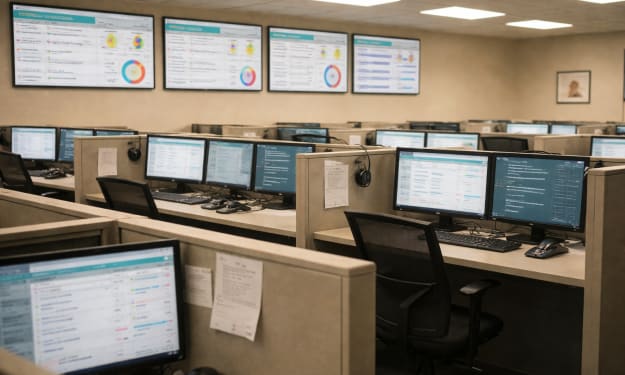
The call center is painted in optimistic colors. Not bright enough to be cheerful, not soft enough to be calm. The walls are a kind of beige that suggests coffee with too much creamer. Someone chose it after a meeting, after a vote, after a PowerPoint about productivity and mood. The color is meant to make people steady. The color is meant to make people stay.
By shallon gregerson7 days ago in Humans
Off the Book
It ended like every other stupid idea. Badly, and alone. I’m researching digital confession ethics, he said. A tech ethicist. He gestured at floating data I couldn’t see then pulled out a physical notebook. Actual paper, fountain pen. He held it up like he was showing me scripture.
By Nicky Frankly6 days ago in Fiction



Comments
There are no comments for this story
Be the first to respond and start the conversation.