
Beige with approved phrases
Will the colors make her stay?

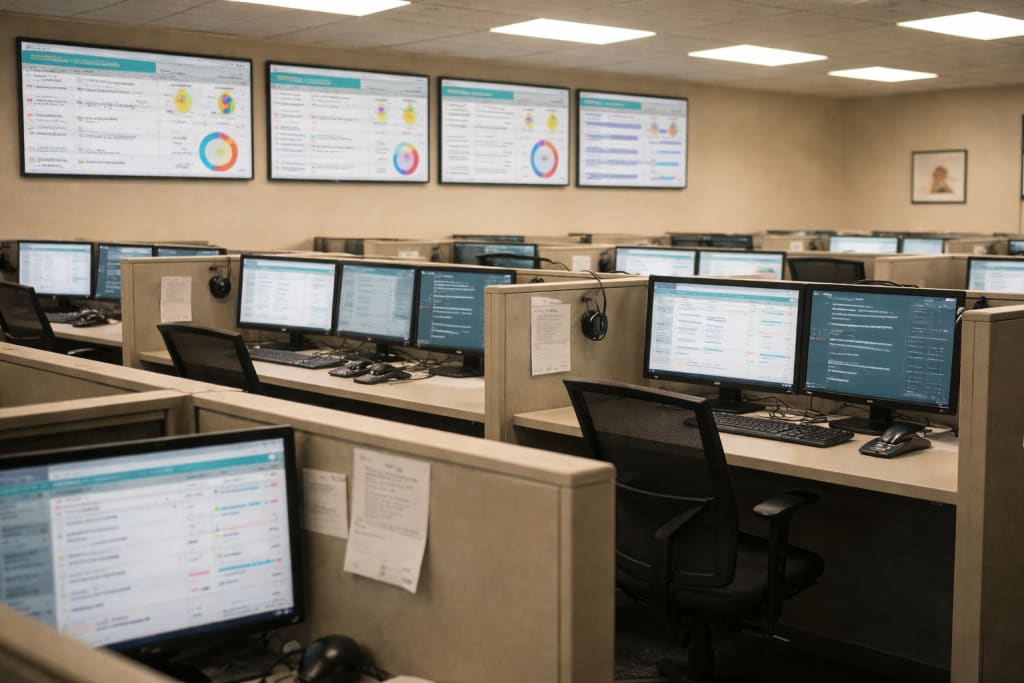
The call center is painted in optimistic colors.
Not bright enough to be cheerful, not soft enough to be calm. The walls are a kind of beige that suggests coffee with too much creamer. Someone chose it after a meeting, after a vote, after a PowerPoint about productivity and mood. The color is meant to make people steady. The color is meant to make people stay.
Every desk is identical: headset, dual monitors, a laminated card with approved phrases. The phrases are promises in corporate dialect.
I understand your concern.
Let me look into that for you.
I appreciate your patience.
Patience is the currency here. The callers spend it. The workers manufacture it.
Lina logs in at 8:59 a.m., one minute early. The system rewards punctuality with a green checkmark next to her name. A small celebration, invisible to anyone except the software. Her performance metrics bloom open on the screen like a second nervous system: average call time, customer satisfaction, escalation rate. Each number pulses gently, alive with consequence.
The first call arrives before she finishes adjusting her chair.
A man is angry about a billing error. His voice is tight, already sharpened by the expectation of a fight. Lina apologizes, following the script. She can feel the phrases sliding into place like pre-cut tiles. They fit the shape of any complaint. That is their design. The script is a universal solvent; it dissolves individuality on contact.
“I’ve been transferred three times,” the man says. “Are you even listening?”
“I understand your frustration,” Lina replies.
The system listens more closely than she does. It measures silence. It measures overlap. If she speaks too soon, her score drops. If she leaves too long a gap, her score drops. The ideal conversation is a choreography of milliseconds, a dance judged by an algorithm that has never heard a human voice except as data.
The man begins to cry without warning. The sound breaks out of him mid-sentence. Lina freezes. There is no laminated phrase for this.
Her eyes flick to the supervisor dashboard mounted above the floor. A screen of names, all color-coded. Green for good performance. Yellow for warning. Red for intervention. She imagines her name flickering, a small wound of color.
“I just—” the man says. “I can’t keep doing this. Every month it’s something. I’m tired.”
Lina looks at the script. She looks at the metrics. She looks at the timer counting the seconds of this call.
She says, quietly, “That sounds exhausting.”
The system marks the deviation.
A small notification appears: Unapproved language detected.
The call ends with the problem unresolved. It was never going to be resolved. Lina documents the interaction using dropdown menus that reduce the man’s voice to categories: billing dispute, emotional distress, no resolution. She clicks submit. The record enters the archive, where it will live forever as a neat row in a spreadsheet.
At lunch, the break room smells like microwaved leftovers and resignation. Posters line the walls: smiling employees pointing at slogans about teamwork. The smiles are too wide. They are the smiles of people who have been told to demonstrate morale.
Her coworker Malik sits across from her, scrolling through his phone. “I got flagged again,” he says without looking up.
“For what?”
“Empathy overuse.”
Lina laughs, then stops when she sees he’s serious.
“They said I’m extending calls by validating feelings too much,” he continues. “We’re supposed to acknowledge, redirect, resolve. Not… linger.”
“Feelings are inefficient,” Lina says.
He finally looks at her. “You joke, but that’s literally what the supervisor told me.”
The system is built on the assumption that problems are linear. Input complaint, output solution. Any excess is treated as waste. But the callers bring their lives with them. They bring fear, grief, loneliness disguised as anger. The system has no fields for these. There is nowhere to log the weight of a voice that hasn’t been heard all day.
After lunch, Lina’s screen flashes with a coaching request. She walks to the glass office where her supervisor, Dana, sits surrounded by charts. Dana smiles the way the posters smile.
“You’re doing well overall,” Dana says. “But we’ve noticed some… creative phrasing.”
Lina nods. The beige walls lean closer.
“The script exists for a reason,” Dana continues. “It ensures consistency. Customers trust consistency.”
“I know,” Lina says. “Sometimes they just… need something else.”
Dana tilts her head, sympathetic but immovable. “Our job isn’t to be therapists. It’s to resolve issues efficiently.”
The word efficiently lands like a period. The conversation is over before Lina stands up.
Back at her desk, she logs in again. The next caller is an elderly woman who cannot understand her online statement. Lina walks her through it step by step. The woman apologizes repeatedly for being slow. Lina tells her there’s nothing to apologize for. The system flags another deviation.
The woman says, at the end, “You’ve been very kind.”
Kind is not a metric. Kind does not appear on the dashboard. Lina watches her satisfaction score tick upward anyway. A coincidence, or a small rebellion in the data.
The day continues in increments of voices. Each one arrives compressed into a problem statement, each one leaves as a record. Lina feels herself flattening to match the interface. Her tone becomes smoother, her pauses more calculated. She is learning the shape the system prefers.
At 5:00 p.m., she logs out. The green checkmark fades. Her performance freezes in time until tomorrow. She removes the headset and her ears ring with phantom voices.
Outside, the city is loud and irregular. People talk over one another. They stop mid-sentence. They hesitate. No one is scored for it. The air feels unscripted.
On the bus ride home, Lina thinks about the man who cried, the woman who apologized for being slow, Malik’s empathy warnings. The system did not invent their problems. It did not create their loneliness. But it has a way of sanding down the edges of every interaction until nothing sharp can remain. It promises order. It delivers silence shaped like order.
She imagines the archive of calls expanding endlessly, a cathedral of categorized voices. Each entry neat. Each life compressed into dropdown menus. The system is proud of its clarity. It mistakes clarity for care.
Tomorrow she will return to the beige room and put the headset back on. She will speak in approved phrases and sometimes in forbidden ones. The dashboard will glow above her, patient and exact. The callers will bring their unscripted lives to her desk.
The friction will continue. Not collapse. Not revolution. Just the steady heat of misfit parts turning against each other, generating a warmth no one designed and no one quite knows how to measure.
About the Creator
shallon gregerson
I conspire, create and love making my mind think
Keep reading
More stories from shallon gregerson and writers in Humans and other communities.
Dragon in the Basement
The dragon was chained in the basement of a failing marriage. No one else knew that. To the city inspector, the building was just another condemned brownstone with bad wiring and a mold problem. To the neighbors, it was the place where the couple on the second floor fought at night, their voices leaking through the radiator pipes like steam.
By shallon gregersonabout 3 hours ago in Fiction
Whiskey At Dusk
Guess the whiskey was more important to you in the end, wasn’t it? It was more than the well-being of your friends; more vital than showing up to the places you promised you would and could come to; more critical of a matter than fulfilling your damn responsibilities and getting the press off your back.
By Snarky Lisa5 days ago in Humans
The Boy Who Cried Love
After Terrence ghosted me, it took me awhile to move on. I was well aware that we hadn't been dating, but after three months of 'hanging out' and being intimate, it seemed like we were at the very least, on the road to dating. I couldn't understand how he could just cut me out of his life so callously, how he could live with himself knowing the pain and distress that he was causing me. It wasn't until the following spring that I even started to seriously talk to guys again.
By Gabriel Bradshaw about 17 hours ago in Humans




Comments
There are no comments for this story
Be the first to respond and start the conversation.