
The Light in the Window
Finding Peace Where the Heart Feels at Home

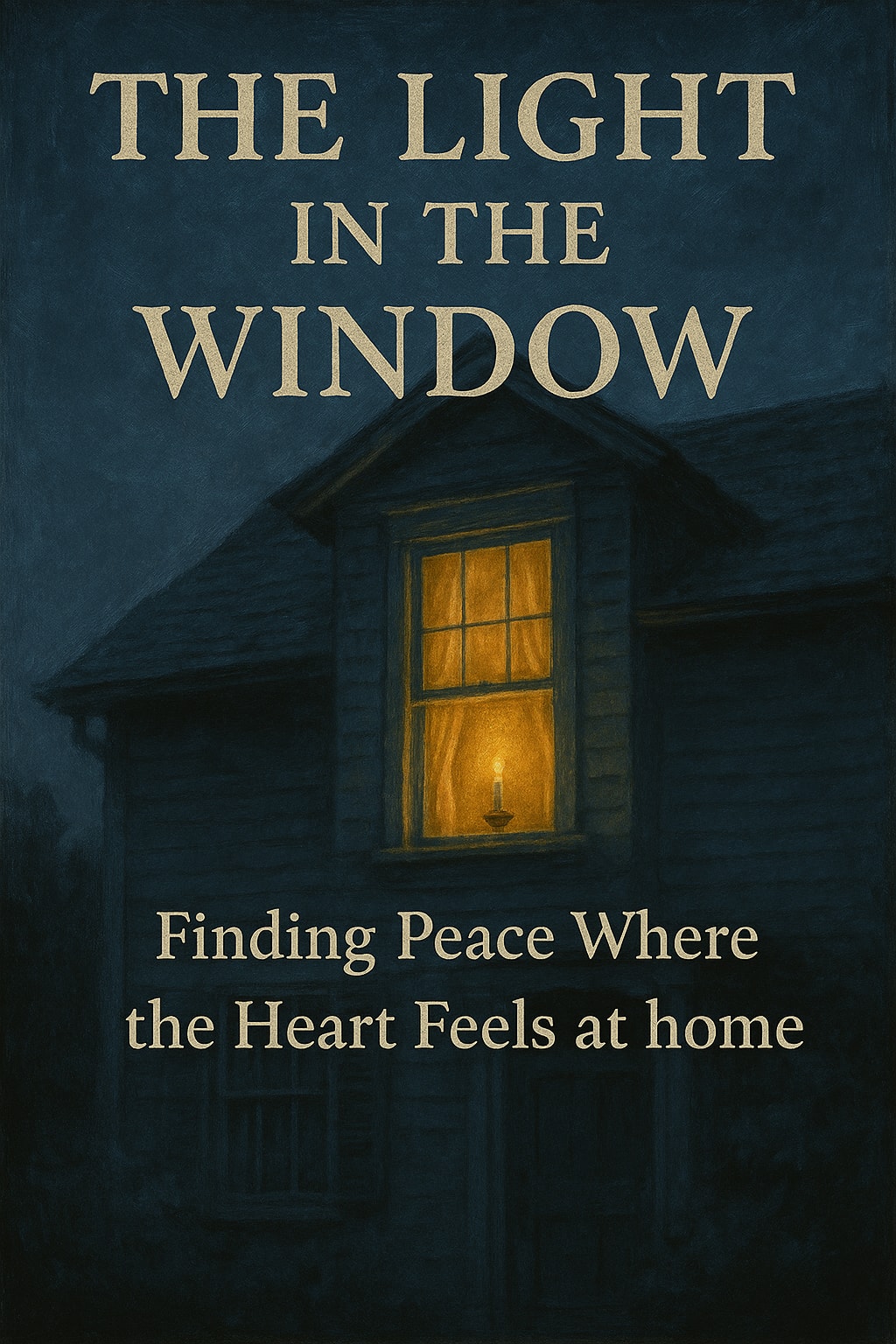
On the very edge of a quiet village—where the fields turned to forest and the sky seemed just a little wider—stood a crooked little house, with ivy-draped walls and a chimney that always let out a ribbon of curling smoke. The windows were a bit foggy in winter, the paint on the door chipped with time, but the house held something special that made people pause.
It was the light in the front window.
Every evening, just as the sky turned purple and the first stars blinked open, the light would glow. Not harsh or cold like a porch lamp, but soft and golden, like candlelight tucked into a memory. It was constant. Gentle. Like the hush of someone saying, “You’re safe now.”
The village kids had stories, of course. Some said the house belonged to a retired sea captain who had battled storms and now watched the world through that window. Others swore it was a kind witch who baked memories into pies. Some even claimed she was a queen in hiding, waiting for a letter that never came.
But the truth was simpler—and, in its own way, more magical.
Her name was Nora. She was a woman in her sixties, with silver in her hair, strong hands, and laugh lines that spoke of both sorrow and joy. Her husband, Theo, had passed away ten years ago. They had bought the house when they were newlyweds, and for thirty years, they’d filled it with music, stories, and quiet mornings.
Theo had believed in keeping a light in the window.
“Someone might be lost,” he used to say, lighting the old oil lamp with a match that always sparked first try. “And if they see the light, they’ll know they’re not alone.”
At first, after his death, Nora lit the lamp every evening out of habit. It felt like keeping a part of him alive. But then came the night when a stranger knocked on her door.
He was a young man, soaked from the rain, shoes muddy, eyes tired.
“I saw the light,” he said quietly. “And I didn’t know where else to go.”
She fed him warm soup, dried his coat by the fire, and gave him a blanket to sleep under. He left before dawn, but not before scribbling a note on a scrap of paper:
"Thank you. I thought I was invisible. But you saw me."
From that night on, the lamp was never just a memory of Theo. It was a beacon—for anyone who needed warmth, quiet, and someone to simply see them.
Over time, people came. Not in crowds, never loudly—but quietly, one at a time. A young woman, backpack slung over her shoulder, who cried into a slice of apple pie and whispered about running away from expectations. A boy who had failed his university exams and felt like a disappointment until Nora taught him how to bake bread and reminded him that success wasn't always a straight road.
They came and went, but the house never felt empty. It echoed with voices, laughter, and sometimes tears. And always, always, the light in the window glowed.
Then one cold December evening, as snowflakes danced outside and Nora wrapped her shawl a little tighter, a knock came at the door. A small girl stood there—maybe ten years old. Her jacket was too thin, her cheeks red from the cold, her shoes soaked through.
Nora looked down with soft eyes. “Would you like to come in?”
The girl nodded.
She didn’t say much that night. Just gave her name—Elsie—and curled up in a big armchair, holding the warm mug of cocoa like it was a treasure. Nora didn’t press her for details. She’d learned, over the years, that silence often spoke volumes.
In the days that followed, Elsie stayed. She helped in the kitchen, listened to Nora’s stories, and sat beside her on the porch watching the snow. Little by little, the girl’s walls began to fall. One night, curled under a quilt, she finally said:
“I ran away. The people I lived with… they never smiled. I didn’t feel real there.”
Nora only nodded, gently brushing a crumb from the girl's cheek. “You’re real here.”
The weeks turned into months, and when spring came, Elsie was still there—planting seeds in the garden, helping sort books in the study, and relighting the lamp each evening.
Eventually, the paperwork followed. Nora officially adopted her. But they both knew that family had happened long before that signature dried.
Years passed. Nora’s hands grew slower, her steps a little more careful. When her arthritis made it hard to strike the match, Elsie took over lighting the lamp. She did it with the same quiet reverence Theo once had, her hand steady, her eyes calm.
And still, the people came.
A soldier with stories too heavy to carry alone. A teenager in the middle of an identity crisis. A woman who had just lost her job and forgot what it felt like to laugh. All drawn to the light. All welcomed with cocoa and conversation and silence when words felt too sharp.
When Nora passed, the whole village came to her little ivy-covered house to say goodbye. Elsie stood by the window that evening and lit the lamp. It burned brighter than ever.
Today, Elsie still lives there. The crooked little house now has a fresh coat of paint, but the warmth remains. The pies still make people cry a little. The porch still creaks under new footsteps. And each night, the light in the window still flickers to life, just as the stars appear.
Because some places aren’t just homes.
They’re promises.
And some lights don’t just guide you back…
They remind you that you were never truly lost.
About the Creator
Keep reading
More stories from Naveed khan and writers in Humans and other communities.
Take Charge of Your Health
In today’s busy, constantly moving world, it’s easy to put our health on the back burner. We juggle work, family, responsibilities, and social obligations — often at the cost of our well-being. But here’s a simple truth: nothing is more valuable than your health. Without it, everything else becomes harder to manage.
By Naveed khan10 months ago in Humans
A Historic Declaration
We the People of the Husbands of the United States of America, in Order to form a more perfect Union, and I mean you...with me...establish Justice, insure domestic Tranquility, provide for the common defence, promote the general Welfare, and secure the Blessings of Liberty to ourselves, after Puberty, do ordain and establish this Declaration of Co-Dependence.
By Gerard DiLeo6 days ago in Humans
Are We Shifting to a 5D Planet? Signs You Are Already Living in Higher Consciousness.
For years, whispers have circulated about a significant shift in human consciousness and a potential ascension to a "5D" reality. While the concept may seem abstract or esoteric, it speaks to a profound transformation occurring both within individuals and collectively as a species. But what exactly does it mean to be shifting to a 5D planet, and how can you recognize if you're already vibrating at a higher frequency?
By Wilson Igbasiabout 11 hours ago in Humans
This Is What I Do When People Throw Rocks At Me
Rocks have been thrown at me for a greater part of my life. Some have been small and missed hitting me. When people don't get a reaction from me, they throw bigger rocks with a better aim. Many have been hurled at me with precision over the years. For a long time, I thought my only options were to dodge them or be crushed by them.
By Margaret Minnicks6 days ago in Confessions



Comments
There are no comments for this story
Be the first to respond and start the conversation.