
The Laws of Learning
None of us are exempt.


Think back to a time in your life when you learned a lesson — a really, really hard one.
For some of us, it was a string of one-night stands that left us feeling only more lonely and tired. Others of us may have fallen victim to a guru scam, shelling out thousands to someone who you were sure had the answer, the magic bullet. Maybe your lesson was ignoring your gut feeling about buying that car from that seller who just felt a bit off, and now you’re saddled with a whip that is costing you more than you bought it for.
Or, you’re someone like me (who has done all of these things), and you really just like to work for those hard lessons.
Whatever your lesson may have been — the partner who cheated (again), the toxic job you stayed in for too long, the friendship that was a total one-way street — we’ve all learned hard lessons. Which brings us to our first Law:
#1: Hard lessons are a part of our contract with life.
Keep in mind, #1 applies to everyone. There are no humans who are exempt from this law. By proxy, this rule also applies to everyone we know: our parents, our siblings, our kids, our partners, our students, strangers — everyone.
Now, for a moment, think back to that really hard lesson you learned. Can you remember anyone trying to warn you against doing that thing?
And if someone did warn you against doing that thing … did you listen? Or did you do the thing anyway?
Now, I’m sure that some readers didn’t need to learn the hard lessons themselves, and learned from someone else, or else heeded the warning that was given to them before having to learn the big, hard lesson.
... but I’m willing to bet that’s not most of us.
Which brings us to Law #2:
#2: You cannot learn someone else’s lessons for them.
Here we are — a bunch of humans who require painful experiences to drive home important lessons — and almost everyone we know operates the same way.
And yet — even though it doesn’t work on us, how many of us still try to warn those that we love, in well-meaning attempts to keep them from having to learn the hard or painful way?
Here’s the problem — the unsolicited warning can pack a bit more of a punch than we realize. There are several messages that tend to be encoded in the unsolicited warnings that we give, messages that often have the exact opposite effect of “helping”:
- I, the giver of the warning, am (wiser / more experienced / less stupid / more mature / smarter / know better) than you
- I, the giver of the warning, do not believe that you are (strong / wise / mature / good enough to deal with the consequences of this action, should you choose to take it
- I, the giver of the warning, do not approve of your idea / decision / thought process
And so often, in that tender moment when we are hearing words of caution that we haven’t asked for, it’s easy to mishear #3 as: “I do not approve of you.” These messages aren’t helpful; they’re disempowering.
Think back to that time someone gave you an unsolicited warning, or advice that you didn’t ask for — how did you feel? Annoyed? Ashamed? Irritated? Patronized? Maybe you felt a sudden distrust of the person, feeling almost violated? How is it that we can make someone feel these things when we’re just trying to protect them?
Let's start by unpacking the word ‘protect’; when is protecting actually appropriate? When does 'protect' show up in our everyday language?
We protect wildlife. We protect our small dogs from larger, more aggressive dogs. We protect forests and natural habitats. To a certain extent, we protect our children.
“Protecting” is appropriate for things that can’t fend for themselves, and as such, are at risk of being physically harmed. Healthy, autonomous adults do not need protecting.
Said differently: You cannot learn a healthy, autonomous adult’s lessons for them. When we try, we run the risk of pushing them away.
Many of us have spent time and energy trying to “save” someone else from having to learn a painful, messy or difficult lesson by giving well-meaning, unsolicited advice. And then we feel outraged, resentful, or frustrated when the person who didn’t ask for our advice doesn’t take the advice they never asked us for.
Which brings us to our final law, Law #3.
#3: Unless they ask for your advice, they probably don’t want it.
Please consider that a certain amount of discernment is appropriate here. For example, it could be argued that a situation that puts anyone in real physical danger (a funny "prank”, driving intoxicated, etc.), might be an appropriate time to be brave and speak up. (Unfortunately, it can be these situations that we feel least inclined to speak up.)
But there’s an important caveat to Law #3, and it applies to all of us:
We all just want to be heard. We want to be seen and witnessed in our struggles and our challenges, and to know that, even in our lowest moments, when we feel uncertain about our own judgement or our own convictions, we are still enough, we are still loved, and we are still worthy of being loved.
So the next time you catch yourself wanting to offer unsolicited advice, try one of these instead:
“That’s an interesting idea. You’ll figure it out!”
or
“Whatever you end up deciding, I know you can do it.”
or
“That sounds tough, but I know you’ve got this.”
Remember, when someone trusts you enough to be vulnerable about that tough situation in their life — the abusive partner, the toxic job, the career change — they’re likely confiding in you because, on some level, they trust you. And if you want them to keep trusting you, it might be worth taking care of that trust. It’s also possible that you don’t care to nourish that trust — whatever the situation is, it’s your business. I can’t tell you what is right or wrong for your situation.
But I can tell you that — even though, sometimes, we wish that we could — we can’t change the Laws of Learning.
. . . . .
About the Creator
Keep reading
More stories from Patti Cobian (she/her) and writers in Humans and other communities.
New Year's Eve: A Progression
January 1st, 2017 (25 years old) I woke up in complete darkness, as per usual. The hum of my mini-fan wasn’t loud enough to drown out the sound of someone’s footsteps thundering down the staircase above me. Groggily, I wondered what time it was, and if I was the last one up.
By Patti Cobian (she/her)4 years ago in Humans
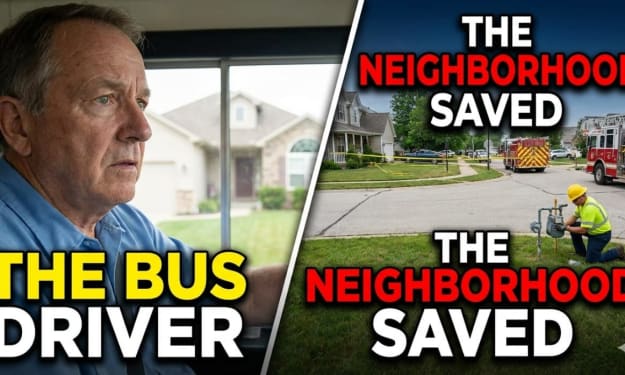
The Guardian of Maple Street: The Bus Driver Who Trusted the Silence
The incredible true story of Harold Jennings, the school bus driver whose attention to detail and refusal to take a day off saved an elderly couple and 27 children from a catastrophic gas explosion.
By Frank Massey 3 days ago in Humans



Comments
There are no comments for this story
Be the first to respond and start the conversation.