

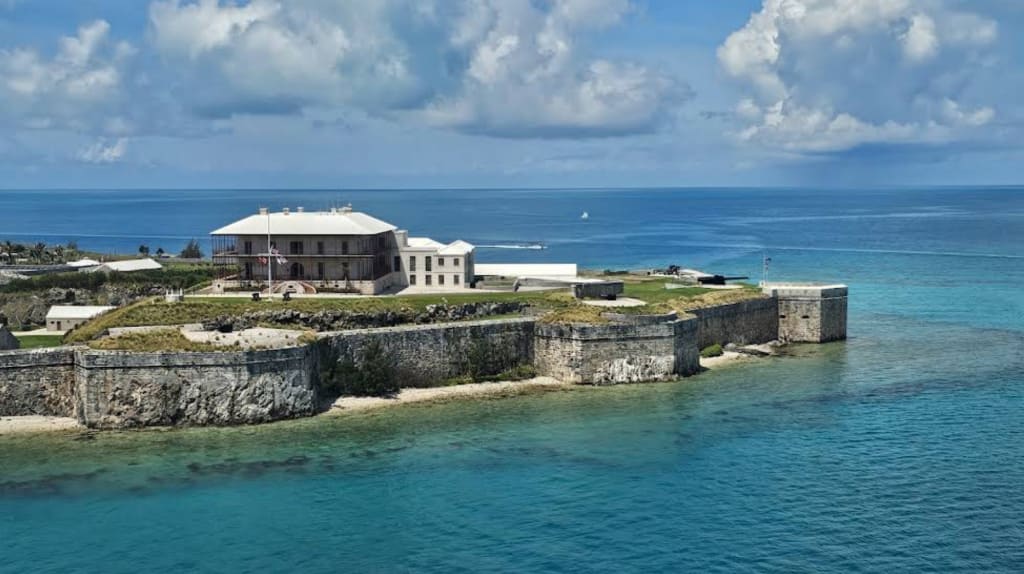
In the shipyards of 1916, the HMS Valerian first touched water with a gleaming hull and a purpose shaped by war. She was no battleship, no mighty dreadnought, but a small, sturdy Arabis-class sloop built for the endless, unsung work of the Royal Navy: escort duty, minesweeping, protecting convoys from the silent menace of submarines.
By the mid-1920s, the Great War was over, but the Valerian still sailed beneath the white ensign of empire. She patrolled warm Caribbean waters now, far from the North Sea’s gray chill, her decks busy with more than a hundred officers and sailors. Among them was a young Irishman from Buncrana, my great grandfather Jack Barnes.
Jack had left behind his wife and three small daughters, the youngest barely six months old. My great-granny remembered him as steady and kind, a man who carried the sea in his veins. When he kissed his young children goodbye, neither of them could have known it was to be a farewell.
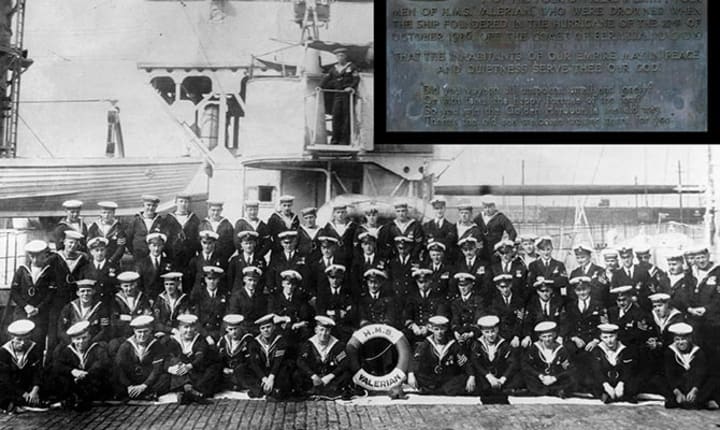
In October 1926, the Valerian lay in Bermuda, uneasy under the threat of a growing storm. Word came of a hurricane sweeping northward, fast and fierce. The captain weighed his choices: anchor in harbor and risk being smashed against the docks, or take the ship to sea and face the storm in open water. As sailors had done for centuries, he chose the sea.
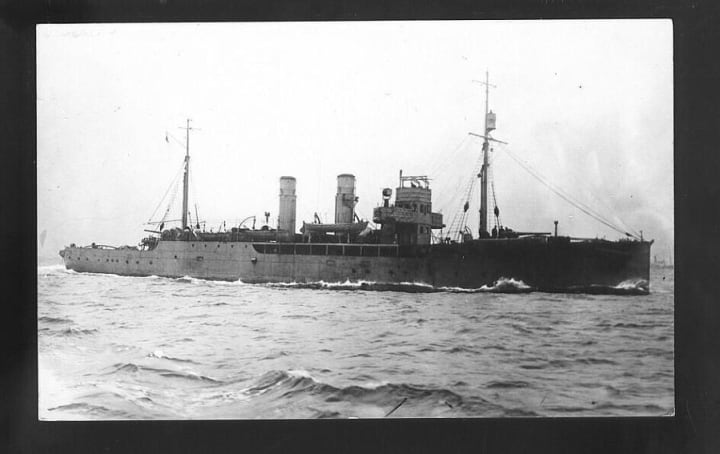
The Valerian steamed out bravely, her engines straining, her crew at the ready. By midday on October 22, the hurricane struck. Winds screamed over a hundred miles an hour. Rain and salt whipped the men until they were raw. Waves rose like mountains and crashed down like a battering ram. The little sloop fought, her bow punching through the seas again and again, but the storm was merciless.
For hours she battled, until a wave larger than the rest rose out of the chaos. It lifted the Valerian high, then smashed her down. Her seams split, water poured in, and the order came: “Abandon ship!” But in seas that wild, abandoning ship was nearly impossible. Lifeboats were torn away. Men who jumped were swallowed by the ocean’s fury.
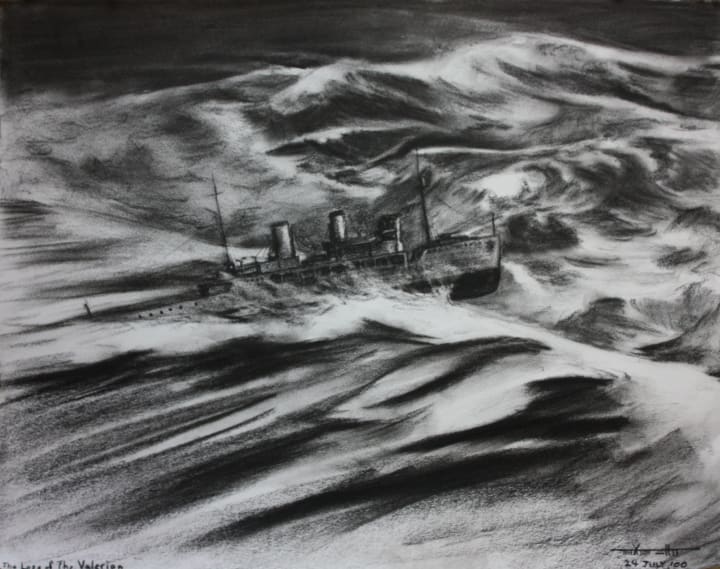
The Valerian vanished beneath the waves, taking with her four officers and eighty-four sailors, including Jack Barnes. Only nineteen men survived to recount the tale. The ship foundered only five miles from the Royal Naval Dockyard.

Back in Buncrana, a telegram arrived—cold words that carried a world of grief. My great-grandmother was left a widow, her children fatherless. She never remarried, choosing instead to raise her three daughters alone, with quiet strength and the memory of Jack always near.
Life pressed forward. Years later, the family moved to Dublin, where the girls could attend university—a remarkable achievement for women of that time. It was there that my grandmother, Eileen, the baby her father had last held, grew into a young woman. While her sisters attended University, she met Claude Fitzgerald Smith, the man whom she would marry, beginning a new chapter of our family’s story. Much later, our family would have a story of another ship, one that transported us overseas from Ireland to settle in America (~1960).
The wreck of the Valerian still rests somewhere in the Atlantic, a steel coffin claimed by the sea; a war grave to remain forever undisturbed. To the world, it is a naval tragedy of 1926, remembered as part of the Havana–Bermuda Hurricane. But to us, it is the story of Jack Barnes—a sailor whose life ended in a storm, whose absence shaped generations, and whose memory endures in the strength of the women he left behind.
About the Creator
Annie
Single mom, urban planner, dancer... dreamer... explorer. Sharing my experiences, imagination, and recipes.
I wanted to title this something different, but worried that my chosen title might cause problems entering the United States in the future so this is the new title. It's the greatest title. No one has ever written a title better than this. (All titles unrelated to content).
Let me be honest. I am finding this difficult. Now, I like a challenge, a stretch, a bit of an obstacle course. “Write about the decline of the British Empire in the form of a narrative poem in which your protagonist is an artichoke” I read, and flex my fingers. “Write a haiku to evoke the sensation of sibilance using only the first half of the alphabet.” “Well”, I think to myself, “this should be fun.” But “write about a system that isn’t working”? A system that isn’t working? Now? In 2026? ONE system? My favourite system that isn’t working? The sexiest system that isn’t working? The one giving me the most angst day to day? The one giving me the most existential dread? I am, as I say, finding this difficult. I will own that I have contemplated writing a thousand words on why the steady “all on” setting on my fairy lights is the EIGHTH of seven options which must be sequentially activated to get there, because that is a system that some fool came up with and it definitely doesn’t work, and now who is paying the price, eh? But how can I write about my fairy lights when…. When…. When….
By Hannah Moore5 days ago in Humans
How Couples Can Address Financial Stress Without Affecting Their Relationship
One of the most popular couple-related problems is financial stress. Money issues can be a source of anxiety, fear, and even shame that may be transferred to communication and decision-making. The studies conducted by the American Psychological Association have proven over time that money is one of the main stressors among adults. In the situation where partners do not recognize the emotional underlying tensions of financial strain, minor conflicts can soon develop. When couples realize that money issues are not usually about numbers, but about security, identity and future stability they will be able to do the issues with empathy and not blame.
By Stella Johnson Loveabout 7 hours ago in Humans
"Scream 7" (2026): Running out of Fresh Screams
This is the seventh time we’ve had a Ghostface crisis. Scream 7 is the latest edition of the Scream franchise. Sydney Prescott and her family are under attack by another anonymous killer dressed in a Ghostface costume. While having issues with her daughter, Tatum, they run from the bloody murders, trying to determine who is behind it all.
By Marielle Sabbag2 days ago in Horror



Comments (3)
Sorry Annie , it’s your granny Eileen not your great grandmother- your great grandmother was Jane Barnes. So I’m wondering who your mother is , Eileen mary or Jane?🤔 jack
Annie , indeed a very interesting yet tragic story about John Norman(jack) Barnes. My mother, Mary, and your grandmother, Eileen, were sisters, the other sister was Dorothy(named after Jack’s sister) affectionately known as aunt Dorrie. When Jack died at sea , my mother was 4, Dorothy was 14 months younger and Eileen ,your great grandmother was only 6 months- my mother only had a vague recollection of her father. They lived in Portsmouth, south of England- their people did indeed originate from East Anglia. They had another brother Hugh who was in the British army and lost both legs in WW1. Neither Hugh nor Dorrie married, but they were fond of their nieces and over the years came to visit us in Buncrana and no doubt visited Dorothy who married and moved to Dublin. Jack indeed met my granny Jane (Mc Kenna), known to all as Ginny during his posting in Dunree , on the coast of Ireland , near Buncrana .You are correct in saying that two daughters went to university but it was only through the benevolence of granny’s sisters in America that this happened. Her sisters, Sarah, Margaret and Hannah sent money home to educate my mother Mary and Dorothy. Granny bought a house in Dublin as part of this process. Actually when my mother ,Mary, left school at age 18, she worked in the local printers as a clerk— they simply needed the money, but the aunts were adamant that they received a university education. Granny also had a brother James - he had one son, Donal, and I don’t believe that any of Mary,Dorothy or Eileen ever met him, the one and only cousin they had on either side of Jack and his wife Jane. When my mother qualified as a teacher, round about the end of WW2 her first teaching post was in Epsom, Surrey- south of London. She regularly took the train down to Portsmouth to visit her uncle Hugh and aunt Dorrie, their parents may have passed on by then -not sure. Anyway Annie this is a bit of family history that I have learned over the years. - my own sister Dorothy is well versed in all of this. I am wondering who your granny is, either Jane, Eileen or Mary? I remember visiting your great grandmother in 1984, met them all then but I can’t remember if Claude was still alive - the address of 56 Elm street, Camillus, New York 16061 is indelibly etched in my memory as my mother used to send local newspapers to Eileen for years and I regularly was sent to the post office to post them over. Hope you are all keeping well, regards to Eileen, Jane , Mary and Claudia. Jack mc ateer - named after my grandfather, son of Mary Barnes and John Mc Ateer, Buncrana. Co Donegal
Hi Annie, nice piece to read! Small detail - Jack was born in England (a place called Norwich I believe). He met his wife, Jane, your great grandmother, when stationed in Buncrana. I’m his great grandson also, Mary’s grandson :)