
The King Who Ruled the World: The Legacy of Genghis Khan...
From Orphaned Outcast to Empire Builder — The Untold Story of the Greatest Ruler in History...
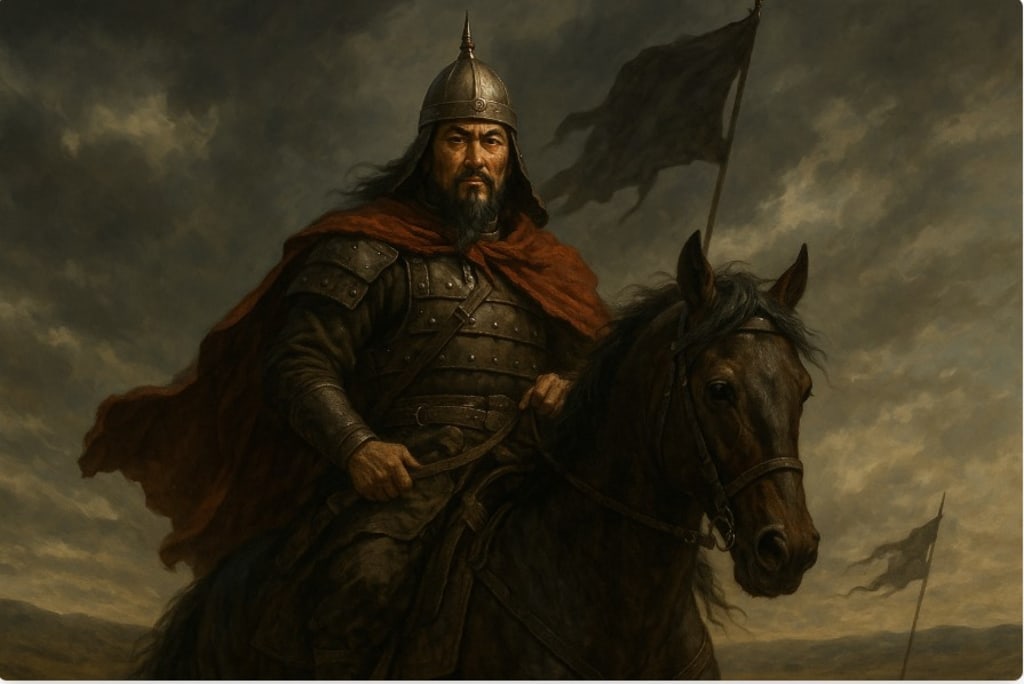
Numerous kings have risen and fallen throughout human history, each with a legacy of glory, conquest, or failure. Genghis Khan, the founder of the Mongol Empire and arguably the most powerful ruler the world has ever known, stands taller than any other king when it comes to sheer dominance, unrivaled influence, and lasting impact. He was born Temüjin in the wild heart of Mongolia around 1162. Even by the harsh standards of the steppe, his early life was harsh. His family was abandoned by their own tribe when their father was poisoned by enemies. They survived on roots and rats they hunted, starving in the cold wilderness. Many would have died. Neither did Temüjin. He learned, instead. He observed. He was aware. He realized that power was earned rather than given to him. He got sharper with every setback. Stronger. Harder.
He was already challenging conventional wisdom when he was young. He didn't believe in bloodline privilege. Men were promoted because of their courage, skill, and loyalty. He was followed by warriors not for his name but rather for his vision and refusal to be broken. The Birth of Genghis Khan
It required brutal warfare, alliances, betrayals, and victory after victory for years. But in 1206, the Mongol tribes finally united under one banner. Genghis Khan, which translates to "Universal Ruler," was Temüjin's name. At that moment, a new kind of kingdom was born—not built on castles and borders, but on speed, fear, and strategy.
The next thing Genghis Khan did would forever alter the world. The Kingdom of Horses There was no other empire like the Mongol Empire. Palaces were not present. There are no stone cities. The empire moved on horseback, traveling light, striking fast, and disappearing before enemies could understand what had happened.
The Mongols rose to prominence as the world's most feared army under Genghis Khan's command. They were able to ride for days without stopping, sleep in the saddle, and shoot arrows at full gallop with deadly accuracy. They didn’t just conquer—they shattered.
However, their brilliance extended beyond combat. Genghis Khan used intelligence networks, psychological warfare, and organized logistics centuries ahead of their time. Before battles, he would send in spies. Before the first arrow was fired, he would allow rumors of his barbarism to spread, lowering the morale of the enemy. At the sound of hooves, entire towns gave in. His warriors were bound by loyalty and a code, not by race or religion. Turks, Chinese, Arabs, and Persians were all accepted into the Mongol army. It was a war machine fueled by discipline and purpose.
Laws, Trade, and Tolerance
Genghis Khan was more than just a ruthless conqueror, despite his reputation. He created a code of law, the Yassa, that demanded discipline, loyalty, and justice. It punished betrayal, theft, and treason. It also promoted religious freedom—something almost unheard of in the medieval world.
Buddhists, Muslims, Christians, and others were free to worship as they chose in the Mongol Empire. Why? Because Genghis Khan believed that unity was political and belief was personal. The people of the empire could keep their gods as long as the empire remained loyal. By revitalizing the ancient Silk Road and making it safer than ever before, he revolutionized trade. Under the protection of Mongol patrols, traders could cross from China to Europe. Ideas, inventions, and cultures flowed like never before: printing, gunpowder, compasses, and even medical techniques spread across the world because of his rule.
The Fear and the Legacy
Naturally, Genghis Khan was not a kind king. His fury was actual. Cities that resisted were wiped from the earth—men slaughtered, women and children taken. Baghdad, Samarkand, Nishapur—these names once glittered in the Muslim world. Under Genghis Khan, they became warnings written in blood and ash.
Some historians estimate that up to 40 million people died during the Mongol campaigns—more than the population of most medieval kingdoms combined.
But there is another side to his legacy. Unlike many emperors, Genghis Khan never saw himself as a god. He didn’t build temples to his ego. He lived simply. He trusted in loyalty. He had faith in strength. Additionally, he held an odd belief in fairness. He elevated both his mother and his daughters, giving women leadership roles in government and even in conflict. In a time when women were often invisible, Mongol women could own property, lead armies, and rule territories.
Not the Empire, but the End of the Man The manner in which Genghis Khan died in 1227 is still up for debate. Some say he fell from his horse. Others claim he was wounded in battle. Regardless, his death was kept secret for months. The site of his burial was hidden. Legend says the soldiers who buried him were killed to preserve the mystery.
But death did not end his empire. His sons and grandsons carried on his conquests. His grandson, Kublai Khan, established the Yuan Dynasty and ruled all of China. For more than a century, the Mongol Empire remained the most powerful force on the planet.
Today, Genghis Khan’s legacy is etched in maps, in trade routes, in technology—and even in our DNA. One in every 200 men alive today, according to scientists, is descended from him. Millions of people have veins that carry his blood. The King Who Changed the World
So why is Genghis Khan the most powerful king in history?
Not just because of the land he conquered. not only as a result of the fear he instilled. However, due to the world he created. Not only did he rule, but he also rewired the ancient world. He connected people who had never dreamed of each other. In addition to steel, he forged unity through strength and respect. He was brutal, yes. But he was also brilliant. Visionary. Unstoppable.
And in the saddle, on the open steppe, he ruled an empire like none before or since.
Genghis Khan was more than just a king who wore a crown. He transformed into the storm that crowns run from. And that is why history will never forget his name.
About the Creator
Keep reading
More stories from Hasan mahamud and writers in Humans and other communities.
“The Healing Power of Love: More Than Just a Feeling”
Love — it’s a word that has inspired countless poems, songs, and stories throughout human history. From whispered confessions beneath starlit skies to lifelong partnerships weathering every storm, true love remains one of life’s most profound experiences. But in a world that’s rapidly changing, where instant connections often replace deep bonds, why does true love still captivate our hearts so deeply?
By Hasan mahamud8 months ago in Humans
Autonomy Is The Real Privilege
Good morning, freedom-seekers! Today we’re gonna be looking at autonomy. A strange word, I know; one many would probably look at blankly and run away from on sight. We’re gonna figure out what it actually means, consider how it’s achieved, and decipher just how deeply most of us are tangled up in dependence without realising it.
By That ‘Freedom’ Guyabout 19 hours ago in Humans
The Guardian of Maple Street: The Bus Driver Who Trusted the Silence
The incredible true story of Harold Jennings, the school bus driver whose attention to detail and refusal to take a day off saved an elderly couple and 27 children from a catastrophic gas explosion.
By Frank Massey 7 days ago in Humans
Smart phones, Humans and Aliens.
WARNING. I will be tapping into one of your favorite creative tensions: The absurdity of humans worshipping their glowing rectangles as if they were tiny oracles. There’s something deliciously poetic about that contradiction, and it lends itself beautifully to an instructive proviso.
By Novel Allen5 days ago in Poets




Comments
There are no comments for this story
Be the first to respond and start the conversation.