
"The Hanging Gardens of Babylon: Unraveling the Ancient Enigma"
WERE THE HANGING GARDENS OF BABYLON REAL?
Introduction:
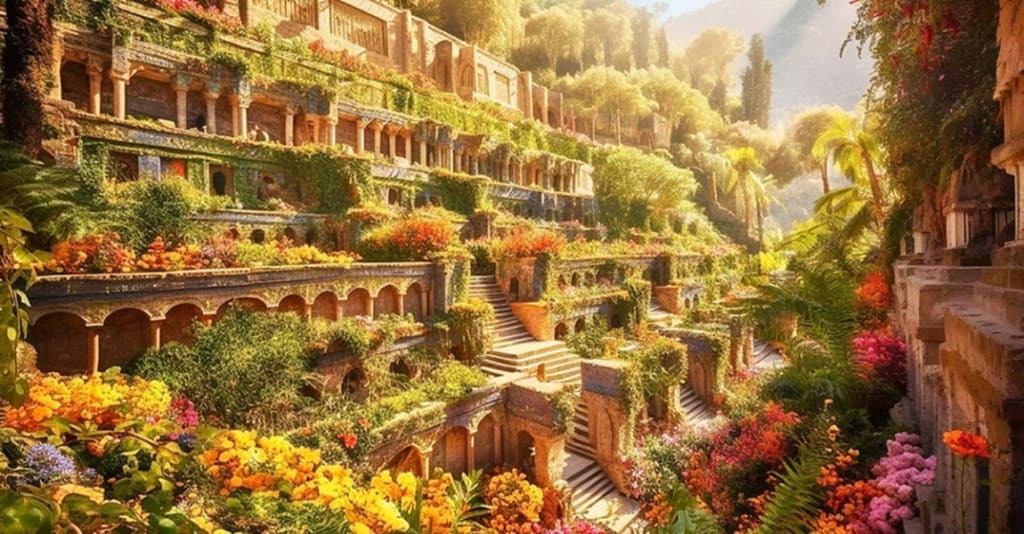
The Hanging Gardens of Babylon stand as one of the Seven Wonders of the Ancient World, captivating the imaginations of scholars, historians, and travelers for centuries. These legendary gardens said to have been an astonishing feat of engineering and a testament to the grandeur of Babylon, have left an enduring legacy shrouded in mystery. In this article, we embark on a journey to explore the historical accounts, archaeological evidence, and ongoing debates surrounding the existence of the Hanging Gardens of Babylon.
Chapter 1: The Ancient Descriptions
The earliest accounts of the Hanging Gardens come from ancient texts, primarily the works of Greek historians and writers. The most detailed description is attributed to the Greek historian Herodotus, who wrote about the gardens in the 5th century BCE. According to Herodotus, the gardens were an awe-inspiring spectacle of terraced greenery, towering above the city of Babylon.
Chapter 2: Nebuchadnezzar II and the Construction
The Hanging Gardens were traditionally attributed to Nebuchadnezzar II, a powerful Babylonian king who ruled from 605 to 562 BCE. According to ancient sources, Nebuchadnezzar built the gardens for his wife, Amytis of Media, who longed for the lush landscapes of her homeland. The king supposedly employed ingenious engineering to bring water from the Euphrates River to irrigate the gardens.
Chapter 3: Architectural Marvel or Myth?
Despite the vivid accounts from ancient sources, the Hanging Gardens of Babylon have long been a subject of debate among historians and archaeologists. The lack of concrete archaeological evidence at the traditional site of Babylon has fueled skepticism about the existence of the gardens as described in classical texts.
Chapter 4: The Absence of Babylonian Records
One of the challenges in establishing the historical reality of the Hanging Gardens lies in the absence of Babylonian records. The Babylonians were meticulous record-keepers, documenting various aspects of their civilization, yet there is no mention of the gardens in their extensive cuneiform texts. This absence raises questions about the gardens' authenticity.
Chapter 5: Alternative Theories
Some scholars propose alternative theories, suggesting that the Hanging Gardens might have been located in a different city or that they were not "hanging" in the way traditionally imagined. Others posit that the gardens could have been a later addition to Babylon, constructed by a different ruler.
Chapter 6: Strabo's Account
The Greek geographer Strabo, writing in the 1st century BCE, offered a different perspective on the Hanging Gardens. Strabo questioned the grandeur of the gardens, stating that they were not as remarkable as described by earlier historians. His account introduces an element of doubt regarding the scale and engineering prowess attributed to the gardens.
Chapter 7: The Role of Semiramis
In some later traditions, the legendary Queen Semiramis is credited with the construction of the Hanging Gardens. Semiramis, a mythical figure associated with Assyrian and Babylonian lore, adds another layer of complexity to the narrative, blurring the lines between history and legend.
Chapter 8: Recent Archaeological Discoveries
Recent archaeological investigations at the site of Babylon have yielded intriguing findings but have not provided conclusive evidence of the Hanging Gardens. German archaeologist Robert Koldewey, who excavated Babylon in the late 19th and early 20th centuries, uncovered a series of vaulted terraces, leading some to speculate about their connection to the gardens.
Chapter 9: The Watering System Debate
One of the key elements of the Hanging Gardens' alleged construction is the complex irrigation system. Some historians argue that the Euphrates River, located near Babylon, would have provided ample water for the gardens. Others contend that the engineering required for such a system in ancient times would have been highly advanced and may have left discernible traces.
Chapter 10: Cultural Impact and Symbolism
Regardless of their historical authenticity, the Hanging Gardens of Babylon have become a powerful symbol of human ingenuity, architectural achievement, and the desire for beauty in the ancient world. The gardens have left an indelible mark on art, literature, and popular culture, inspiring countless interpretations and representations.
Conclusion: A Garden in the Annals of Imagination
The Hanging Gardens of Babylon, whether real or embellished by the imagination of ancient writers, continue to captivate us with their allure. The line between historical reality and mythical embellishment remains blurred, but the gardens endure as a testament to the human fascination with creating beauty amid arid landscapes. As archaeologists continue to explore the mysteries of Babylon and scholars reevaluate ancient texts, the Hanging Gardens persist as a symbol of the enduring quest for the extraordinary in the annals of human history. Whether the gardens were an architectural marvel or a figment of ancient imagination, their legacy lives on in the fertile soil of our collective curiosity.
About the Creator
Keep reading
More stories from fatima zahra ajankar and writers in Humans and other communities.
"The Copper Scroll Treasure: A Parchment Puzzle Shrouded in Mystery"
Introduction: The Copper Scroll, discovered among the Dead Sea Scrolls in Cave 3 at Qumran in 1952, is a unique ancient document that stands out from its parchment companions. While the other Dead Sea Scrolls contain religious and historical texts, the Copper Scroll is a list, a treasure map of sorts, detailing the locations of hidden treasures. In this article, we explore the intriguing history, enigmatic contents, and ongoing debates surrounding the Copper Scroll treasure.
By fatima zahra ajankar2 years ago in Humans
Autonomy Is The Real Privilege
Good morning, freedom-seekers! Today we’re gonna be looking at autonomy. A strange word, I know; one many would probably look at blankly and run away from on sight. We’re gonna figure out what it actually means, consider how it’s achieved, and decipher just how deeply most of us are tangled up in dependence without realising it.
By That ‘Freedom’ Guy6 days ago in Humans
Saturn Is Testing Your Twin Flame Connection.
Many twin flame journeys hit a wall. Connection fades. Silence grows. Distance hurts. You ask why love feels blocked when the bond feels eternal. Astrology gives one clear answer. Saturn stands at work in your connection.
By Wilson Igbasi4 days ago in Humans
The Path to Salvation
The late autumn evening air filled the monk's lungs, but it wasn't the season that chilled his bones. The heavy-handed presence of evil he had sensed upon entering the woods surrounding this mountain village had not bothered to conceal itself from him.
By Made in DNA4 days ago in Fiction



Comments
There are no comments for this story
Be the first to respond and start the conversation.