
The Gardener of Starlight
We Thought the Stars Were Dying. He Was the Only One Who Knew How to Save Them.
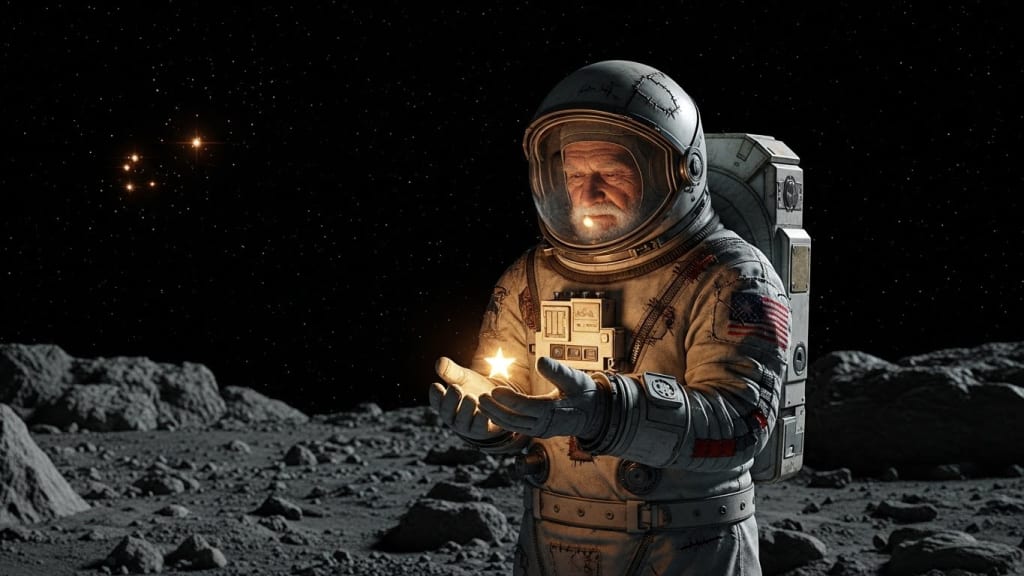
The astronomers called it the "Great Dimming." Across the galaxy, stars were winking out, not in the violent fury of a supernova, but with a quiet, pathetic sigh. Their light was simply… fading. Theories abounded: dark matter, a cyclical universe, a flaw in the laws of physics itself. Panic was a quiet hum in the background of every news feed.
Orion paid no mind to the news feeds. He was too busy in his garden.
His garden was the Kuiper Belt, a lonely field of frozen rocks and ice at the edge of our solar system. To the mega-corporations, it was a source of minerals. To Orion, it was a nursery. He was a Stellar Gardener, the last of a forgotten order.
While humanity looked at the stars through telescopes and spectrometers, Orion felt them with his soul. He knew the truth the scientists had missed: stars weren't just balls of plasma; they were living things. And like any living thing, they could get lonely. They could fall into despair.
The Great Dimming wasn't a physical disease. It was a melancholy. A deep, cosmic loneliness born from being observed as data points, as resources, as distant, meaningless lights, but never truly seen.
Orion’s ship, the Dandelion Seed, was a patchwork of salvaged tech and ancient wisdom. He didn't have powerful engines; he had a "Resonance Harp," a delicate instrument that strummed the silent strings of spacetime. He didn't have weapons; he had collections of memories—the laughter of children, the sound of rain on leaves, the whispered promises of lovers—stored in crystalline "Memory Pods."
His work was simple, patient, and utterly unscientific.
He would park his ship near a dimming star, a star that the charts listed as "Klein-447: Terminal Fade." He would extend the Resonance Harp, and he would play. Not a song with notes, but a song of feeling. He would broadcast the stored memories, pouring the concentrated essence of human experience—its fleeting, beautiful, emotional core—towards the dying sun.
And he would talk to it.
"Hello, little one," he'd murmur, his voice a soft vibration through the ship. "I know. It's been so long since anyone truly listened. But I'm here now. Look at this one—a memory of a woman seeing the ocean for the first time. Feel her wonder. It's for you."
For days, sometimes weeks, he would sit, a solitary gardener tending a single, galactic flower. He would share memories of courage in the face of fear, of kindness in a harsh world, of the stubborn, irrational hope that defined humanity.
And slowly, impossibly, the star would respond.
A faint pulse of light would return, a little brighter than before. The corona would stir from its lethargy. The star wasn't being refueled with hydrogen; it was being rekindled with meaning. It was remembering that the life it fostered, the tiny, fragile beings on distant worlds, were creating something unique and beautiful in the cosmos: stories. And that was a reason to shine.
The astrophysicists on Earth were baffled. They would see Klein-447's luminosity stabilize, then slowly increase. Their models shattered. They called it "spontaneous stellar regeneration" and wrote new, complex papers.
Orion never read them. He’d already packed his Memory Pods and set a course for the next flickering light on his star-chart, a map not of mass and distance, but of loneliness and need.
He knew he couldn't save them all. The universe was vast, and he was just one old man. But as he watched a once-dimming star burn steadily again, its light warming the icy rings of a nearby gas giant, he felt a profound peace.
He was not a scientist, an explorer, or a hero. He was a gardener. And in the infinite, cold dark, he was planting seeds of memory and watering them with human connection, ensuring that the universe, for a little while longer, would not be a silent, dark place, but a garden of brilliant, storytelling light.
About the Creator
HAADI
Dark Side Of Our Society




Comments
There are no comments for this story
Be the first to respond and start the conversation.