
The Four Faces of Ishaaq
A life's chronicle through the eyes of one man—child, boy, man, and old-man—woven with horror, injustice, satire, and salvation.

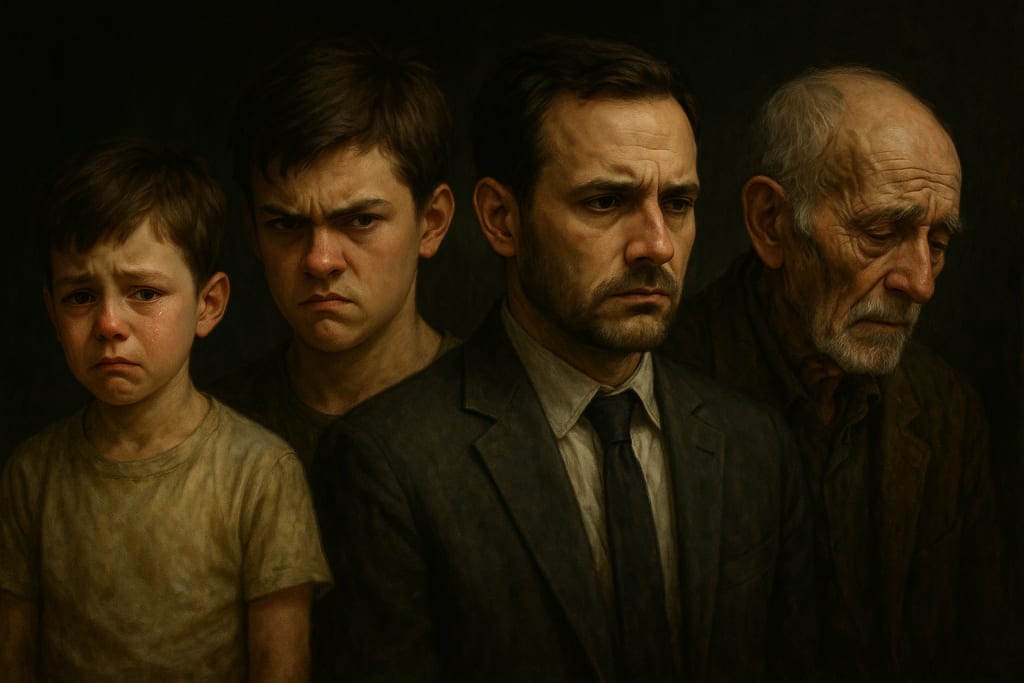
I. The Child: Born in a House of Silence
Ishaaq was born on a Monday—a day neither holy nor cursed—into a house made of mud, secrets, and silence. His mother’s scream was the only sound in the room when he arrived. Not a wail from Ishaaq, not a word from his father. A midwife muttered “He looks like a thinking boy”, as if that were a curse in a town that worshipped ignorance.
The village was small, surrounded by a forest of forgotten names. Houses were close, not for warmth, but for surveillance. Here, to smile was suspicious. To question was dangerous. To cry was weakness. Ishaaq learned to cry without noise, scream without sound, and think without moving his lips.
His father never beat him out of anger. He did it with the calmness of a surgeon and the discipline of a priest. “To shape a man,” he’d say, “you must carve the child.” Ishaaq wondered why shaping required breaking. He once asked. Only once.
His mother washed his wounds in silence. Her love was mute, buried under decades of obedience and a neck that no longer turned to see the stars. Piety, in that house, meant stillness. It meant knowing the alphabet of fear.
II. The Boy: School of Irony and Bruises
At nine, Ishaaq entered a school that smelled like stale sweat, chalk, and resignation. The headmaster believed beatings were divine tools. He often quoted: “Spare the rod and spoil the child.” Ishaaq noticed no one quoted love, patience, or empathy.
He was clever—too clever. He once corrected the teacher’s arithmetic, only to be whipped with the same stick used to herd goats. Irony, he thought, was a subject no one taught, yet everyone practiced.
He met injustice in uniform. A prefect named Bilal stole his lunch and blamed him for theft. Ishaaq was beaten in front of the class. The bruises faded, but not the lesson: truth is weak without a sponsor.
One afternoon, Ishaaq saw a boy crying behind the latrines. That boy had tried to escape through the window during Quran class. He’d broken his leg. The teacher called it divine intervention. Ishaaq called it a prison.
But he smiled. Always smiled. Because in his world, smiles were masks. And he’d learned to wear the best.
III. The Man: Shackled in Suits
At twenty-four, Ishaaq wore a tie like a noose. He worked at a government office where files grew like tumors and ambition was curable only with bribes.
He was smart—so smart he made others feel dumb. That was a crime. He was pushed sideways, denied promotions, blamed for errors he never made. Once, he filed a complaint about an officer stealing pension funds. Three days later, his desk was moved to the toilet corridor.
He met a woman. Her name was Zara. She believed in dreams and had eyes that read poetry. Ishaaq fell for her. Hard. But her family wanted a businessman, not a file clerk with rebellion in his blood.
They parted. Not because they didn’t love each other, but because love was an expense neither could afford.
At thirty, Ishaaq wrote articles under a pseudonym. He criticized the state, the education system, the theology of obedience. His words spread like wildfire. Anonymous. He became both ghost and hero.
Then the call came.
A number with no name. A voice with no accent: “Stop writing. Or we’ll write your obituary.”
He stopped.
But his silence wrote louder things.
IV. The Old-Man: Memory as a Punishment
At sixty-eight, Ishaaq sat by a window that looked onto a world that never changed. Children still carried bags heavier than their spines. Women still covered bruises with foundation and faith. Men still shouted over tea about revolutions they’d never join.
He lived alone in a narrow house filled with books and ghosts. His neighbors called him “The Mad Mullah” though he prayed less and read more.
One evening, a young man visited. A journalist. “You’re Ishaaq? The real Ishaaq who wrote The People’s Plague?”
Ishaaq nodded slowly. The boy wept. He had memorized every banned line, every censored truth. “Why did you stop?”
Ishaaq smiled. The same smile he’d worn as a child, a boy, a man.
He said, “Because I wanted to live long enough to meet you.”
The Ending (Or Beginning?)
Two weeks later, Ishaaq died in sleep—peacefully, they said.
At his funeral, a government officer spoke of his “contributions to literature.”
A boy in the crowd laughed. “They banned his books!”
Another spat on the ground. “Now they honor him?”
The crowd murmured.
And Ishaaq, wherever he lay, might’ve smiled. The same way he always had: beneath silence, behind satire, through the teeth of horror and hope.
Because Ishaaq wasn’t one man. He was many. He was every child beaten for curiosity. Every boy punished for brilliance. Every man broken for truth. Every old man remembered too late.
He was the satire of systems.
The cry behind closed doors.
The suspense of a life unlived.
And the cruel irony of being right… too early.
Author’s Note
This story is a scream trapped in ink.
A prayer without sound.
A satire without punchlines.
And a fiction that feels like truth.
About the Creator
Muhammad Abdullah
Crafting stories that ignite minds, stir souls, and challenge the ordinary. From timeless morals to chilling horror—every word has a purpose. Follow for tales that stay with you long after the last line.
Keep reading
More stories from Muhammad Abdullah and writers in Humans and other communities.
Melissa Grelo: Biography, Husband, Net Worth, Children, Career & More
Melissa Grelo is one of Canada’s most beloved television hosts, best known for her work on CTV’s The Social and CP24 Breakfast. With her vibrant personality, multicultural background, and passion for storytelling, she’s become a household name in Canadian broadcasting.
By Enoch Sagini5 days ago in Humans



Comments
There are no comments for this story
Be the first to respond and start the conversation.