
The Fire of the Lamp
A timeless tale of virtue, sacrifice, and divine wisdom in the courts of kings and hearts of beggars.

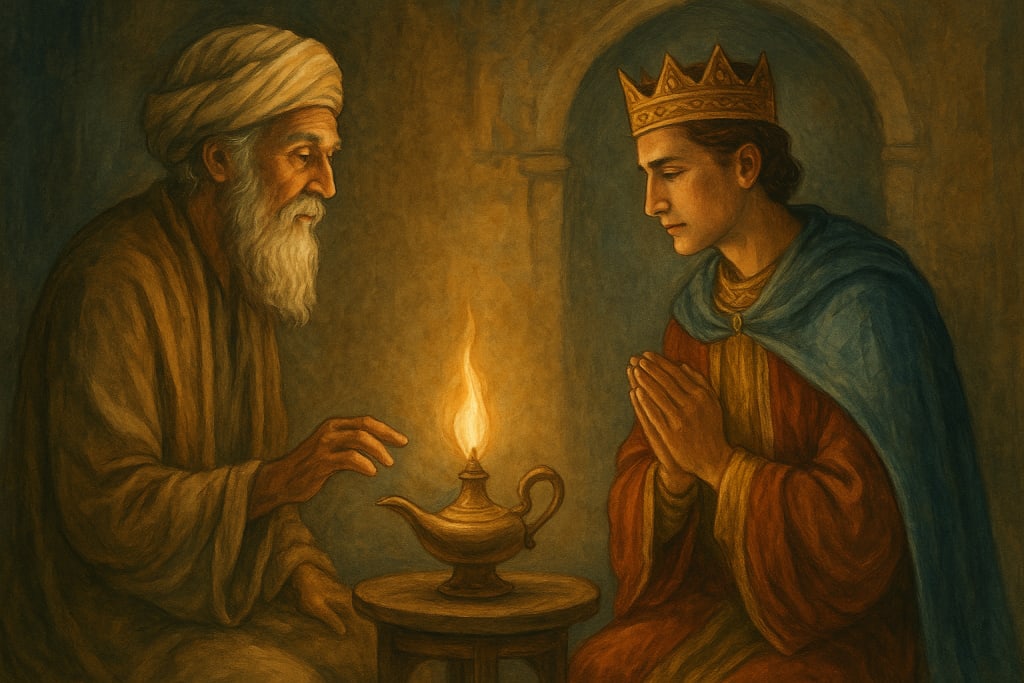
Once upon a time, there happened to be a revered sage who lived in a distant valley hidden between mountains where the stars bowed lower, and the wind whispered in verses.
The sage, by name Harith, was a man neither bound by wealth nor drawn to the ornaments of the world. He lived in a humble clay hut, and his only possession of value was a lamp that had burned with a sacred flame for forty years. He claimed it was lit by the oil of sincerity and truth, and that no worldly oil could ever keep it aflame.
People came from far and near for his wisdom—kings sent caravans for his blessings, and beggars sent their prayers. His words were rare but carved deep, like rain in stone.
One day, a young prince named Omar, who had just inherited the throne after the sudden death of his father, journeyed to the sage. Wrapped in silk, and armored by pride, he said:
“O wise Harith, I seek counsel on ruling my kingdom. What must I do to gain the loyalty of my people and the fear of my enemies?”
The sage smiled, a smile like a shadow of sorrow, and said, “To rule men, first learn to kneel among them. To own a kingdom, be willing to lose it for justice.”
The prince frowned. “But I have armies, riches, and counsel from the wisest. Why must I kneel to govern?”
Harith led the prince into his hut, where the sacred lamp still glowed.
“Watch,” said Harith.
He took a bowl of pure olive oil and poured it into the lamp. The flame flickered once—and then extinguished.
He then poured a drop from a small vial—oil he had pressed by hand from seeds planted by orphans he had raised. The flame returned, steady and golden.
“This lamp only lives on sacrifice, and so too does a kingdom. The oil of ego cannot sustain the light of wisdom.”
That night, the prince stayed with Harith and listened to tales of old kings who built palaces on the backs of the poor, only to be buried beneath their own walls. He heard of beggars who gave their only coin to a hungry dog, and were blessed with gardens the next life. He heard of a girl who forgave the man who killed her father, and in that act, saved a village from bloodshed.
Each story burned a prideful thread in his soul.
By dawn, the prince had removed his crown and laid it before the lamp.
“I am not worthy to wear this,” he said. “Teach me.”
But Harith shook his head. “Return to your people. Rule. But do not forget this: A ruler is the servant of the unseen justice. The higher his seat, the more he must bow.”
Years passed.
The prince became a king beloved beyond his lands. He opened granaries in famine, forgave debts in war, and sat beside widows in mourning. He carried a small lamp wherever he went, lit not by flame but by memory.
When Harith passed into the realm beyond, the king declared:
“Today, the brightest light of our land has returned to the source of all light.”
And upon his tomb was written:
“He lit the world not with fire, but with truth. And such light never dies.”
Moral:
To rule others, one must master the self. Power fed by pride dies in the dark; but power lit by sacrifice, humility, and justice—shines eternally. The soul is a lamp, and only virtue is oil.
About the Creator
Muhammad Abdullah
Crafting stories that ignite minds, stir souls, and challenge the ordinary. From timeless morals to chilling horror—every word has a purpose. Follow for tales that stay with you long after the last line.
Keep reading
More stories from Muhammad Abdullah and writers in Humans and other communities.
A Wise Woman
In a quiet village nestled between rolling hills and ancient woods, lived a woman named Elira. Her house sat at the edge of the forest, half-covered with ivy, with wind chimes made of glass bottles swaying in the breeze and wild herbs growing along the stone path. People said she had been born under a crescent moon, that she could speak with birds, and that time never touched her skin. Children whispered her name with a mix of fear and wonder: the Wise Woman of Linden Hollow.
By Muhammad Abdullah8 months ago in Humans



Comments (1)
Well written. Hey I am new here please support me