

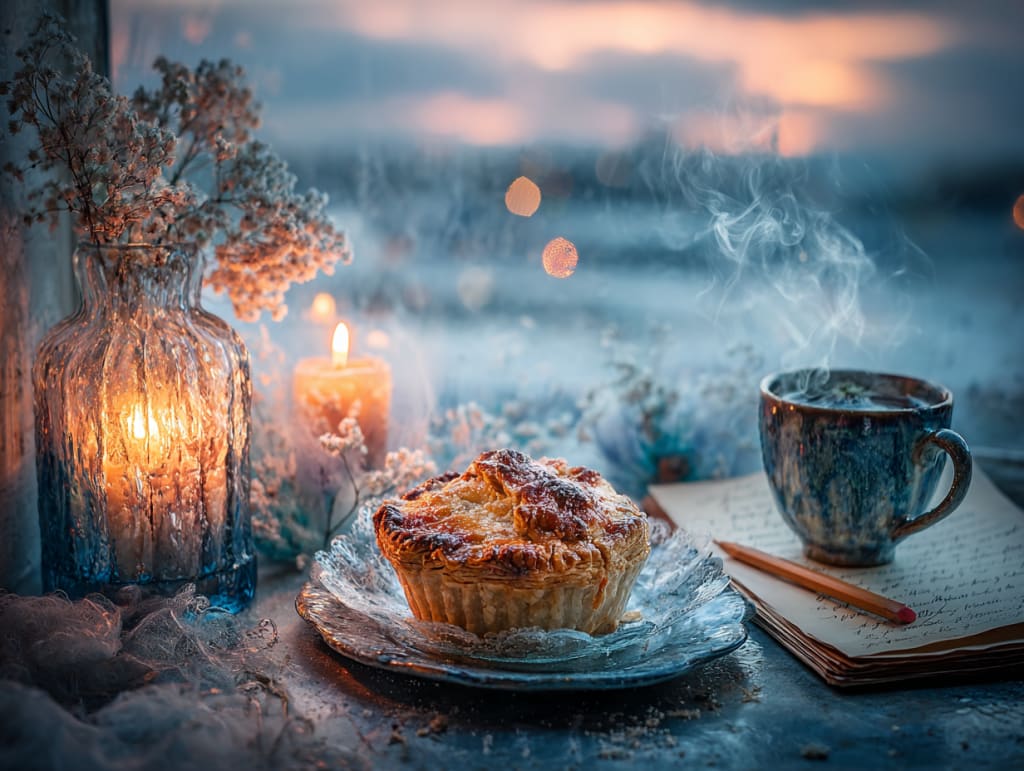
I grade supermarket mince pies like a stern Victorian headmistress.
It started as a joke. I had a clipboard one December because I was doing the big food shop and wanted to keep a handle on the chaos. I’d scribbled “mince pies?” with a box to tick, then—because boredom and trolleys are a dangerous mix—I added a pretend rubric beneath it: pastry flake, filling warmth, sugar sparkle, lid integrity. Ten points each. Very serious. I told myself the clipboard would make me efficient. It made me insufferable. I was delighted.
Back then, the ritual was light. I’d line up two or three boxes from different supermarkets, brew a pot of tea, and call it “The First Mince Pie Test.” Friends would laugh, then lean in, then argue, then reach for seconds. Someone would make a speech about the importance of suet. Someone else would insist on clotted cream, which I would condemn as exam cheating. We’d crown a winner and forget the score by morning. That was the point: it was play. A small ceremony against the dark.
Then everything changed in a year that keeps its teeth in my memory. Grief is greedy like that. The person who taught me to love the quiet silliness of winter rituals—buying the off-brand brandy butter, hiding the best chocolates at the back of the tree, singing the descant only to make the cat leave the room—was suddenly not there. The house echoed. The calendar loomed. I thought I might skip the season, as if it were a train I could simply wave past.
December arrived anyway.
On the first Saturday, I found myself in the supermarket with a dead phone and a basket I didn’t remember picking up. The bakery aisle smelled warm and wrong. Someone had stacked the mince pies into a cheerful tower and stuck a star on top. I stood there too long, staring. A woman reached around me and said, “Sorry, love,” which startled me into motion. My hands moved on their own. Two boxes in the basket, then another. At checkout, I had five. At home, I put them on the table like I was laying out tools for a job I had no training for.
The clipboard was still in the utility drawer, next to the batteries and several mysterious Allen keys. I took it out and pressed the metal clip, just to hear the snap. I wrote the date. I wrote the silly categories. The first line wobbled because my hands were shaking. Still, I lined up the pies on a chopping board and set a knife between them like a referee. I lit a candle. Then I put the kettle on and waited for the water to boil.
Here is how the First Mince Pie Test works now.
First, the smell. Lift the lid, let the steam out, breathe in. A good pie carries cinnamon and clove without shouting. Stealthy warmth. I hover over the plate like a suspicious customs officer. If the filling hits the back of my throat with a boozy cough, I mark it down. If I get the faint tang of citrus peel and a memory of raisins soaking in the same old blue bowl, I allow myself one small nod. Score: 7. Or 8, if I’m generous. It varies year to year. Grief has a way of moving the goalposts.
Next, the pastry. It should flake at the edges and hold at the base. No soggy bottoms permitted, out of respect for both science and decency. I tap a fork against the lid and listen. A tiny shatter is a good sign. A dull thud means trouble. I cut each pie in half and check the layers. If crumbs tumble like confetti, I brush them into my palm and eat them. I make a note: “Decent crumb. Slightly pale. Would benefit from a minute in the oven.” I realise I sound like the teacher I was imitating. I also realise I am talking to the room like they’re still here.
Then, the filling. This is the soul of the thing. I want fruit you can recognise. Raisins that aren’t sulking. A bit of bite. A jellyish mass gets the frown. I want to find a brave almond shard or a stubborn cherry, something for teeth to do in the dead of winter. I want a sweetness that arrives, makes its point, and leaves. Not the kind that lingers like a bad guest. I adjust the categories every year—once I added “moral fibre,” just to see what it felt like to give a mince pie a lecture. It felt ridiculous. I kept it.
Finally, the sugar on top. Light dusting or ridiculous crust, I don’t mind, but I do check for intention. If the sugar looks like it missed and landed by accident, I sigh. We are not animals. We are people who make small, deliberate choices in cold months. Sugar is not an accident. It is a promise.
I score each pie, write the total, and award a stern verdict in plain caps. PASS. BARELY PASS. MAYBE NEXT YEAR. And once, to a box that tried too hard with the brandy and left us both coughing, ABSOLUTELY NOT.
The first year without them, I completed the test and stared at the page. I thought the ritual would make the ache worse, like touching a bruise, but it didn’t. It gave me something to do with my hands. It made space for a conversation I could no longer have out loud. The minutiae saved me: the angle of the knife, the scratch of the pencil, the kettle’s second boil when I forgot to pour. I poured again. I ate half a pie and cried into the plate, which is not a recommended pairing but is sometimes what’s served.
People think rituals are about the final act. Light the candle. Eat the pie. Hang the wreath. I don’t think that anymore. I think rituals are about the minutes around the act. Where you put the lighter back so it’s always there. How do you fold the paper before writing the first score? Which mug do you choose for tea when the one you want isn’t clean? All those choices make a frame for the thing you can’t hold.
In winter, the frame matters. The days thin out to short strips of light, and you need edges. Candles give you edges. A list gives you edges. Even the supermarket gives you an edge when everything else is a spill. So I lean into it. On the day of the Test, I set the table. I use the good small plates, the ones that don’t fit anything useful except a mince pie. I put the clipboard on a tea towel like it’s precious. I turn off the big light. The room steps closer.
Some years, I invite people. We treat it like a game show. Someone reads out numbers like a sports commentator. We debate the ethical question of icing. We chew, we argue, we eat another half to be fair. We award a winner and invent a trophy on the spot from a novelty star ornament and a bit of ribbon. We talk about them without using the past tense for as long as we can manage. Humour holds the sorrow steady. It doesn’t cure it. It gives it a chair.
Other years, it’s just me. I sit at the end of the table with my pencil and my candle and the box that makes the best promise. I break a pie open and watch the steam lift. I write down 7. Then 8. Then I cross it out and write 7 again because the last bite wasn’t as good. I like the fairness of it. I like that I can change my mind and no one will knock on the door to correct me. I like that I can imagine them laughing and telling me I’m being severe, and I can pretend to be offended, and neither of us has to be right.
Sometimes I save a pie for later and eat it cold, standing at the counter. Cold pies tell a different truth. They show you what the pastry is made of and whether the filling can handle silence. You learn a lot about yourself eating a cold mince pie in a quiet kitchen. Mostly that you are still here.
By the end of the evening, there are smudges of sugar on the clipboard and flakes in the candle dish. The scores are messy and honest. I wash up the small plates and leave them to dry. I fold the tea towel, refill the lighter, and put the knife back in the block. I slide the clipboard into the drawer next to the batteries and the Allen keys. I stand there for a second, holding the edge of the counter, and feel the house shift into winter. The Test is done. The season can begin.
I don’t keep the scores from year to year. People imagine I have a wall chart somewhere, a spreadsheet of shame for substandard pastry. I don’t. I like the ritual to reset. The taste I’m measuring changes every December anyway. Some years, the best pie is the fanciest, with a sugar-crusted lid and a whisper of orange. Some years, it’s the most ordinary one, brushed with milk and dusted with restraint. Once, the winner came from the corner shop, the last box on the shelf, slightly bashed. It tasted like a polite apology after a long day. It tasted like relief.
If the pie is very good, I make a cup of tea and take one to the front step, even if it’s cold enough to bite. I wrap myself in a jumper and breathe into the air like a dragon with poor time management. I hold the pie carefully and look at the thin winter sky. I don’t make speeches. I don’t ask for signs. I just eat and think the simple thought that this is nice, which is the kind of thought that used to feel expensive and now feels worth paying for.
The Test has become a small lighthouse, visible even on the messy days. When the dark comes early and the headlines gnaw, I know there’s a box on the counter and a lighter that works. I know I can be silly and strict at once. I can grade pastry like it’s coursework and laugh at myself for caring, all while caring very much. It’s a strange tenderness, but it’s mine.
Every winter, the first mince pie puts me back in conversation with the life I had and the one I’m building. It gives me a way to say their name without speaking, a way to keep choosing to notice small good things when the larger ones are harder to carry. The ritual holds steady, so I can wobble. It says: light the candle, sharpen the pencil, cut the pie, have a laugh, tell the truth, clean the plate, and go to bed.
It’s not profound. It’s not nothing. It’s a test that nobody else will ever sit, with a pass mark I change as needed. It’s the calendar turning and a kitchen filling with cloves. It’s me, still here, hands busy, winter beginning, sugar catching in the light.
About the Creator
Diane Foster
I’m a professional writer, proofreader, and all-round online entrepreneur, UK. I’m married to a rock star who had his long-awaited liver transplant in August 2025.
When not working, you’ll find me with a glass of wine, immersed in poetry.
Keep reading
More stories from Diane Foster and writers in Humans and other communities.
The Long Way Back to Breakfast
I didn’t know I was drawing a map until I looked back and saw the lines. Three years ago, the first mark was a pin in a place I never wanted to visit: the clinic where the word cancer slid into the room and sat with us like an uninvited guest who wouldn’t leave. After that, the world rearranged itself. Geography shrank to corridors, waiting rooms, and the route from the car park to the ward. Time bent around scan dates. The old map with its trips and dinner plans and casual weekends curled at the edges and disappeared. In its place, a new one started to form out of practical things: which lift actually stops at Level 7, which café opens at 6 a.m., and the nurse who smiles even when the news is complicated. I drew it because I had to.
By Diane Foster5 months ago in Humans
My First Time Skiing and I Got Lost, Alone, in the French Alps
Looking back, I can trace some of my life’s biggest adventures to a simple action from my sister. She’d introduced me to Tommy (a very long time ago), a colleague of hers, who had overshared his penchant for Italian-looking women, and I ticked that box.
By Chantal Christie Weissabout 15 hours ago in Humans


Comments
There are no comments for this story
Be the first to respond and start the conversation.