
The First Breath: Adam’s Divine Legacy
Where clay met eternity, the story of mankind truly began.
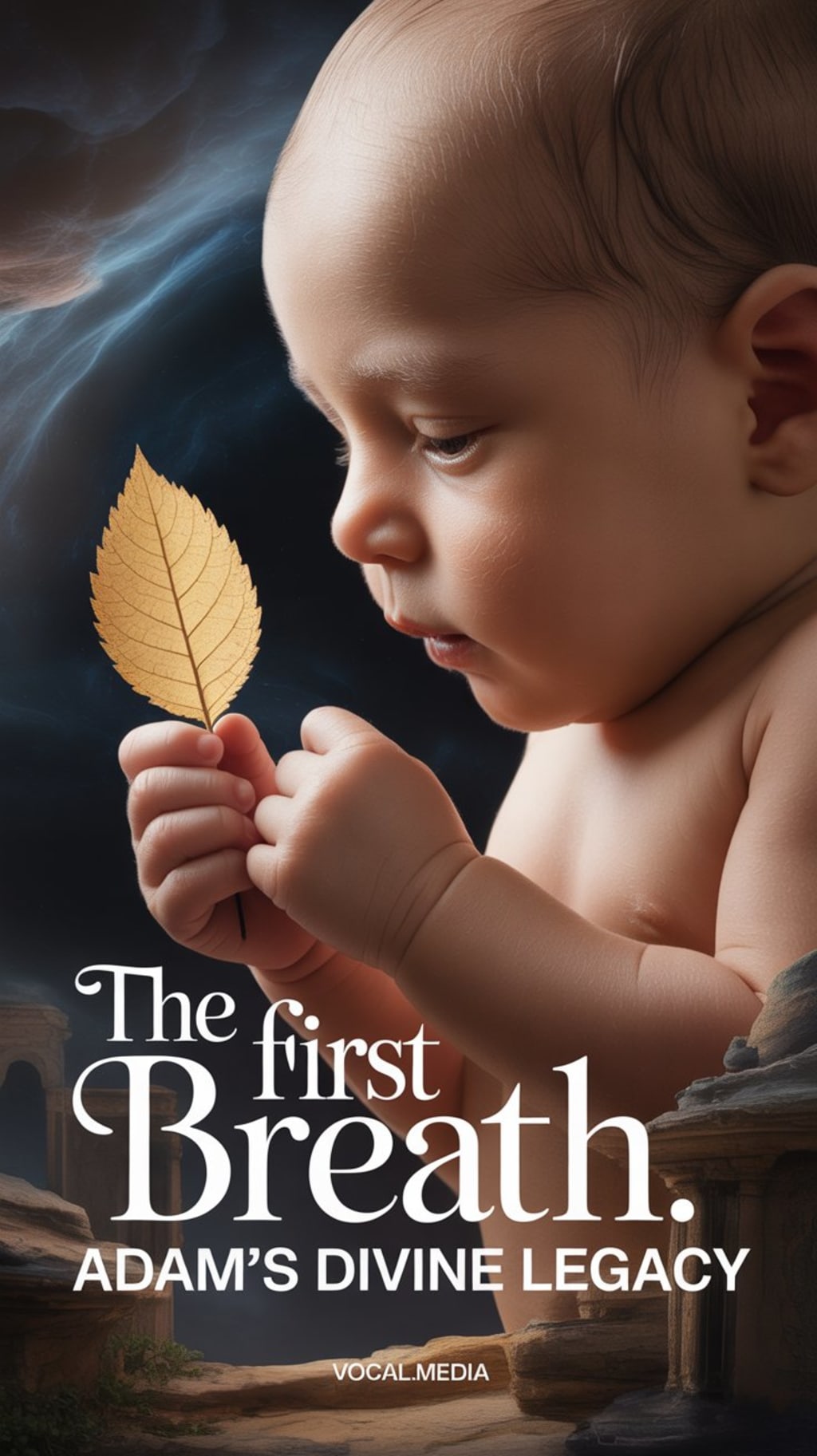
In the beginning, silence reigned.
Not the silence of sleep or serenity, but a breathless, eternal hush—a waiting, as if the universe held itself back, anticipating something it could not name. The stars, newly flung into being, burned without witness. The Earth, fresh in its infancy, brimmed with the wildness of untouched creation. Trees grew without eyes to admire them. Rivers sang to no one. Winds danced for an audience that did not yet exist.
And then, there was clay.
In a secluded cradle of light nestled between the Tigris and Euphrates, the Creator knelt by the riverbank. With hands older than time, He shaped the dust and water of Earth into the form of a man. This was not a body for its own sake. It was a vessel, a mirror—destined to reflect something divine.
The form was perfect, yet still and lifeless.
Until breath.
It was not a wind or exhalation as we know it. It was something deeper, more eternal. A piece of the infinite entering the finite. When the Creator breathed into the nostrils of the clay form, it shuddered, surged, and came alive. The eyes opened—not merely to light, but to wonder. This was Adam, the first human. And his first breath was the most sacred in history.
That breath carried within it all of us.
The Legacy Carried in Lungs
With his first inhale, Adam received more than life—he inherited a legacy. That breath was the transfer of potential, the beginning of memory, the seed of every emotion we have ever known: awe, curiosity, loneliness, love.
He stood in Eden, but not as a servant or spectator. He was made sovereign. The animals approached him, and he named them—not as a cataloger but as one who understands the soul of a thing. In giving names, Adam participated in creation. He wasn’t just made in the image of the divine; he was made to reflect the Creator's heart.
But knowledge, like fire, warms and wounds.
Adam's divine legacy wasn't just about paradise. It was about choice. He was given the will to obey or defy, to love or to fall. And when the fruit of that forbidden tree passed between his lips, something ancient within him fractured.
We often blame Eve for the fall, forgetting that Adam, too, chose. He, too, was there. And in that choice, the breath that had once come so freely began to come with effort—with labor, with cries at birth, with sighs of sorrow, and, ultimately, with death.
But that breath—the first breath—was never taken away.
A Legacy Lived in Every Generation
Every time a newborn gasps their first breath, Adam's echo resonates. Not just biologically, but spiritually. We are all clay made conscious. We are all carriers of divine potential, yet burdened with earthly weight.
The story of Adam is not just about a man who walked with God and fell. It's about a lineage—a thread of divine spark winding through generations. It's in the hands of a sculptor who shapes from stone. In the voice of a singer who raises lament into the air. In the quiet courage of a parent who stays.
It is the reminder that even from dust, beauty can rise.
Returning to the Breath
Centuries after Adam’s breath stirred the air of Eden, another man stood on a hillside, surrounded by the weary and the wandering. He said, “Blessed are the poor in spirit, for theirs is the kingdom of heaven.” This was another breath, spoken into a world choked by struggle.
In Him, many say, the second Adam arrived—not made of clay, but born of woman. He breathed not only life, but hope. And with His final breath on a hill called Calvary, a new legacy began.
The breath of Adam was the start of humanity. The breath of Christ was the start of redemption.
Why It Matters Now
In today’s world of noise, division, and distraction, it’s easy to forget that we are all descendants of that divine breath. The story of Adam isn't just ancient scripture—it’s a mirror. We are breath-carriers, soul-bearers, decision-makers. We still name things, shape things, build or break.
And perhaps, if we remember where we came from—that clay touched by the infinite—we’ll live differently.
Maybe we’ll listen more closely. Forgive more deeply. Create more fearlessly.
Because in every breath we take, we live out the legacy of the first man. And with each exhale, we choose: to pass on that divine spark, or let it fade into dust.
What will you do with your breath?
About the Creator
Keep reading
More stories from Shehzad Ahmad and writers in Humans and other communities.
"The Midnight Messenger: A Story of Unlikely Connections"
Sarah Caldwell had always preferred solitude. The humdrum of daily life, the chatter of people, the never-ending noise—none of it ever appealed to her. She lived in a small cottage on the outskirts of a quiet town, far from the bustling crowds and the clamor of city life. For years, she had grown comfortable in her isolation, surrounded only by books and the occasional stray cat.
By Shehzad Ahmad7 months ago in Horror
Autonomy Is The Real Privilege
Good morning, freedom-seekers! Today we’re gonna be looking at autonomy. A strange word, I know; one many would probably look at blankly and run away from on sight. We’re gonna figure out what it actually means, consider how it’s achieved, and decipher just how deeply most of us are tangled up in dependence without realising it.
By That ‘Freedom’ Guyabout 9 hours ago in Humans
Why Being Observant Matters More Than Being Loud
Why Being Observant Matters More Than Being Loud Loudness demands attention. It’s the first thing we notice. The booming voice. The person who interrupts every conversation. The social media post that screams for likes. The ones who dominate the room not because of what they know, but because of how forcefully they announce it.
By Nolan Wright about 13 hours ago in Humans



Comments (1)
i was searching so much tims like this story which is related to world begining era.