
The Endless Expanse of Love in a Memory
A short story in under 2,000 words

When Gabriela opened the door that morning to step outside, she was mouthing a few lines:
the soles of my soul touched the ocean
‘fore I left the shore and traveled west.
but by night I wake to its motion
those turning dreams
return to me, an ocean in a mist.
She exhaled, but the restful rhyme was interrupted by her own gasp: a sharp, “Good God!”
Her mail was scattered across the front yard and her olive-green mailbox was lying bent and scraped by the curb. A week prior, a friend had told Gabriela about some bored teenagers who were cruising around the neighborhoods at midnight, clobbering mailboxes with baseball bats. She hadn’t believed the tale when she heard it; but now, the evidence before her, she reconsidered its credibility. The mindless assault, coupled with the previous day’s message that someone had been hacking into her teacher account, only furthered to make her feel vulnerable and tired.
Her legs stiff and aching, Gabriela squatted down to collect the nearest piece of mail, but when she noticed that its sender was Sanderson Mortgage, she decided it could wait. She proceeded down the walkway and into the street, setting out on her morning route to Crestview Cemetery, where her husband, José, was buried.
His recent death was still a tender wound for Gabriela, who, at every 8am, would sit flat-legged beside his modest gravestone — a shallow slab, bearing only his name and lifespan — tracing her fingers along the groove of the engravings and recounting the last moments she’d experienced with him: standing behind a glassy pane, contending with the nurses, insisting that she be beside her husband in his waning hour, and being persistently, adamantly told, “you cannot enter, Señora.”
So instead, José, on a hospital-issued iPad, would video-call his Gabriela, on her cellphone behind the medical barrier, praying for him to recover. And when Gabriela would run out of prayers, she’d read him the poetry that she had once read him when they were young lovers — unearthing the memories of drive-in movies and late-night diners; José and his 4 brothers bailing hay through the summers; the truck dash filled with cassette tapes; the sugary scent of pan-fried plantains on her dress; the tight grip of her arms around his waist, atop a dirt bike drifting through the Texan countryside. She’d read and they’d remember.
When, at last, the COVID-19 virus swallowed up his last breath, there was still a lingering tear in the corner of José’s eye as he listened through the tablet’s tiny speakers: “…the soles of my soul touched the ocean ‘fore I left the shore and traveled west.”
Walking home from his grave, Gabriela began dreading the mail on her lawn. Not only had the pandemic stolen her sweetheart of 42 years, it had also plundered their bank account. Gabriela had always been the breadwinner of their home, largely on account of an adjunct position she’d secured at a local college, where she taught poetry on Mondays, Wednesdays, and Fridays. She’d been there since 1998, while working various upholstery jobs on her off-days. José’s work, however, had been sporadic: in construction, painting, sometimes food service, other times working on electronics, which he enjoyed most. To them, the inconsistency of his work was not an issue. They’d always had just enough to live on, which they regarded not as a shortcoming but a blessing. They were happily modest.
But the pandemic was not interested in modesty. The array of José’s jobs evaporated overnight. Summer college classes were altogether canceled, and by the time they resumed virtually in the fall, Gabriela and José had exhausted the totality of their savings. After missing their fifth mortgage payment, the coughing began. José went to the hospital on January 5th, and by the 14th he was gone forever, leaving Gabriela with only the inheritance of his love.
“Help me, Mother Mary,” Gabriela sighed, picking up the last envelope, stamped “Final Notice”. She dropped the stack on the front step and then retrieved the contorted mailbox.
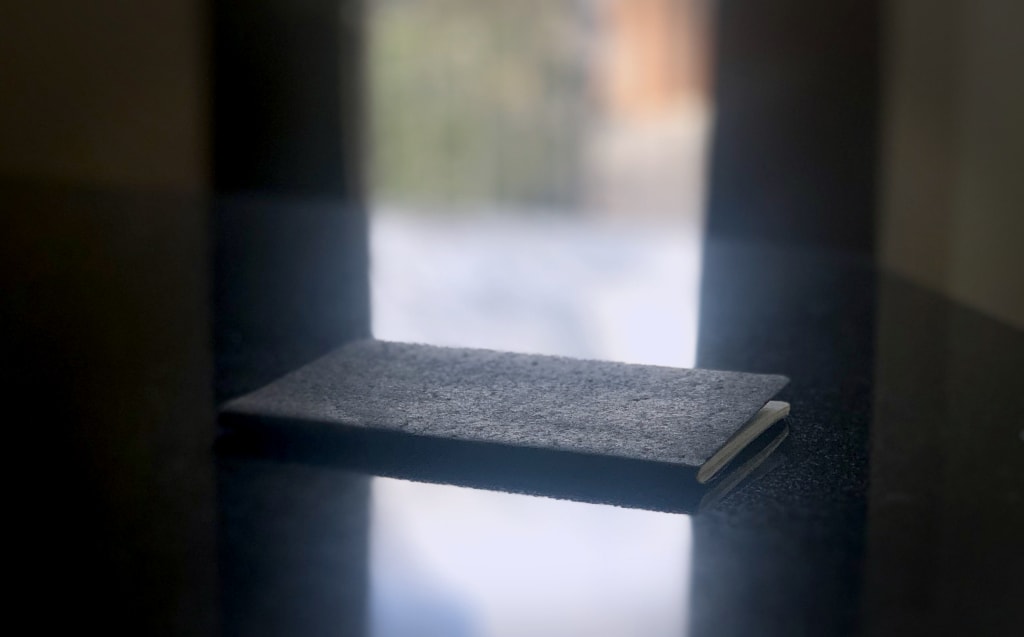
But then, while holding the metal shell, she realized there was still a package wedged within. Setting the mailbox down, Gabriela pulled out a thin-cardboard envelope, folded-over once to fit. It was addressed to her — Professor Nuñez — but had no return address. Curious as to what it was, she immediately tore the perforated seal and emptied its contents into her hand: a single, plain black notebook.
Gabriela opened the small book. The initials J.R.P. were penned on the inside cover. The handwriting resembled José’s but the initials were not his. She turned the first page and found a scribbly sentence:
Every Tuesday I wake up and I hear that annoying grinding sound that the garbage truck makes.
Gabriela squinted and read it again, confused by its inane simplicity. She turned another page and then saw:
when the song opens
with the grinding grit
of the garbage truck,
I sing along: Tuesday!
Gabriela thumbed back to the inside cover. As best she could recollect, she didn’t know a J.R.P. She gathered the mail from the step, walked inside, and was further inspecting the peculiar notebook when her cellphone rang. It was Lorraine, the one who had told Gabriela about the nocturnal teenagers with the baseball bats.
“The little devils got me!” Gabriela informed her. That wasn’t why Lorraine had called, but she was nonetheless pleased to hear that the rumor she’d been spreading was now justified. Instead, Lorraine was checking to see if Gabriela had acquired the money to stop the foreclosure of her home. She knew that Gabriela needed at least $15,000.
“I don’t know what to do,” Gabriela confessed — a deep, inescapable sorrow returning to her voice. Lorraine offered to have Gabriela come stay with her.
“I’m very grateful,” Gabriela replied, “but this is where I can still be with José. I don’t want to leave. I can feel him here with me: in the kitchen, in the hallway, on the sofa. I want his clothes to hang in our closet a little longer. I want to keep his comb on our sink. I don’t want to pack up his life, Lorraine.”
She went quiet.
“I don’t want to lose my home.”
That afternoon Gabriela tried to repair the mailbox. She was holding a roll of duct tape when the mailman drove up. Without asking, he knew exactly what had transpired: the teenagers.
“Little mierdas,” he mumbled — handing a couple items directly to Gabriela. There was another package, once more addressed to Professor Nuñez and without a return. Upon opening it she discovered a second notebook, identical to the first. She turned to a random page and began reading:
// a couple arguing (about nothing) at lunch
// a flock of birds
// I had pizza and I might like onions now?
// Smiling is its own form of wealth.
// the more I pay attention to seeing what’s around me,
the more I see myself.
Her thoughts were swimming; she’d read those last lines at another time in her life. She flipped to the front cover and found a name: Paul Waverly. Hurriedly, she went inside, opened her laptop, and logged-in to her teacher portal, navigating to an archival section that allowed her to search for students who had enrolled in her class over the last few decades. Her suspicion was confirmed: Paul Waverly had been a student of hers in 2003. Gabriela continued scrolling through the rolls of names, year by year. In the class of 1999, she spotted another name: Jasmine R. Potter — J.R.P.
She knew what this was.
During her earliest years of teaching college poetry, Gabriela had required every student to purchase these small, black notebooks. As beginners, her students were instructed to carry the journal throughout the day, jotting down the common and uncommon occurrences that were all around them. Any one of these moments, she’d insist, could be the impetus for finding beauty — tragedy — comedy — divinity — humanity — and thus, poetry. Gabriela had never collected any of them, but each student could receive a bonus on their semester’s final exam by showing her the completed assignment: a book filled with observations.
But this was all a while ago. With the advent of smartphones, students complained about carrying around an “additional” notebook when there was already one on their devices. After two years of enduring their whining, Gabriela eventually gave-in and discontinued the exercise altogether.
For more than a decade she’d forgotten about the black books. And yet, here were two of them, suddenly back in her life, on her kitchen counter…
words of happiness and happenstance,
penciled memories otherwise forgotten,
confessions, complaints,
the sudden appearance of the marvelous in the mundane,
the collisions she had orchestrated for the J.R.P.s and the Paul Waverlys…
there was a musty smell
in the Science building today.
it made me think
of my great-grandmother
for the first time in a long time.
it felt good to feel close
to her again.
…the instigations of art and awareness —
each annotation, each poem the evidence of her own life, threaded into others, returning to her like a song of youth.
“…but why now?” Gabriela wondered. “Why were these mailed to me?” The doorbell rang. A FedEx worker handed Gabriela a box, which she plopped on the living room floor and opened with a kitchen knife. Over a dozen more black notebooks were within. She opened one up:
I hate the cafeteria food.
I hate it I hate it I hate it I hate it.
except the fries.
In another:
It snowed for 12 minutes today.
It was a great 12 minutes.
In another:
a child with a yellow balloon
ran down the aisle
during Mass today.
his mother, mortified,
caught up
and promptly removed him
from the service.
she was not pleased
but I think God might have been.
“Come over here! You have to see!” Gabriela urged Lorraine. A half-hour later the two 60-year-old women were combing through the little black books together. It was Lorraine, seated at the kitchen table, who opened the last page of one and discovered a brief letter:
Dear Professor Nuñez,
I’m so sorry to hear about your husband,
but I’m glad he found a way to reach us.
(...though I’m pretty sure he wasn’t supposed
to have access to the alumni database! haha)
We made a Facebook group to reach others,
so hopefully you’ll be receiving more than just my notebook.
Thanks for helping us to write down the wonder
all around us.
With the note, tucked into the back cover, was $70 in cash.
“Gabriela!” Lorraine exclaimed, holding up the bills. The soft indents of Gabriela’s tears began to mark the pages of each notebook, one by one, as she turned to the last spread and discovered a $200 check, $30 cash, a $1000 check — each accompanied by a present-day message, mourning the passing of José, while praising his ability to use a hospital iPad to access her school account and contact them.
The next day, 12 more notebooks arrived. The day after that: 83. Each afternoon: some arrived individually, while others by classes who had coordinated to send theirs together. By the week’s end, Gabriela’s kitchen table was covered with 192 little black books, with cash and checks that added up to some $20,000.
It took Gabriela a month to read through them all:
each one an unforeseen reunion with a distant smile,
journals of life as it had once been,
reminders of the frustrations and felicity of youth,
a shadow of her own:
the ordinary splendor
the days dawned
the meals shared
the laughter of her José.
In little black blooks
a lifetime had returned to Gabriela,
swiftly and quietly,
like an ocean in a mist,
the endless expanse of love in a memory.
About the Creator
Jason Dyba
writer + producer in atlanta
Keep reading
More stories from Jason Dyba and writers in Humans and other communities.
Whiskey At Dusk
Guess the whiskey was more important to you in the end, wasn’t it? It was more than the well-being of your friends; more vital than showing up to the places you promised you would and could come to; more critical of a matter than fulfilling your damn responsibilities and getting the press off your back.
By Snarky Lisaabout 22 hours ago in Humans
He Was Not Sting
Tasawur, Sajid, and Nasir were close friends. Nasir had joined the college only two months earlier and soon developed a friendship with Tasawur and Sajid. Nasir belonged to a middle-class family and was a well-mannered, kind-hearted boy. No student in the class had any complaint against him. However, Sajid and Tasawur often called him stingy.
By Sudais Zakwan3 days ago in Humans
Affection and Healing for Yourself
During the night of the last quarter moon, I gathered my ritual supplies. I carefully handled the chunk of black tourmaline that would protect me from your overall negative and narcissistic energy. I carefully walked the house with my stick of selenite in hand, asking the universe to cleanse our working space.
By Alisha Wilkins ✒️🦋🖋️6 days ago in Fiction


Comments
There are no comments for this story
Be the first to respond and start the conversation.