
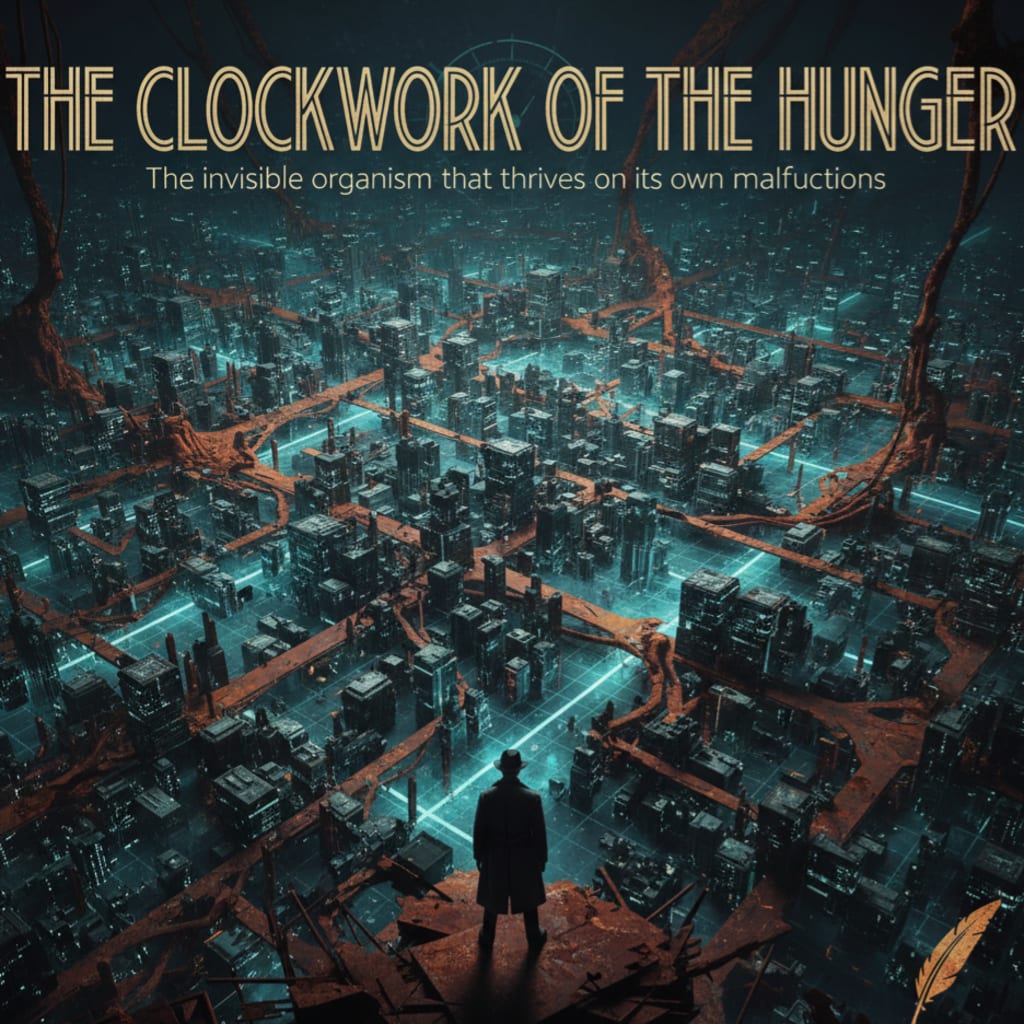
The Clockwork of the Hunger
The invisible organism that thrives on its own malfunctions.

"The clock has struck three, the coffee is cold, and the shadows are beginning to speak. Welcome back to the desk of The Night Writer, where the stories are brewed in the dark."
The global economic system is often described as a machine, but machines are bound by the laws of physics. Machines have a point of failure where the gears shear and the movement stops. Our system is something more biological and more terrifying: it is a sprawling, invisible organism that has learned to thrive on its own malfunctions.
Systems promise us the grid. They promise that if you input labor at point A, you will receive security at point B. It is a mathematical grace we are taught to believe in from the moment we learn to count. But for the vast majority of the eight billion souls walking the earth, the math has begun to leak. The variables are no longer human.
The Friction in the Individual
On a Tuesday morning in a studio apartment in London, or a brick-and-mortar flat in Mumbai, an individual wakes up and feels the "quiet failure." It is not a stock market crash on the news; it is the friction of a life that no longer fits the available currency.
We have entered an era where the cost of existing has outpaced the value of living. The individual is shaped by a design that demands infinite productivity from a finite body. The system overlooks the "unproductive" hours—the time spent grieving, the time spent daydreaming, the time spent simply being still—and marks them as deficits.
When a person cannot afford the roof over their head despite working forty, fifty, sixty hours a week, the system hasn't "failed" in its own eyes. It has successfully optimized the cost of labor. The psychological cost—the constant, low-frequency hum of anxiety, the thinning of the spirit, the narrowing of the future until it is only as wide as the next paycheck—is treated as an externalized cost. It is smoke from a factory chimney that the factory doesn't have to breathe.
The Distortion of the Border
Move the lens wider, and you see the countries. Nations are no longer sovereign bodies of people; they are credit ratings with flags attached.
In the Global South, entire countries are held in a state of permanent adolescence by the design of debt. They are shaped by the requirements of structural adjustments, forced to choose between feeding their children and servicing the interest on a loan taken out by a dictator three decades dead.
The misalignment is visible in the way we move resources. A continent like Africa is rich in everything the world's technology requires—cobalt, gold, lithium, —yet its people often live in the shadow of the very wealth they extract. The system is a one-way valve. It draws the raw material up toward the "shining centers" of the North and drips back just enough capital to keep the extraction sites running.
This isn't an accident of history; it is a feature of the architecture. The system requires "sacrifice zones"—places and people that must remain poor so that the global average of "growth" remains positive.
The Continental Divide
The continents themselves have become characters in a drama of misalignment. Europe and North America are the aging aristocrats, sitting on hoards of accumulated capital, terrified of the very ghosts their past prosperity created. They build walls to keep out the people who are simply following the money that was taken from their own lands.
Meanwhile, Asia becomes the world’s factory floor, a place where the air is thick with the cost of making things that people elsewhere buy to feel better about their own thinning lives. The continents are not cooperating; they are competing in a race to the bottom of the wage floor, all while the planet itself begins to signal that it can no longer support the weight of the "infinite growth" model.
The Empty Promise of More
At the global level, the system has become a closed loop. We are told that the solution to a broken system is more of the system. More trade, more data, more efficiency, more "disruption."
But the disruption never touches the core. The power remains concentrated in a few digital nodes, in algorithms that can move billions of dollars across borders in the time it takes a child to blink, indifferent to whether that movement creates a famine or a fortune.
We are living in a time of "Ghost Wealth." Trillions of dollars exist only as flickers on a screen, detached from the reality of soil, sweat, and breath. This misalignment creates a world that feels hollow. We have all the information in the world, but we cannot figure out how to distribute a surplus of grain to the people who are starving. We have the technology to reach the stars, but we cannot ensure that a mother in a rural village has access to clean water.
The system is not broken because it doesn't work. It is broken because it works exactly as it was designed to, but the design has forgotten the human element. It has become a self-serving entity, a clockwork hunger that consumes the future to pay for the present.
We feel it in the quiet moments. In the way we talk about "the economy" as if it were a temperamental god we must appease with sacrifices of our time and health. We feel it in the way we look at our children and wonder what kind of world will be left for them once the machine has finished its harvest.
No diagnosis is needed. The friction is the diagnosis. The misalignment is the reality. We are the ghosts in a machine that has stopped recognizing our voices, and all we can do, for now, is pay attention to the sound of the gears grinding against our lives.
"The sun is threatening to rise, and my ink is running dry. Until the next moonrise, keep your lights on and your secrets close. This has been The Night Writer."
About the Creator
The Night Writer 🌙
Moonlight is my ink, and the silence of 3 AM is my canvas. As The Night Writer, I turn the world's whispers into stories while you sleep. Dive into the shadows with me on Vocal. 🌙✨
Keep reading
More stories from The Night Writer 🌙 and writers in Humans and other communities.
Time to change your life.
Is it even possible for you to change your life? A lot of people, more than there should be, are unhappy with their lives. But what are they doing about it? Usually nothing. People talk about how shitty their lives are and want change, but are they not taking the actions to change?
By Jen Phillipsa day ago in Humans
Success Quietly Breaks Some Friendships and No One Talks About It
No one really prepares you for the social cost of personal growth. We talk openly about risk, burnout, and financial uncertainty. We talk about discipline, routines, and long nights. What rarely gets discussed is how success can slowly reshape your relationships in ways that feel confusing, uncomfortable, and sometimes painful.
By Armi Ponsica5 days ago in Humans


Comments
There are no comments for this story
Be the first to respond and start the conversation.