
The Christmas Card Study That Stunned Psychology
Kindness, Confusion, and Copying Behavior

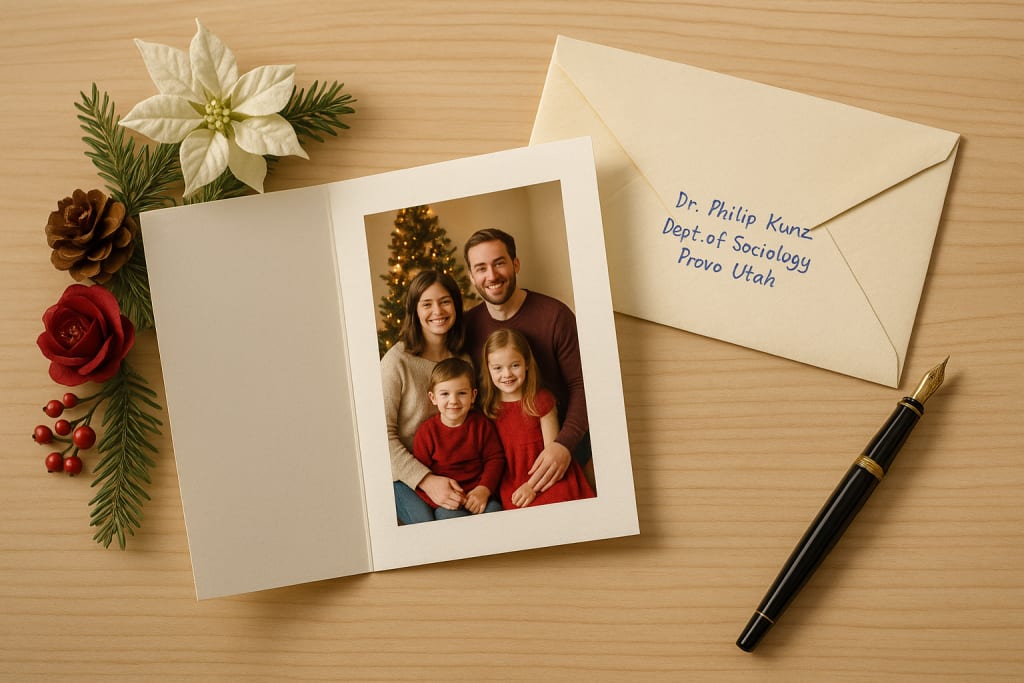
In the winter of 1974 a sociologist named Philip Kunz dropped hundreds of Christmas cards into the mail. He sent them to people he had never met. The names and addresses were pulled from directories. The cards looked personal. They included a photograph of his family, a handwritten signature, and all the small cues that signal genuine warmth. He waited to see what would happen.
The first replies arrived almost immediately. Neatly addressed envelopes from strangers landed in his mailbox through December and into January.
- Many people wrote long, heartfelt notes. Some included their own family photos.
- Several added yearly updates about children, work, health, and hopes for 1975.
- Most assumed they must have known Kunz at some point, even if the memory had faded.
- Others admitted they could not place him but returned the card anyway.
When the count stopped, nearly all returned the gesture.
The experiment became famous because it exposed a behavioral reflex that sounds simple but runs deep. Humans copy the intent they think they are receiving.
- Kindness pulls kindness.
- Warmth pulls warmth.
- The social brain imitates incoming signals before it confirms their source.
The fact that the sender was a stranger did not matter. The signal felt real, so people matched it.
In behavioral science this sits under reciprocity, but the Kunz study shows something wider. It is not just about paying someone back. It is about copying a tone that seems directed at you.
I have seen the same mechanism in criminal interviews, domestic conflicts, and field crisis assessments.
- When a subject thinks they are approached with respect, their tempo changes.
- When they think they are being cornered, their speech tightens and their body compresses.
- Humans match what they believe they are receiving, even when the belief rests on thin evidence.
The Christmas card study is a rare case where the incoming signal was positive. Most of the famous behavioral stories lean the other way. Anyone who has studied group harm knows how quickly people copy aggression, fear, or suspicion. Pressure moves through a crowd the same way warmth moved through those holiday letters. What the Kunz experiment captured was the benign version of a rule that holds across the spectrum.
The replies also showed how willing people are to create a story that explains the incoming signal, without any evidence. Many assumed there must be a forgotten connection, a meeting years ago, or a distant friend-of-a-friend who kept better records than they did.
This narrative patchwork is something I have watched countless times when people receive mixed signals in relationships or during conflict mediations. When a gesture feels directed, the brain tries to make it fit. The story often comes after the behavior, not before it.
There is a second layer that rarely gets mentioned. The warmth people returned was not driven by deep cognitive reasoning. It was driven by social mimicry. When a letter arrives with a family photo and a handwritten note, it triggers the scripts people use with familiar others.
- They respond automatically without critical or independent thinking.
- They act as though the connection is real because the cues appear real.
Had Kunz sent typed cards with no photograph, the rate of return would have been different. The form mattered. People respond to cues long before they respond to facts.
During my forensic and trauma therapy careers I saw the same pattern in high-risk situations.
- A soft tone lowered defenses even when the history was volatile.
- A sharp phrase escalated a room even when no threat existed.
People read cues faster than they read content. The Kunz study is a gentle illustration of a mechanism that often shows its sharpest edge in violent settings.
The experiment also raises a seasonal tension. December amplifies mimicry. People follow the emotional temperature of the moment:
- bright storefronts,
- holiday music,
- year-end rituals, and the old scripts of sending cards or checking on relatives.
The environment cues people to act a certain way. Most do not question it. Social momentum pulls them. The same momentum can push people in the opposite direction during stressful seasons when financial strain, grief, or isolation interrupt the script.
When I look at the Kunz cards now, I see a simple question behind them. How much of what we call kindness is a decision, and how much is a reflex?
- The replies were genuine, but they were also patterned.
- They followed the tone that arrived in their mailbox.
The Christmas card study is a reminder that influence does not always arrive through force. Sometimes it arrives through a folded card, a handwritten line, and a photograph of a family that belongs to someone you have never met. The response tells us less about the sender than it does about the mind that receives it.
When you understand this mechanism, watch any crowd.
- Protests.
- Religious events.
- Violence that sweeps through a block in seconds.
People copy the tone they think they are receiving from other humans. They always have.
Sources That Don’t Suck
Cialdini, R. (2009). Influence: Science and practice (5th ed.). Pearson.
Goffman, E. (1967). Interaction ritual: Essays on face-to-face behavior. Anchor Books.
Milgram, S. (1974). Obedience to authority. Harper & Row.
Myers, D. (2010). Social psychology (10th ed.). McGraw-Hill.
Snyder, M., & Stukas, A. (1999). Interpersonal processes. In D. Gilbert, S. Fiske, & G. Lindzey (Eds.), The handbook of social psychology (4th ed., Vol. 2). McGraw-Hill.
Turner, J. C. (1987). Rediscovering the social group: A self-categorization theory. Basil Blackwell.
About the Creator
Dr. Mozelle Martin
Behavioral analyst and investigative writer examining how people, institutions, and narratives behave under pressure—and what remains when systems fail.
Keep reading
More stories from Dr. Mozelle Martin and writers in Humans and other communities.
Why Highway Stops Feel Harsher
I have taught law-enforcement classes since 1987. In classrooms and ride-alongs, a pattern kept showing up in story after story. Drivers say highway patrol feels brusque, sheriffs’ deputies feel more human, and city police land somewhere in the middle. The truth isn’t personality. It is structure. Change the mission, the boss, and the metric, and you change the roadside script.
By Dr. Mozelle Martin3 months ago in Humans



Comments
There are no comments for this story
Be the first to respond and start the conversation.