
The Call of Abraham: A Bible Story of Faith, Promise, and a Journey into the Unknown
A Bible Story


In the annals of ancient history, long before the great kingdoms of Israel and Judah, there lived a man whose life would forever alter the course of human destiny. His name was Abram, and he hailed from Ur of the Chaldeans, a bustling, idolatrous city in Mesopotamia, renowned for its ziggurats and its worship of many gods. Abram was a descendant of Noah's son Shem, and he lived with his father, Terah, his wife, Sarai, and his nephew, Lot, who was the son of his deceased brother Haran. Their lives in Ur were settled, rooted in the familiar rhythms of their culture and their ancestral lands.
Yet, amidst the polytheistic fervor of Ur, a singular, powerful voice pierced through the din – the voice of the One True God. This God, who had created the heavens and the earth, chose Abram for a unique and extraordinary purpose. The divine call came with an audacious command and an even more astounding promise:
"Leave your country, your people and your father’s household and go to the land I will show you. I will make you into a great nation, and I will bless you; I will make your name great, and you will be a blessing. I will bless those who bless you, and whoever curses you I will curse; and all peoples on earth will be blessed through you."
Imagine the weight of such a command. To leave everything familiar – family, friends, homeland, security – and embark on a journey to an unknown destination, guided only by an unseen God. This was not a suggestion; it was a divine imperative, demanding absolute trust and unwavering obedience. The promise, however, was equally immense: a great nation, a great name, a blessing that would extend to all the families of the earth. This was a covenant, a sacred agreement, initiated by the Creator of the universe with a humble man from Ur.
Abram, then seventy-five years old, did not hesitate. His faith was not a blind leap into the dark, but a profound trust in the character of the God who called him. He gathered his wife Sarai, his nephew Lot, all their possessions, and the people they had acquired in Haran (a city they had settled in for a time during their journey from Ur, as Terah had died there). They set out from Haran, turning their backs on the known world, their faces set towards the land of Canaan, the land God had promised to show him.
Their journey was long and arduous. They traversed vast deserts, navigated rugged terrains, and faced the uncertainties of nomadic life. Yet, throughout it all, Abram held fast to the promise. He was a sojourner, a pilgrim, his identity defined by his unwavering faith in the divine call.
Finally, they arrived in the land of Canaan, a land already inhabited by various peoples. Abram passed through the land as far as the site of the great tree of Moreh at Shechem. And there, at Shechem, the Lord appeared to Abram once more, confirming the promise: "To your offspring I will give this land." In response to this renewed assurance, Abram built an altar to the Lord, who had appeared to him. This act of building an altar was a profound declaration of worship and dedication, marking the sacred ground where God had revealed Himself.
From Shechem, Abram moved on to the hill country east of Bethel and pitched his tent, with Bethel on the west and Ai on the east. There he built another altar to the Lord and called on the name of the Lord. These altars were not merely stones piled high; they were monuments of faith, places of communion, and markers of God's presence in his nomadic life. They signified Abram's commitment to worship the One True God in a land filled with idols.
However, the path of faith is rarely without its trials. A severe famine struck the land of Canaan, forcing Abram to descend into Egypt to live there for a while, because the famine was so severe. This period in Egypt brought its own set of challenges and moral compromises, serving as a stark reminder of human frailty even in the life of faith. Yet, through divine intervention, Abram and Sarai were protected, and they eventually returned to Canaan, enriched by their experiences, though not without the lessons learned from their temporary deviation from the promised land.
Upon their return, the land could no longer sustain both Abram's and Lot's large flocks and herds. Disputes arose between their respective herdsmen. Abram, ever the man of peace and wisdom, proposed a separation: "Let’s not have any quarreling between you and me, or between your herders and mine, for we are close relatives. Is not the whole land before you? Let’s part company. If you go to the left, I’ll go to the right; if you go to the right, I’ll go to the left." Lot, looking out over the well-watered plain of the Jordan, chose the fertile land towards Sodom, a choice that would later bring him much distress. Abram, in humility and trust, settled in the land of Canaan.
After Lot had parted from him, the Lord spoke to Abram again, reaffirming and expanding upon His earlier promises: "Look around from where you are, to the north and south, to the east and west. All the land that you see I will give to you and your offspring forever. I will make your offspring like the dust of the earth, so that if anyone could count the dust, then your offspring could be counted. Go, walk through the length and breadth of the land, for I am giving it to you."
This was a profound moment of confirmation. Despite the challenges, the uncertainties, and the temporary setbacks, God's promise remained steadfast. Abram, in response, moved his tents and went to live near the great trees of Mamre at Hebron, where he built yet another altar to the Lord. Each altar was a testament to his journey, his encounters with God, and his unwavering belief in the divine covenant.
The story of the Call of Abraham is not merely an ancient tale; it is a foundational narrative of faith. It illustrates the power of a divine promise, the courage required for radical obedience, and the transformative journey of one man who dared to trust an unseen God. From Abram, who left everything, came Abraham, the "father of many nations," whose descendants would number as the stars in the sky and the dust on the earth. His willingness to step into the unknown, guided by faith alone, set a precedent for all who would follow, demonstrating that true blessing comes from trusting in the One who calls.
About the Creator
David Andrews
Hi, I'm David A., I'm excited to explore topics that inspire, inform, and engage readers across different genres. I bring a blend of curiosity and creativity to my writing journey here on Vocal Media.
Keep reading
More stories from David Andrews and writers in Humans and other communities.
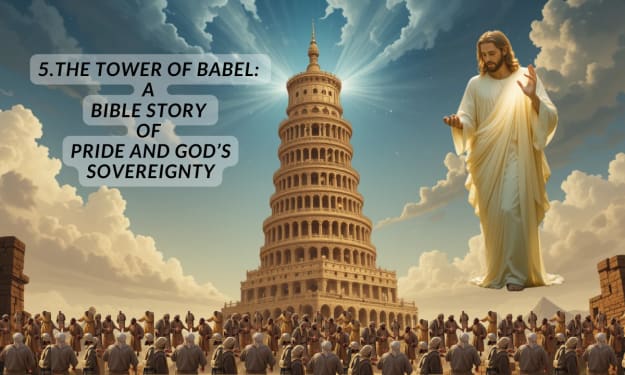
5. The Tower of Babel: A Bible Story of Pride and God’s Sovereignty
In the ancient days, not long after the great flood that covered the earth, the descendants of Noah began to multiply and spread across the land. They settled in a fertile plain called Shinar, in the region of Mesopotamia, around 2000 BC. The story of the Tower of Babel, found in the Book of Genesis (11:1-9), is a brief yet profound account of human pride, unity gone astray, and God’s sovereign plan to humble mankind. This narrative, one of the earliest in the Bible, reveals the dangers of self-exaltation and the power of God to redirect humanity toward His purpose, a lesson that echoes through time.
By David Andrews8 months ago in Humans
Let's Don't Do This
"I just can't do this anymore..." "Do what?" What can't you do? Put gas in your own car? I swear to God you make me take care of everything, don't you? You know I'm on my way to work right now but that never stops you from bothering me, does it?"
By Shirley Belk7 days ago in Fiction


Comments (1)
This story of Abram is truly remarkable. It makes you wonder how he found the courage to leave everything behind on just God's command. I can't help but think about times in my life when I've had to take a leap of faith, even when the outcome was uncertain. How do you think Abram's faith grew stronger as he faced the challenges of this journey? And what lessons can we draw from his willingness to obey God?