
5. The Tower of Babel: A Bible Story of Pride and God’s Sovereignty
A Bible Story

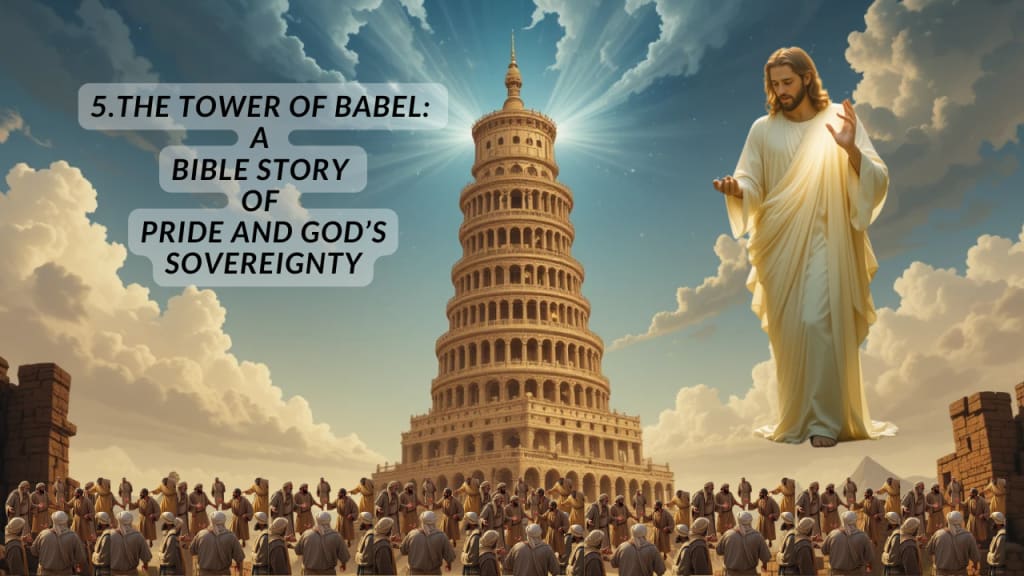
In the ancient days, not long after the great flood that covered the earth, the descendants of Noah began to multiply and spread across the land. They settled in a fertile plain called Shinar, in the region of Mesopotamia, around 2000 BC. The story of the Tower of Babel, found in the Book of Genesis (11:1-9), is a brief yet profound account of human pride, unity gone astray, and God’s sovereign plan to humble mankind. This narrative, one of the earliest in the Bible, reveals the dangers of self-exaltation and the power of God to redirect humanity toward His purpose, a lesson that echoes through time.
At this time, all the people of the earth spoke one language and shared a common speech. They lived together as one community, their unity a gift from God meant to foster harmony and cooperation. But as their numbers grew, so did their ambition. The people began to dream of greatness—not to honor God, but to make a name for themselves. One day, they gathered and said, “Come, let us build ourselves a city, with a tower that reaches to the heavens, so that we may make a name for ourselves and not be scattered over the face of the whole earth.” Their plan was bold: a towering structure, a ziggurat, that would symbolize their power and independence, as if they could reach the heavens and rival God Himself.
The people set to work with determination. They discovered they could make bricks by baking clay, a new technology for the time, and they used tar for mortar to hold the bricks together. Day after day, the tower rose higher, its base sprawling across the plain, its peak piercing the sky. The city around it buzzed with activity as men, women, and children worked together, their voices united in a single language, their hands united in a single goal. They believed their tower would be a monument to human achievement, a way to secure their legacy and avoid being scattered, as God had commanded Noah’s descendants to “fill the earth” after the flood.
But God saw what they were doing. From His heavenly throne, He looked down on the tiny tower—so grand in the eyes of humans, yet so small in His sight. He saw the pride in their hearts, their desire to exalt themselves above their Creator. God knew that if they succeeded in this, their unity in rebellion would lead to even greater sin. So, in His wisdom and mercy, He decided to intervene. “Come, let us go down and confuse their language so they will not understand each other,” God said. In an instant, the people’s single language splintered into many. Where they once spoke as one, now they babbled in strange tongues, unable to comprehend one another.
Chaos erupted on the plain of Shinar. A bricklayer called for more bricks, but his partner heard only gibberish. A worker shouted instructions, but the others stared in confusion, their words lost in a jumble of unfamiliar sounds. Frustration grew, and the once-unified community fractured. Unable to communicate, they abandoned their grand project. The tower, left unfinished, stood as a monument not to human greatness, but to the folly of pride. The city was called Babel, meaning “confusion,” because there God confused the language of the whole world. From that place, the people scattered across the earth, forming new nations and cultures, just as God had intended.
This ancient story, passed down through the ages, holds deep meaning for us today on May 26, 2025, at 06:49 PM IST, as we share it on platforms like Vocal Media. The Tower of Babel teaches us about the dangers of pride and the importance of humility before God. The people of Babel sought to make a name for themselves, placing their own glory above God’s, but their plans were thwarted by His sovereign power. It reminds us that true unity and purpose come from aligning our hearts with God’s will, not from exalting ourselves.
For us now, this story challenges us to examine our own ambitions. Are we seeking to build “towers” in our lives—whether through success, wealth, or recognition—for our own glory, or for God’s? The confusion of languages at Babel also highlights the beauty of diversity that resulted from God’s intervention. Today, the world is filled with countless languages and cultures, a testament to God’s plan for humanity to spread and fill the earth. Yet, in our diversity, we can still find unity by coming together in faith, love, and humility, as God desires.
The story of Babel also points to a greater hope. Centuries later, at Pentecost, as described in the Book of Acts, God reversed the confusion of Babel by enabling the apostles to speak in many languages, uniting people through the Gospel. This reminds us that God’s ultimate plan is to bring people together under His love. As we reflect on this story on this Monday evening, let us humble ourselves before God, seek His purpose for our lives, and celebrate the diversity of His creation, trusting that He is always in control, even when our plans crumble.
About the Creator
David Andrews
Hi, I'm David A., I'm excited to explore topics that inspire, inform, and engage readers across different genres. I bring a blend of curiosity and creativity to my writing journey here on Vocal Media.
Keep reading
More stories from David Andrews and writers in Humans and other communities.
Cain and Abel: A Bible Story of Jealousy and Redemption
In the early days of the world, shortly after Adam and Eve were expelled from the Garden of Eden, they began a new life on the earth God had created. They had two sons, Cain, the firstborn, and Abel, the younger. The story of Cain and Abel, found in the Book of Genesis (4:1-16), is one of the Bible’s earliest accounts of human struggle, revealing the destructive power of jealousy and the enduring mercy of God. Set in a time long before recorded history, this story speaks to the complexities of the human heart and God’s call for righteousness, a lesson that resonates even today.
By David Andrews8 months ago in Humans
Time Management Tricks Used by Top Performers
Time is one of the most valuable resources, yet many struggle to use it effectively. Top performers—be they entrepreneurs, executives, or athletes—understand that managing their time efficiently is crucial to achieving extraordinary results. Effective time management allows them to prioritize what matters, maintain focus, and consistently reach their goals. This article explores the key time management tricks used by high achievers and how you can adopt them in your own life.
By Muhammad Irfan Afzal6 days ago in Humans


Comments (1)
The story of the Tower of Babel is really something. It shows how humans can get carried away with pride. I wonder what would've happened if they'd succeeded. It makes me think about how our own ambitions can sometimes lead us astray. And that new tech of making bricks? It was a game-changer for them, just like new tech is for us today.