
The Boy Who Refused to Blink
A literary tale of rebellion, injustice, and the cost of keeping your eyes open in a world built on silence.

I. The Child: Born Guilty
The boy was born on a Tuesday—a day his village called Damnation’s Dawn. His mother bled silence, and the doctor wore no gloves. The hospital bed was cold; the window open in winter. They say he didn’t cry when he was born. They say he blinked once, then never again.
His first word was “No.”
Not Mama, not Papa, but a firm, steady No to the man who slapped him for crawling too slowly toward a bowl of rice.
They didn’t name him for five years.
The villagers whispered, “Don’t name a creature that curses every breath.” He was called Bastard, Burden, That Boy, until he carved his name—Ameen—into the teacher’s desk with a broken pencil and dried blood.
At seven, he asked the priest why God had ten fingers but only pointed with one.
He was whipped.
At ten, he asked why men drank the wine they forbade their daughters to touch.
He was locked in a room for three days and fed regret and rice.
He blinked once.
The priest died a week later of unexplained seizures.
II. The Boy: A Student of Contradiction
Ameen’s adolescence was a battlefield of silent wars. He had questions. Too many. He asked why schools banned literature about revolutions but made students pledge loyalty to a flag that stood for none. He asked why abuse at home was called “discipline,” and why teachers could fail children for failing to obey.
He once wrote an essay titled: “If Freedom Were Real, I’d Have Met It by Now.”
He got a zero. And a slap.
But the story leaked. A rebellious blog posted it.
They expelled him and told his parents, “Your son is dangerous.”
His father wept not out of grief, but fear. “I raised a thinker. God forgive me.”
He blinked once.
III. The Man: Shadows in Suits
Ameen grew older, and the world grew narrower. He worked in a corporate building where injustice was painted white and called “policy.”
Bosses shouted.
HR whispered.
Women cried in elevators.
Men drank behind thick glass.
The company motto? “Dignity in Profit.”
He once saw a man fired for refusing to laugh at a client’s racist joke.
He blinked once.
When a female colleague was demoted after rejecting her manager’s hand on her thigh, he stood up at the next board meeting and read aloud a resignation letter not his own.
He was fired. But the company didn’t admit it.
They said: “Mr. Ameen has chosen a new path toward growth.”
He left with a grin.
The building burned down two weeks later.
The official cause was “faulty wiring.”
IV. The Old Man: A Stranger Among Sheep
By the time he was seventy, Ameen had outlived five presidents, two dictators, four coups, and one revolution that changed everything except the people.
His village, once gray with hunger, was now gold with hypocrisy. The church had Wi-Fi. The school taught obedience as ethics. The police smiled more, but their batons were longer.
They called Ameen The Last Madman.
He lived in a one-room shack with rusted spoons and overgrown truth. Children were warned not to speak to him. Some said he was a witch. Others said he had once made a government official cry with a single question.
The question?
“What do you owe the people you lied to?”
Ameen blinked once.
V. Suspicion, Suffering, and Salvation
One stormy evening, a girl knocked on his door.
Twelve years old. Bruised forehead. Torn skirt.
She didn’t speak for ten minutes.
Then: “My uncle says girls are born sinful.”
Ameen asked, “What do you say?”
“I say my uncle drinks oil and calls it God.”
Ameen laughed for the first time in thirty years.
He gave her a blanket, a bowl of leftover courage, and a page from his journal. It read:
“If you survive them, you owe them nothing.”
She stayed. Word spread. Children began visiting. Listening. Asking. Disagreeing. Reading. Crying. Blinking.
The village elders called it a cult.
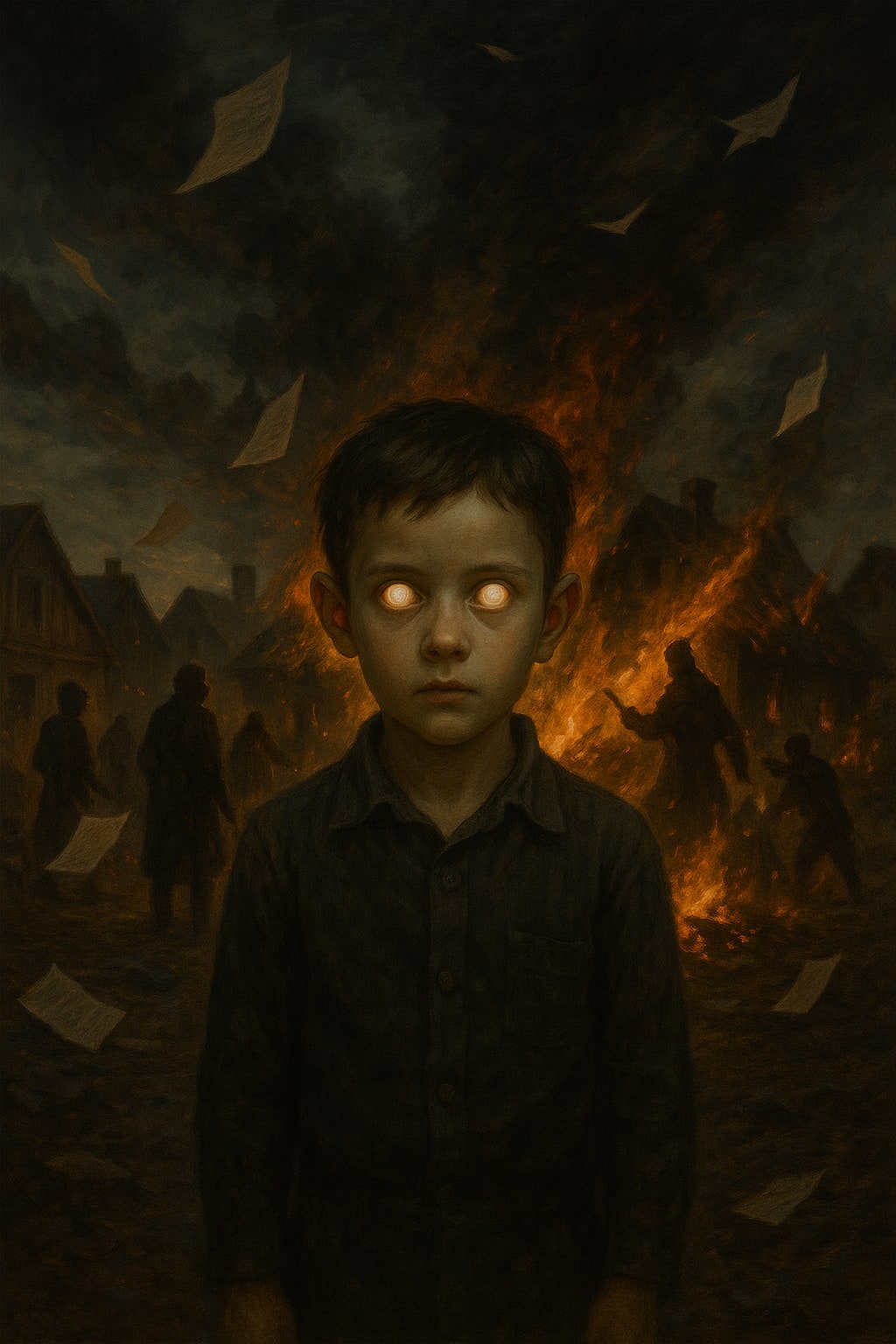
They came at night with torches and a man in a red robe who said, “You corrupt our youth.”
Ameen said nothing. He only stared.
They burned his shack. But they didn’t see him inside.
They found the girl instead, sitting cross-legged amid the flames, reciting Ameen’s poems.
VI. Legacy and Literary Rebellion
Two days later, newspapers reported the fire as “An unfortunate accident during a community festival.”
The mayor denied all accusations of forced silence.
The police arrested no one.
The girl was never seen again.
But then—
His writings began appearing on abandoned billboards, school lockers, the inside of confession booths.
“They said I was born guilty, so I lived as if guilt was a myth.”
“The only crime worse than rebellion is acceptance.”
“Those who profit from your silence will call your scream insanity.”
The new generation began blinking less.
As if remembering something ancient.
Something... forbidden.
VII. The Final Blink
They say Ameen died sitting on a broken chair beside a mirror that never reflected him. There was no body—only an old diary soaked in rain, and a final scribbled line:
“If truth must suffer, let it bleed through the mouths of the abused, the mocked, the disrespected, the dismissed. And if I must die for blinking last, so be it. Let them fear the eyes that never closed.”
They buried him in an unmarked grave, hoping memory would decay faster than bones.
But memory, like rebellion, rots slow.
And somewhere, a child asks:
“What happens if I stop blinking too?”
About the Creator
Muhammad Abdullah
Crafting stories that ignite minds, stir souls, and challenge the ordinary. From timeless morals to chilling horror—every word has a purpose. Follow for tales that stay with you long after the last line.
Keep reading
More stories from Muhammad Abdullah and writers in Humans and other communities.
The Four Faces of Ishaaq
I. The Child: Born in a House of Silence Ishaaq was born on a Monday—a day neither holy nor cursed—into a house made of mud, secrets, and silence. His mother’s scream was the only sound in the room when he arrived. Not a wail from Ishaaq, not a word from his father. A midwife muttered “He looks like a thinking boy”, as if that were a curse in a town that worshipped ignorance.
By Muhammad Abdullah9 months ago in Humans
A Historic Declaration
We the People of the Husbands of the United States of America, in Order to form a more perfect Union, and I mean you...with me...establish Justice, insure domestic Tranquility, provide for the common defence, promote the general Welfare, and secure the Blessings of Liberty to ourselves, after Puberty, do ordain and establish this Declaration of Co-Dependence.
By Gerard DiLeo6 days ago in Humans
me, me, me
when i read back my poetry it screams “me, me, me” on my screen in bold letters and i can’t shut it up — most days, i cannot make any other words out; i want to throttle a thousand versions of the me gone by, i want to throw myself from a figurative balcony, i want to sink a sword into every pen i’ve held
By angela hepworth7 days ago in Poets


Comments
There are no comments for this story
Be the first to respond and start the conversation.