
Taj Mahal
History, architecture, legends, significance, controversies, and cultural events surrounding the Taj Mahal.

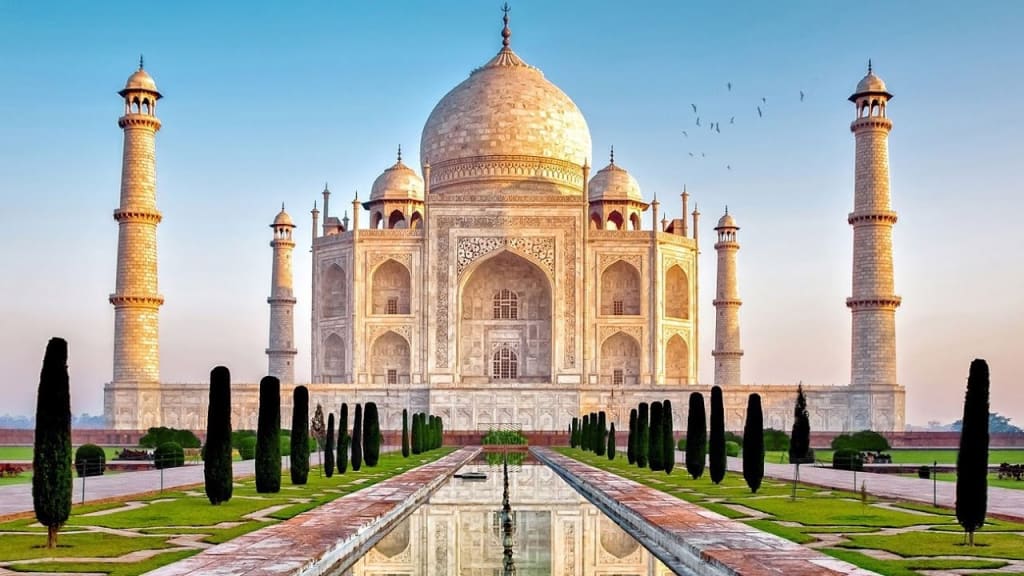
The Taj Mahal is a white marble mausoleum located in Agra, India. It was commissioned in 1632 by the Mughal emperor Shah Jahan in memory of his beloved wife Mumtaz Mahal, who died in childbirth. The Taj Mahal is considered one of the greatest examples of Mughal architecture, and is renowned for its intricate design and beauty.
The structure features a central dome flanked by four smaller domes, with a minaret at each corner. The white marble facade is decorated with intricate inlaid designs made from precious and semi-precious stones. The interior of the Taj Mahal is equally impressive, with elaborately carved marble screens and a large marble cenotaph that marks the location of Mumtaz Mahal's tomb.
The Taj Mahal is also notable for its beautiful gardens, fountains, and reflecting pool, which add to the overall grandeur of the complex. It is considered one of the most iconic and beautiful buildings in the world, and is a popular tourist destination. The Taj Mahal was declared a UNESCO World Heritage Site in 1983, and is considered a masterpiece of Islamic art and architecture.
The construction of the Taj Mahal took over 20 years to complete, with thousands of artisans and workers involved in its creation. The white marble used in the construction was brought from Rajasthan and the precious and semi-precious stones were sourced from all over India and beyond.
The Taj Mahal is also steeped in history and legend. It is said that Shah Jahan was so devastated by the death of his wife that he went into mourning for two years and contemplated giving up the throne. During this time, he planned the construction of the Taj Mahal as a symbol of his love for Mumtaz Mahal. It is also said that Shah Jahan intended to build a mirror-image of the Taj Mahal in black marble on the other side of the river, but this plan was never realized.
Over the years, the Taj Mahal has undergone several restorations to preserve its beauty and structural integrity. In recent years, there have been concerns about the impact of pollution on the marble structure, and measures have been taken to mitigate this. Today, the Taj Mahal remains one of the most iconic and awe-inspiring structures in the world, attracting millions of visitors each year.
In addition to its architectural and cultural significance, the Taj Mahal has also played a role in various historical events. During the Indian Rebellion of 1857, the Taj Mahal served as a barracks for British soldiers. In 1942, during World War II, the Indian government had the Taj Mahal covered in scaffolding to prevent it from being bombed by the Japanese.
The Taj Mahal has also been the subject of many literary works and artistic representations. It has been depicted in numerous films, including the popular 2001 movie "Moulin Rouge!" and the 2012 James Bond film "Skyfall." The Taj Mahal has also been the inspiration for many poems, novels, and songs over the years.
Despite its popularity as a tourist destination, the Taj Mahal remains an active site of worship, with daily prayers offered at the mosque located within its complex. The Taj Mahal also plays host to many cultural events throughout the year, including the annual Taj Mahotsav festival, which celebrates Indian culture and heritage.
In 2007, the Taj Mahal was declared one of the Seven Wonders of the World in a global online poll. This recognition cemented the Taj Mahal's status as one of the most iconic and celebrated structures in the world.
While the Taj Mahal is a widely recognized symbol of love and romance, it has also been the subject of controversy and political debates in recent years. Some political groups in India have raised objections to the Taj Mahal, arguing that it represents a legacy of Muslim rule in India and promotes an Islamic cultural identity. These groups have called for the removal of the Taj Mahal from Indian tourism brochures and for the renaming of streets named after Mughal emperors.
However, these calls have been met with widespread criticism, with many arguing that the Taj Mahal represents a shared cultural heritage of India and is an important symbol of the country's history and identity. The Indian government has also taken steps to preserve and protect the Taj Mahal, including the establishment of a 24-hour monitoring system and a ban on the use of polluting fuels in the surrounding areas.
Despite these controversies, the Taj Mahal continues to inspire awe and wonder in visitors from all over the world. Its enduring beauty and cultural significance make it one of the most iconic landmarks not just in India, but in the entire world.
About the Creator
Autonomy Is The Real Privilege
Good morning, freedom-seekers! Today we’re gonna be looking at autonomy. A strange word, I know; one many would probably look at blankly and run away from on sight. We’re gonna figure out what it actually means, consider how it’s achieved, and decipher just how deeply most of us are tangled up in dependence without realising it.
By That ‘Freedom’ Guyabout 13 hours ago in Humans



Comments
There are no comments for this story
Be the first to respond and start the conversation.