social media
Social Media for modern lovers in the digital age.
Influence in Action
Today’s influencers epitomize a sea of change. They are, in a sense, our present role models – both good and bad. With the last two years being even more reliant on technology as we distanced ourselves from face-to-face relationships, this trend is even truer.
By Jennifer Christiansen4 years ago in Humans
Learning the next Language
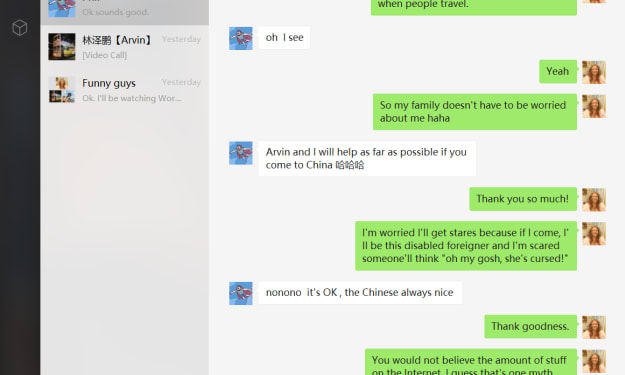
Not a lot of people love learning a language. When most people are teenagers, a lot of them don't want to even confront something that isn't their home language, at least not in America and not in my experience. In my previous attempts at learning languages, I had learned French and Spanish via the free mobile app called DuoLingo. Although it was useful for learning basic reading skills and pronunciation with the two previously mentioned languages, I found speaking Chinese hard because I didn't have a way to record myself on the app, so I couldn't know how I was doing with reading unless I recorded myself on my phone's original voice app. I didn't have enough space to do this, so I just suffered through it until I discovered WeChat through a friend named Arvin.
By Savannah Davidson4 years ago in Humans
Parasocial or Parasitic
What defines a parasocial relationship? “Wikipedia notes parasocial interaction (PSI) refers to a kind of psychological relationship experienced by an audience in their mediated encounters with performers in the mass media, particularly on television and on online platforms. Viewers or listeners come to consider media personalities as friends, despite having no or limited interactions with them. PSI is described as an illusionary experience, such that media audiences interact with personas (e.g., talk show hosts, celebrities, fictional characters, social media influencers) as if they are engaged in a reciprocal relationship with them. The term was coined by Donald Horton and Richard Wohl in 1956.”(1)
By Atomic Historian4 years ago in Humans
Has Online Shaming Become Out Of Control?
Online shaming is often described as a form of cyberbullying and has become more abundant than ever, in the past couple of years. As a society that relies so much on the internet, seeing online shaming has become a norm. There are many different ways that one can be shamed online. Common examples include shaming an individual for what they look like, who they love, what their gender identifies as, what their ethnicity is, and what their political views are. While in some cases online shaming can be okay, much of it is simply full of rude, and unnecessary remarks and opinions that would be better left unsaid. Because there is such a huge amount of these unnecessary cases of online shaming, it is most certainly justifiable to say that it is becoming out of control.
By Emily Clare Burgess4 years ago in Humans
America isn't Great
Why is America the greatest country in the world? Will McAvoy It's NOT the greatest country in the world. Fine. [to the liberal panelist] Sharon, the NEA is a loser. Yeah, it accounts for a penny out of our paychecks, but he [gesturing to the conservative panelist] gets to hit you with it anytime he wants. It doesn't cost money, it costs votes. It costs airtime and column inches. You know why people don't like liberals? Because they lose. If liberals are so fuckin' smart, how come they lose so GODDAM ALWAYS!
By Mae McCreery4 years ago in Humans
How to grow my instagram account
How to Get More Followers on Instagram: Today Instagram has established himself as one of the most used social media and many people are using it to make a revenue with it, it can rise to 10.000$ per post or story it depends the category and the number of followers
By Christophe Ribos4 years ago in Humans