
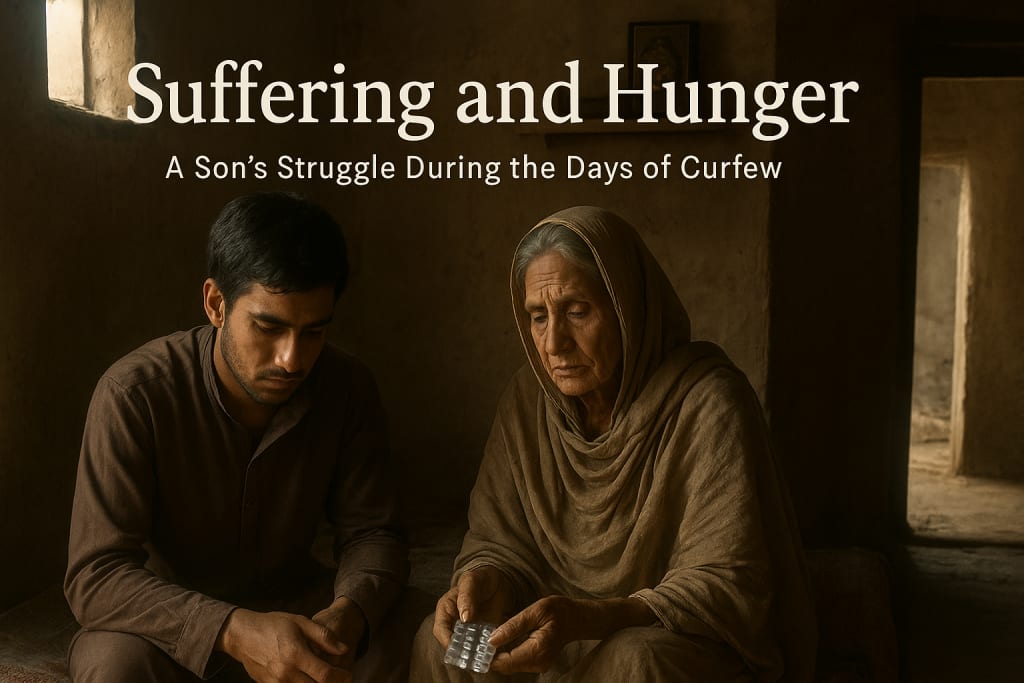
Suffering and Hunger: A Son’s Struggle for Survival During the Days of Curfew
When the world went silent, hunger spoke the loudest.

It was the day of pilgrimage. Like every other morning, I woke up to the call of dawn prayer. I washed, prayed my Sunnah, and left home for the mosque. Our small village sits between Mardan and Charsadda, and the mosque stands right along the main road.
As I turned toward the paved road, I saw flashing lights from several vehicles parked along the bypass. I didn’t pay much attention — garbage trucks often stopped there at dawn. But that morning was different.
When I entered the mosque, the usual peace was missing. Men sat in circles, voices raised, everyone arguing like doctors and journalists. The topic was the same everywhere — the Corona pandemic.
Hearing them brought back a memory of the day before — of Dr. Saadat Khan Saeed, a respected man from our village. He had just returned from Umrah and lived across from our market in Manga Bazaar. Health officials had come to question him, worried he might be infected. He told them, calmly, “I’m fine — no fever, no cough.” Tests confirmed he was healthy. Yet that night, a coffin arrived from the hospital, his face covered. The rumor spread faster than truth ever could.
Lost in thought, I didn’t notice the tension outside until someone shouted, “Boy, why are these police blocking the bypass?”
Another man replied, “Curfew! The whole Manga area is sealed — no one in, no one out.”
My heart sank. My job was in Manga Bazaar, and my mother’s medicines were running out. She had diabetes, high blood pressure, and weak eyesight — her pills were as vital to her as air. She’d told me the night before, “Son, please bring my medicines after Fajr.” I had nodded, but my pockets were empty. I had hoped to earn some money from the mine that week — but now even that was gone.
The curfew hit like a storm. Shops closed, people locked inside, silence on every street. I sat in the mosque, whispering Astaghfirullah under my breath, wondering how we would survive.
At home, my mother tried to stay calm. She asked about the virus, and I told her what people were saying — that it was a foreign conspiracy. She raised her trembling hands and prayed, “May Allah destroy those who spread such suffering.”
In the evenings, we gathered for prayers, reciting Surah Yasin for protection. Hope was all we had left.
Days passed. One morning, as I sat reading, my mother placed two empty pill strips before me.
“Son,” she said softly, “these are finished. Everything else can wait — but these cannot.”
I looked at her fragile hands, her tired eyes. I wanted to tell her it would be fine, but I didn’t believe it myself. The pharmacies were closed, and no one was allowed to leave the area. Hunger had already begun to bite.
That day, I realized something: disease doesn’t always kill — sometimes it’s hunger, sometimes helplessness.
As I watched my mother quietly recite prayers, I felt both powerless and blessed — powerless because I couldn’t save her, and blessed because I still had her by my side.
The curfew lasted weeks. I don’t remember how many days we survived on tea and dry bread. But I’ll never forget the fear, the silence, and the hunger that taught me what it truly means to depend on God.
This story isn’t just about a virus or a lockdown. It’s about the quiet suffering hidden behind closed doors — where a mother’s prayer and a son’s love become the only medicine left.
About the Creator
Keep reading
More stories from shahkar jalal and writers in Humans and other communities.
The Broken Promise: A Tale of Love, Class, and Silent Suffering
Aslam was leaving his uncle’s house today — apologizing to everyone as if he would never return. Even if his uncle had lived for a thousand years, Aslam no longer felt like spending another moment there. The silence of the previous day, the silence that came from Shinu, still echoed painfully in his mind.
By shahkar jalal3 months ago in Humans
Minnesota and Illinois Invoke the 10th Amendment in Lawsuits to Block Federal Agents in Their Cities — Here’s Why That Matters
States Push Back Against Federal Enforcement Minnesota and Illinois have launched high-profile lawsuits invoking the 10th Amendment of the US Constitution in an effort to block or limit the actions of federal agents—particularly immigration enforcement officers—operating within their cities. The legal challenges mark a significant escalation in the long-running conflict between state governments and Washington over who has the authority to enforce immigration laws and how far federal power can reach.
By Aarif Lashari5 days ago in Humans


Comments
There are no comments for this story
Be the first to respond and start the conversation.