
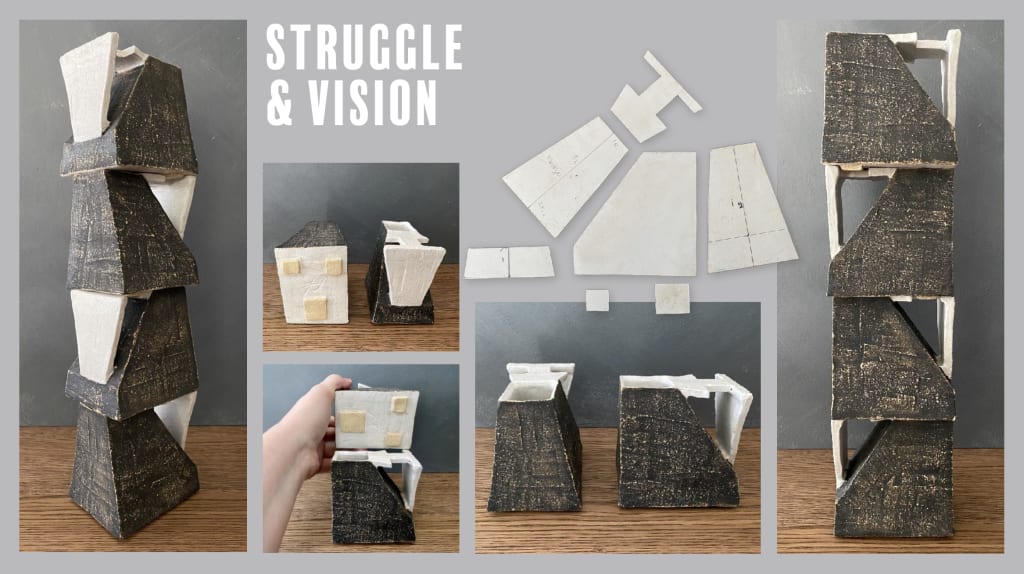
Being the sculptor of ceramic pieces endows the artist with a unique sense of power. Whatever comes from our hands has the ability to transcend time. The time our bodies, and the bodies of those we love, and the bodies of those we will love, are allowed. It’s a responsibility that few get to experience — creating something that has the potential energy to be seen and studied as a touchstone of present-day culture.
It’s that feeling, mixed with pride and trepidation, that I’m reeling with when inspecting my recently completed architectural, brutalist tower of stacking mugs. Each one is only four inches by four inches, a handful at best. They stack four cups high, all angles and rough texture. They’re made to mimic the feeling and look of a concrete structure, and stacked together they really, truly seem like a miniature tower. I step back and sigh. It’s taken two years of trial and error to reach this moment.
When the idea came to me two years back, I was supposed to be monitoring fourteen year-olds taking an exam. Teachers typically aren’t allowed to do anything. We’re just supposed to walk around placidly, give reminders about the time, and tell students to keep their eyes on their own work. However, illicit drawing was something I took part in every year. I would take a pencil from the pre-sharpened student bundle and find some scrap of paper no one needed. After each round of student surveil, I would primly sit on the edge of my chair, ready to pounce up at any moment as if I was actively monitoring at all times, and sketch on the corner of my scrap.
The idea formed slowly. I wanted to refine the ceramic series I started in college. I wanted a shape that shifted in width. I wanted it to stack, but for the stacking to rotate with each new cup. Once I’d completed the sketch, it felt important and daunting. It was only forty or so lines grouped together on a page, but the idea held significant weight. When testing finished, I carried it out of the classroom with reverence.
I sat on the idea for a little while, biding my time until I knew what steps I would take to bring it to fruition. I needed to see it in real proportion, to feel what it might be like in-hand.
“Ah!” I jolted up from my couch and into my tiny apartment ceramic studio. In the corner was an unassuming pad of Strathmore bristol paper. Zealously, I tore out a hearty sheet, plucked out the deep purple pair of Fiscars scissors from the jar of tools on my desk, and yanked the pad of graph paper from the top of my precariously stacked shelves. My head down at the kitchen table, I began designing the proportions on the graph paper, creating a template on the bristol paper, meticulously slicing through each penciled line, and then taping it together piece by piece.
Done. A sense excitement was welling in my stomach, but as I turned it in my hands, it felt clunky and awkward, too big in some places and lacking in others. I went back to the graph paper, creating new proportions with a slight hint of frustration. My scissors sliced satisfyingly through my thick sheet of bristol, and I felt closer this time. Delicately, I taped together my new mock-up. It was near perfection before I realized that ceramics shrink once they’re fired. My eyes widened, I groaned loudly, scared my dog, apologized, then went back to the graph paper one last time.
As I held the finished mock-up in my hand, it felt even more intimidating than the sketch had. I would need to build four of these, each exactly the same. Clay doesn’t cut as nicely as paper does. It moves and shifts.
I took time to choose my materials carefully. I couldn’t build with any clay body. It needed that well-known concrete grittiness. At my beloved local ceramic shop, I found just the clay with just the right name: Armstone. With its grit and grey color; it was perfect.
However, the ceramic process moves on its own schedule.
It looks a little something like this: I first knead the clay, then use a machine, which looks something akin to a printing-press, to roll the clay into a slab with just the right thickness. Those meticulously cut bristol pieces become my guide, and I trace them onto the clay, cut them out, and bevel their edges. I leave them on plasterboard to eep out some of the moisture, but just the right amount, so they no longer flop but are still slightly malleable. Once I’ve determined, through much practice, that they are at the correct stage, I put them together into their final form. WHEW.
This process alone takes two to three hours. Then they’re dried, fired, glazed, fired again, and hopefully by the time you’ve gone through all the whoo-ha, they are what you’ve envisioned them to be. If not, you get to start all over again. Knowing this, I ended up making one, two, then three single mug prototypes before even starting the set of four. But the months of trial and error had me rearing to complete my geometrical, architectural feat.
I had been at my bench for hours, headphones on, music blaring. My back ached; my hands were covered in a thin layer of dried grey-ish mud, but I was almost done. All that was left was to see if they actually stacked together correctly. I gingerly grasped each mug, placing it gently on top of another. If my construction was sound, the raw clay should be able to take the pressure even without having gone through a 2000 degree oven.
“HAH! Look at that!” I shouted, jumping and pointing. My dog’s head lifted from her curled position, she tilted her head, and then flopped it flippantly back down. I wasn’t phased. I was alight with the joy of seeing something in real life that had been an idea only four months ago.
As I took these pieces through the rest of the ceramic process, they were practically treated like newborn babies. It took twice as long to do everything because these perfect angels were not about to be corrupted by carelessness. Their first firing was a triumph, so I painted them carefully with the new glaze I’d concocted in prototype. Swaddled in the perfect shade of grey and white, they went into the kiln for their final firing.
I sat up restless that night. It takes a full twenty-four hours for the kiln to heat then cool. Opening the kiln before it reached the right temperature could ruin everything, so I groaned into my pillow and reminded myself that they would be ready in the morning.
Eyes bleary, I blinked a few times before realizing what was waiting for me. I shot out of bed, dashed to the patio, swung open the door, and squealed. The back of my hand tested the temperature of the side of the kiln. Not too hot, but still a little warm. I slid in the kiln thermometer just to make sure I wasn’t putting my small babes in danger. It read 150 degrees. Perfect. Once I had my electrician’s gloves on, for the heat, I lifted the lid and collected all four onto a heat proof shelf. I hadn’t given them my full attention yet, my adrenaline was far too high for that; my fingertips were practically buzzing.
I placed the lid back on the kiln and took off my gloves. I took three deep breaths to gain back some control and finally turned, ready to critique my work. Placing them on one another, my chest started to feel tight. Fear started to creep in. This wasn’t it. They were too dark. The handles were too shiny. This wasn’t right at all. I went back and forth with myself. Was I going to have to re-do it all? Did this suffice? It…wasn’t what I had imagined it to be, and for the first time through this process, I was lost.
They stayed on my precariously stacked shelf for a year. My eyes flitted passed them in shame. It ultimately didn’t feel right to remake them, and so they sat there in limbo. Not quite finished, but not in progress.
One Saturday morning, as I was sitting on my couch, coffee in hand, I replayed in my head a lesson I’d given my students the day before about perseverance. I had stressed that creating a piece of writing was supposed to feel uncomfortable. The pull they felt in their chest and small spike of adrenaline was normal. Sitting with that uncomfortable feeling until inspiration comes is all part of the process, and I told them very directly not to let it scare them off.
Taking my first sip of coffee, I was first taken over by a wave of shame for my hypocrisy. But then I stood up and went to my shelves. I pulled off the mugs, dusted them, and started to sit with my discomfort.
Inspiration came flooding in. With sandpaper and a can of clear matte primer, I went to work. Conversely to my original plan, I sanded down the grit, but I was left with a gorgeous visual texture. My heart nearly kept out of my chest. While the spray was certainly unorthodox, it rendered the handle nearly perfect. I was elated. I stacked them together and just stared, baffled that it took me two years, but overflowing with pride.
This piece could last centuries, and it represented everything I was had. My struggle and my vision.
About the Creator
Keep reading
More stories from writers in Humans and other communities.
5 Things to Know About Intensive Outpatient Care and How It Works
Intensive outpatient care has become an important treatment option for individuals seeking support for substance use or mental health challenges without entering residential treatment. This level of care offers structured therapy while allowing people to maintain daily responsibilities such as work, school, and family life.
By Jordan Blake3 days ago in Humans
Wild Card Weekend Recap: What Happens Now?
I think I figured out why I love Wild Card Weekend so much. It's because it's the first playoff anything of the calendar year. The NFL season starts in the fall, and once upon a time, the champion was crowned either on or slightly before New Year's. The evolution of the NFL schedule has resulted in the playoffs starting just into the New Year, and currently, the final week of the season falls on the first weekend of the New Year, with Wild Card Weekend coming a week after that. So yes, chronologically, the NFL's Wild Card Weekend serves as the first playoff anything of the calendar year.
By Clyde E. Dawkins4 days ago in Unbalanced




Comments
There are no comments for this story
Be the first to respond and start the conversation.