
Standing In A Public Toilet, A Fellow Woman Called Me A Man
Being misgendered bothered me. But not as much as not telling anyone.

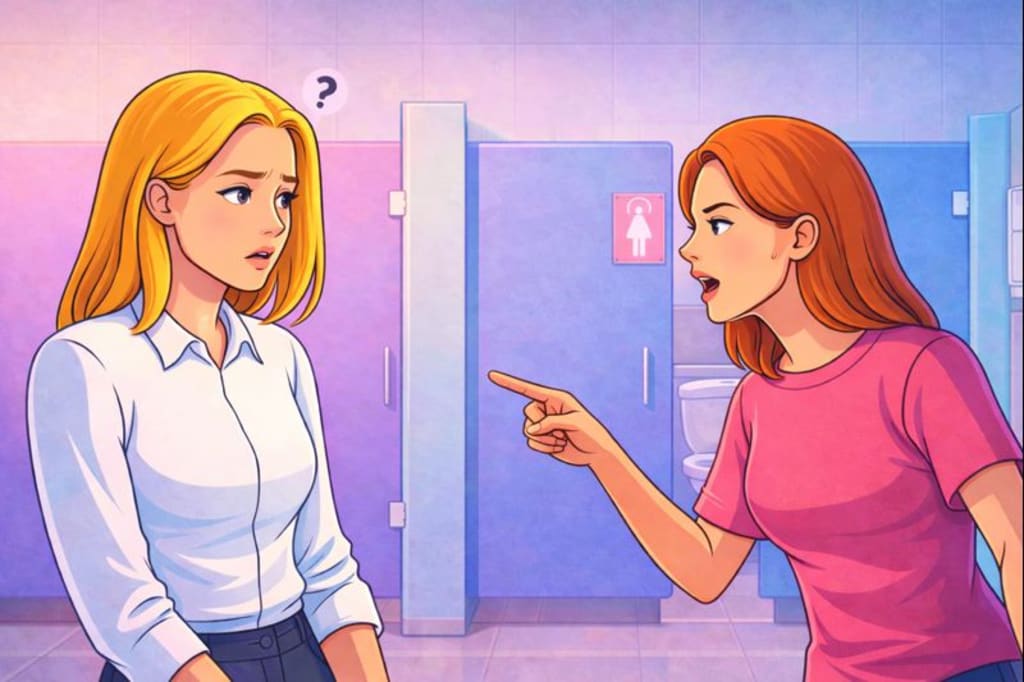
I haven’t told anyone this story before. The only person who knows it is my ex-husband, and that’s because he was there and he saw the devastation written across my face.
He also consoled me as I came to terms with the encounter I will never forget in the women’s bathroom.
As I recount what happened to me on that seemingly uneventful day, I wish I hadn’t been there either.
I can’t rewrite history, but something compels me to tell it. A part of me also knows it’s best to keep this a secret.
I’m struggling with the latter because when someone grossly offends you and simultaneously ruins your day, you want to tell someone.
So here goes.
Same old routine…
I make the same trek every time I’m at Forest Hill shopping centre, my local set of shops in Melbourne.
I enter through the food court entrance, snake my way to the closest escalators (past the always bustling McDonald’s), and use the first set of toilets I can see.
For some reason, I must go to the toilet whenever I get to the shops. As I get older, I’ve quit questioning my routine and wondering why this occurs. Instead, I go through the motions on autopilot.
When I arrived at the shops a week ago and journeyed to the bathroom, I didn’t think anything of what I was doing.
Dressed in exercise leggings, a Sherpa zip-up hoodie, and my hair down, I made my commute to the women’s bathrooms.
Normal.
…until it isn’t your routine
As I approached the bathroom entrance, I noted one of the cleaners ahead of me. She pushed her cart, gradually passing through the door that read “Female.”
I felt myself slow down as I saw her. Though I needed to use the facilities, I wasn’t desperate enough to run over a woman trying to do her job.
Besides, rushing people is the height of rudeness in my etiquette book.
But as she pushed the cart overflowing with paper towels and toilet paper, I watched as she angled the apparatus, which I assumed was a way to block the entrance to the bathroom.
I thought she might have been setting up to close the bathrooms and clean the floors and stalls uninterrupted. It wouldn’t have been the first time I had attempted to use the bathrooms only to find them closed for cleaning.
As I made my way through the entrance where she stood, I gave her a kind smile. She stared at me, studying my face with an intensity I had never seen before. Her eyes widened like I was an apparition entering her bedroom in the middle of the night.
I watched as she caught her breath.
I held my smile and politely asked, “Is it okay if I sneak by you to use the toilet?”
Her panicked expression quickly drained away from her. “Oh,” she remarked. “Oh, oh,” she repeated. “I thought you were a man. I thought you were a man coming into the bathroom.”
“Ah,” I responded. “I see.”
I then proceeded to the cubicle, used the toilet, washed my hands, and left.
Did that just happen to me?
I’m not a man. I’m a woman, a female in every sense of the word, and have been since birth.
I will occasionally wear men’s clothing, but typically, it’s an oversized T-shirt with a graphic print on the front.
To the naked eye, you wouldn’t know I bought it from the men’s department, and you wouldn’t be able to tell if it came from the women’s department, either. It’s just a T-shirt, after all.
I’ve never been called a man before.
I’ve never been mistaken for a man.
During my formative years at school, the nasty girls often noted that I was taller than everyone else, reaching 6 feet by my final year.
But they never went as far as to imply I wasn’t female.
There had never been any confusion before, which is probably why the experience hit me like a ton of bricks. It wasn’t like this was on my life bucket list, either.
The first person I ran into after the encounter was my husband. He was waiting for me outside the bookstore, just beside the side of the toilets. He looked at me, noticing my shocked expression and confused face, and asked, “What happened in there?”
It’s never good to leave a public bathroom looking traumatised. But for all my efforts, I couldn’t hide how I was feeling.
“I just got called a man.”
“What? Who called you a man?”
It’s the worst thing you can do to a woman
I recounted the story and watched my husband scan the shopping centre to find the cleaner in question. He noted that she was walking off in the opposite direction from us, unaffected by her assessment of me, continuing her work like nothing had happened.
“Oh babe, I’m so sorry this happened to you. You don’t look like a man.”
These were kind words from my husband, words that I knew were genuine and not just to appease me. After twelve years of dating, I appreciate the way he sees me.
He doesn’t think I’m a masculine-looking woman. He also knows it’s one of the most awful things you can do to a woman.
Outside of physical abuse, implying that she looks like a man cuts her femininity in half. It trivialises parts of her identity. It also suggests she’s not attractive and doesn’t have the womanly features that make her desirable.
Part of me has always lived with the fear of being called a man. Not because I worry that I look like one or that people will be confused.
But I watched one of my childhood friends receive the same question after we graduated.
It was our second time going to a nightclub, and one of the security guards tried to stop her from using the female toilet.
Watching my slightly tomboyish friend ridiculed in front of our friends and unforgiving punters was heartbreaking.
I never wanted to be in that situation, but history seemed to repeat itself in strange circumstances.
Instead, I wasn’t the bystander.
Was she right?
“Then why did she think I was a man?”
I didn’t want to ask or even contemplate the answer. But at that moment, I had to ask. I had to understand why a stranger was misgendering me in the middle of the day, in the middle of a public shopping centre, leaving me reeling from the experience.
My husband looked me up and down. “It’s not like you look like a man, by the way. I know you’re wearing pants, but your hair is out, and you’re clearly a female.” He cheekily pointed to my chest as he made my last remark.
I immediately put my hands to my face. “Is it because I’m not wearing make-up?”
“Even though you’re not wearing make-up, you’re obviously a female.”
“Is it because I’m tall?” I understand I’m taller than most average women. I usually come shoulder-to-shoulder with most of the men in my life.
My husband turned to where the cleaner was walking up in the distance. “I would’ve blamed that if it were a short woman, but she’s taller than you. So that’s not a good reason.”
Say it or don’t
It’s impossible not to speculate about why the cleaner chose to say her thoughts out loud.
She didn’t need to say that she thought I was a man or wondered if the figure approaching her was female. She didn’t have to justify why she looked surprised or alerted by my presence.
She didn’t have to say anything at all.
But for some reason (her reasons), at that moment, she decided to open her mouth and declare something that she could never take back.
“Do you think she misspoke?”
My husband paused. “Well, she might not have meant it to sound so cold. Perhaps she saw a tall finger enter the bathroom and, without looking, thought it was a man. But she didn’t have to say it.”
“That’s the problem I’m having. She chose to say it. She chose to call me a man.”
I keep repeating that sentiment to myself—this person chose to say these words, knowing the repercussions. There must be some belief behind it, which is troubling me.
A lot.
If one person is thinking and saying it out loud, how many people are sharing her thoughts and not saying anything at all?
Say something or get over it
“Are you going to say anything to her?”
My husband asked me this question, and as we stood in the shopping centre, both in shock, I contemplated the answer seriously.
Part of me wanted to march over to her as she walked away from us with her cleaning cart. I wanted to storm over, full of fury, and tell her how rude she had been.
If my words became argumentative and loud, I wouldn’t be apologetic. Chewing her out couldn’t possibly undo the hurt she bestowed upon me.
My second thought was to bypass her and go straight to the centre management for the shopping centre.
I wanted to find her boss and tell them all about how their employee had misgendered me in the bathroom.
I wanted to detail how I felt uncomfortable and ridiculed in a public setting by one of their employees.
I wanted to tell them to take action against this woman who needs common courtesy education.
But all those thoughts were irrational, perturbed thoughts that didn’t last long before my logical side took over. I wasn’t going to yell at her in the middle of a shopping centre — that wouldn’t help anybody.
I also wasn’t going to get her fired over it. People are struggling right now and don’t need some offended woman costing them their job.
My decision seemed clear. I wouldn’t say anything.
“No,” I quipped. “And there’s no point saying anything to her boss. She shouldn’t get in trouble for a slip of the tongue.”
A slip of the tongue. I repeated it to myself.
Even though my logical side knew it was the right thing to do, I couldn’t ignore how I was making excuses for someone I didn’t know who had insulted me to my face.
At this point, I was going through it.
But what if it wasn’t me?
I could handle moving past what happened if it were just me, my experience, this being an experience all to my own. After all, it was a once-off in a tiny shopping centre in the south of Australia, in a suburb some Melbournians haven’t heard of.
No big deal.
But what if this wasn’t just me?
My thirty-second encounter in the bathroom, my once-off in my lifetime misgendering, is what some people experience every single day, every time they enter a bathroom outside the safety of their home. Sometimes, their home isn’t safe, either.
In a brief moment, I understood what it was like to be a transgender person, walking into a bathroom and having a stranger question their reasons for being there.
I felt the pain, the ridicule, the shame of picking the “right” bathroom. I understood their pain and hurt and how a stranger can tear you down with a straightforward statement.
My experience lasted a moment, a minute, and I will likely never experience it again. I couldn’t fathom going through this every day. I don’t want to imagine needing to use the bathroom and having to question every look, every person I pass, and every move I make.
Thinking about it brings me to tears — for everyone else, not for me.
Thinking about the transgender community has made me question my complaint. Perhaps I should say something to the cleaner’s boss before she goes misgendering a transgender person who is trying to go about their day and wanting to visit the bathroom like everyone else.
I’m not an activist, but this could be my chance to do something right for others.
Once again, it’s not about me.
I’m still not telling people
Here is my most messed-up thought: I don’t want to tell other people this story.
By the time we left the shopping centre, we were more baffled by the situation than upset. It had been a long day, and we just wanted to get home.
But as we were about to leave, I asked my husband for a simple favour: “Please, don’t tell anyone about this.”
Anyone? I meant, ‘Please, especially, don’t tell those in my personal life, for the fear they might agree with the cleaner’. I worry that if I tell people she misgendered me, other people, less kind people, will claim I deserved it.
Even though I don’t think I look like a man, putting that thought into people’s heads is like spreading the disease. It can become airborne quickly if you don’t contain it. This is not a thought I want anyone to contemplate.
So why tell it to you?
Maybe you called someone a man today and didn’t mean it. Or perhaps you offended somebody you know and care about, and you don’t quite understand the trauma you’ve left in your wake.
Or perhaps you’ve become the unforgettable face for someone traumatised by your words and actions — for a transgender person just trying to use the bathroom.
I’m telling you on behalf of those people who can’t articulate their pain and can’t express to you how your throwaway comment left them bitter and twisted about their lives.
I’m telling you, so one day you won’t become the cleaner in someone else’s life.
And that you won’t walk away with your cart and ignorance, leaving a trail of pain in your wake.
---
I write about the emotional and practical reality of being a writer - drafting, doubt, discipline, and publishing while still figuring it out.
Mostly for people who write because they have to, need to, want to | https://linktr.ee/ellenfranceswrites
About the Creator
Ellen Frances
Daily five-minute reads about writing — discipline, doubt, and the reality of taking the work seriously without burning out. https://linktr.ee/ellenfranceswrites
Keep reading
More stories from Ellen Frances and writers in Humans and other communities.
Whiskey At Dusk
Guess the whiskey was more important to you in the end, wasn’t it? It was more than the well-being of your friends; more vital than showing up to the places you promised you would and could come to; more critical of a matter than fulfilling your damn responsibilities and getting the press off your back.
By Snarky Lisa3 days ago in Humans
When AI Makes Decisions About Humans
Artificial intelligence is no longer a distant or abstract technology. It is already deciding which resumes get reviewed, who qualifies for loans, how long prison sentences might be, and which patients receive priority care. These decisions—once made exclusively by humans—are increasingly influenced or executed by algorithms. While AI promises efficiency, objectivity, and scale, it also raises profound ethical questions. When machines make decisions about humans, what values guide them, and who is responsible for the outcomes?
By Mind Meets Machine4 days ago in Humans
One Hard Thing
Stop me if you’ve heard this one before: You have the number, you know your schedule- you’ve even picked out the perfect day and time to make this appointment. Shoot, you’ve even picked out alternative days and times just in case their schedules can’t accommodate you!
By Taylor Rigsby2 days ago in Motivation


Comments
There are no comments for this story
Be the first to respond and start the conversation.