
Spartacus: The Legendary Gladiator Who Fought for Freedom
The Inspiring Story of a Champion Fighter and Folk Hero

Introduction:
Spartacus was a gladiator who led a slave revolt against the Roman Empire in the 1st century BC. He is considered a folk hero by many modern historians, and his story has been popularized in numerous books and films. Born in Thrace (modern-day Bulgaria), Spartacus was once a soldier in the Roman army before being captured and sold into slavery. He was trained as a gladiator in Rome and eventually rose to become a champion in the arena. However, Spartacus' true legacy lies in his rebellion against the Roman Empire, in which he and a group of fellow gladiators and slaves fought for their freedom and equality. Though his rebellion was ultimately unsuccessful, Spartacus' story continues to inspire people around the world with its themes of resistance and hope.
Early Life:
Spartacus was born in Thrace, which is now modern-day Bulgaria. It is believed that he was a soldier in the Roman army before being captured and sold into slavery. He was trained as a gladiator in Rome, where he received extensive training in combat and weapons. As a gladiator, Spartacus became known for his strength and skill in the arena, eventually rising to become a champion.
Despite his success as a gladiator, Spartacus remained a slave and was owned by a wealthy Roman. Like all gladiators, he was treated as property and had no rights or freedoms. Despite this, Spartacus dreamed of one day gaining his freedom and living a life of dignity and equality.
It was this desire for freedom that ultimately led Spartacus to plan his escape from slavery and join the rebellion against the Roman Empire. Along with several other gladiators, Spartacus successfully escaped from the gladiator training school in Rome and began building a rebellion that would eventually grow to include hundreds of slaves and other oppressed people.
The Slave Revolt:
After escaping from the gladiator training school in Rome, Spartacus and his fellow rebels established a base in the hills near the city. From there, they began raiding the surrounding countryside for supplies and weapons. As word of the rebellion spread, more and more slaves and oppressed people joined their ranks, swelling their numbers to several thousand.
The Roman authorities initially underestimated the rebellion and did not take it seriously. However, as Spartacus and his followers continued to evade capture and inflict defeats upon Roman troops, the Empire began to take notice. Eventually, the Romans sent a force of several thousand soldiers to crush the rebellion once and for all.
Despite being vastly outnumbered, Spartacus and his followers were able to achieve several victories against the Romans thanks to their superior training as gladiators and their ability to use guerrilla tactics. For several years, the rebellion was able to hold its own against the Roman Empire, striking fear into the hearts of the ruling class and inspiring hope among the oppressed.
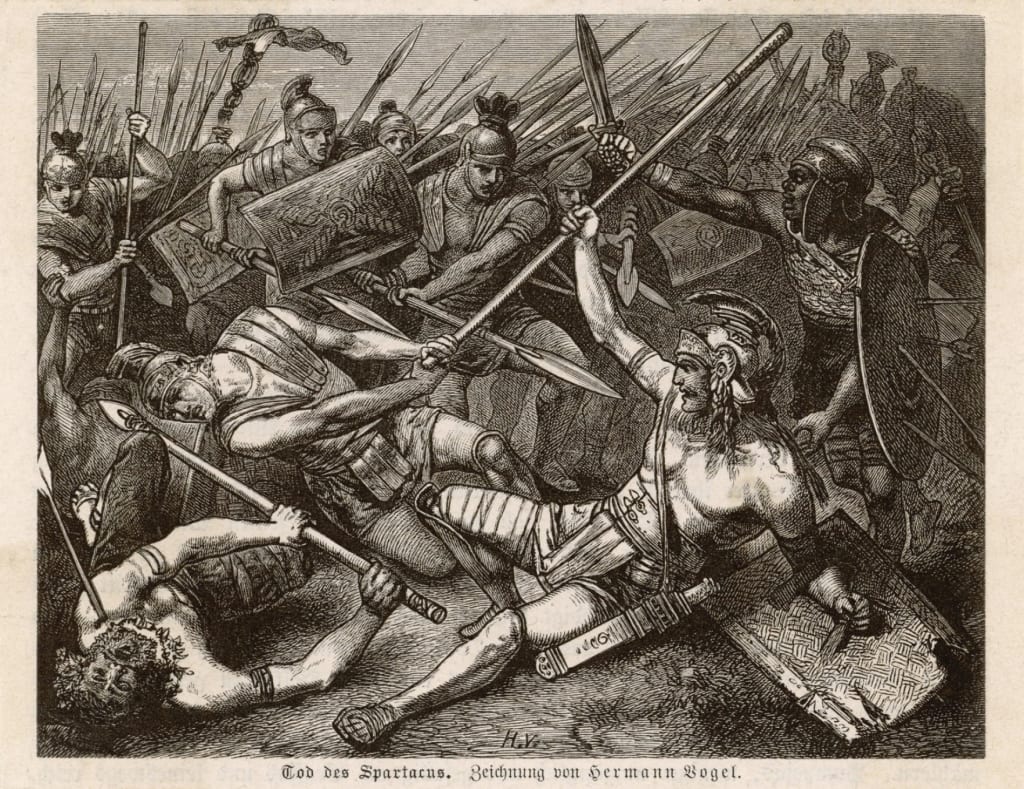
However, Spartacus' luck eventually ran out. In 71 BC, the Roman general Marcus Licinius Crassus was able to surround Spartacus and his followers, and after a fierce battle, Spartacus was killed. Though the rebellion was ultimately unsuccessful, Spartacus' legacy lived on, inspiring other slaves and oppressed peoples throughout history.
Battles with the Romans:
Spartacus and his followers were able to achieve several victories against the Romans during the slave revolt. Despite being vastly outnumbered, they were able to use their superior training as gladiators and their knowledge of guerrilla tactics to their advantage.
One of Spartacus' most famous victories was the battle of Mount Vesuvius. In this battle, Spartacus and his followers were able to use the treacherous terrain of the mountain to their advantage, ambushing the Romans and inflicting heavy losses upon them.
Another significant victory was the battle of the Silarus River. In this battle, Spartacus and his followers were able to repel a Roman attack and inflict heavy losses upon the enemy.
Despite these victories, Spartacus and his followers were eventually surrounded by the Romans and defeated in a final battle. However, their resistance and bravery had struck fear into the hearts of the ruling class and inspired hope among the oppressed. Spartacus' legacy lived on, and he became a symbol of resistance and hope for those who were oppressed.
Defeat and Legacy:
Despite his successes on the battlefield, Spartacus and his rebellion were ultimately unsuccessful in their quest for freedom. In 71 BC, the Roman general Marcus Licinius Crassus was able to surround Spartacus and his followers, and after a fierce battle, Spartacus was killed.
Though the rebellion was defeated, Spartacus' legacy lived on. His story inspired other slaves and oppressed peoples throughout history, and he became a symbol of resistance against oppression. His example of bravery and determination in the face of overwhelming odds continues to inspire people around the world to this day.
In modern times, Spartacus has been depicted in numerous books and films, further popularizing his story and cementing his place in history as a hero and a symbol of resistance. His legacy continues to inspire people to fight for their freedom and equality, and he remains a powerful symbol of hope for those who are oppressed.
Popular Culture:
Spartacus' story has been popularized in numerous books and films over the years. One of the most well-known depictions of Spartacus is the 1960 film "Spartacus," starring Kirk Douglas as the titular character. The film was a critical and commercial success, and it helped to further popularize the story of Spartacus.
In addition to the film, Spartacus has been depicted in numerous books, including the 1951 novel "Spartacus" by Howard Fast, which served as the basis for the 1960 film. There have also been several television series and miniseries based on the story of Spartacus, including the 2004 miniseries "Spartacus," which aired on the USA Network, and the 2010-2013 series "Spartacus: Blood and Sand," which aired on Starz.
Spartacus' story has also been depicted in several video games, including the strategy game "Total War: Rome II," which includes a campaign based on the Spartacus rebellion.
Overall, Spartacus' story has had a lasting impact on popular culture and continues to be a popular subject in media to this day.
Conclusion:
Spartacus was a gladiator who led a slave revolt against the Roman Empire in the 1st century BC. Though his rebellion was ultimately unsuccessful, his legacy lived on, and he became a symbol of resistance and hope for those who are oppressed. His story has been popularized in numerous books and films, and his example of bravery and determination continues to inspire people around the world.
Today, Spartacus is remembered as a hero who fought for freedom and equality. He remains a powerful symbol of resistance and hope, and his legacy continues to inspire people to fight for their rights and freedoms. Despite his defeat, Spartacus' story serves as a reminder of the strength and resilience of the human spirit, and it continues to inspire people to fight for a better world.
About the Creator
Verizon Outage: When Silence Replaces the Signal We Trust
The moment your phone stops working, the world feels smaller. Messages do not send. Calls fail. Maps freeze. For many people, a Verizon outage is not just a technical issue. It is a sudden break in daily life. Parents worry they cannot reach their children. Workers panic about missed meetings. Travelers feel stranded, even in familiar places. We trust our phones to be there without thinking about it, until one quiet screen reminds us how fragile that trust is. This article explores what a Verizon outage really means, why it happens, how it affects real people, and what you can do when the signal disappears. Not with hype or panic, but with clarity, calm, and honesty.
By Muqadas khan2 days ago in Humans
Silver Screen Magic with Mae West
American actress and singer Mae West became a popular film actress during the Great Depression. She started entertaining in vaudeville, then performed on Broadway, and finally went to Hollywood. She signed up with Paramount Pictures and made her debut in the 1932 film “Night After Night.” She also starred in musicals, comedies, and crime dramas. The American Film Institute named her one of the best classic Hollywood actresses.
By Rasma Raisters4 days ago in Geeks




Comments
There are no comments for this story
Be the first to respond and start the conversation.