
Silencing the Critic Within: A Creative’s Guide to Overcoming Self-Doubt (Inspired by Van Gogh)
The Action Principle: "By All Means, Paint."

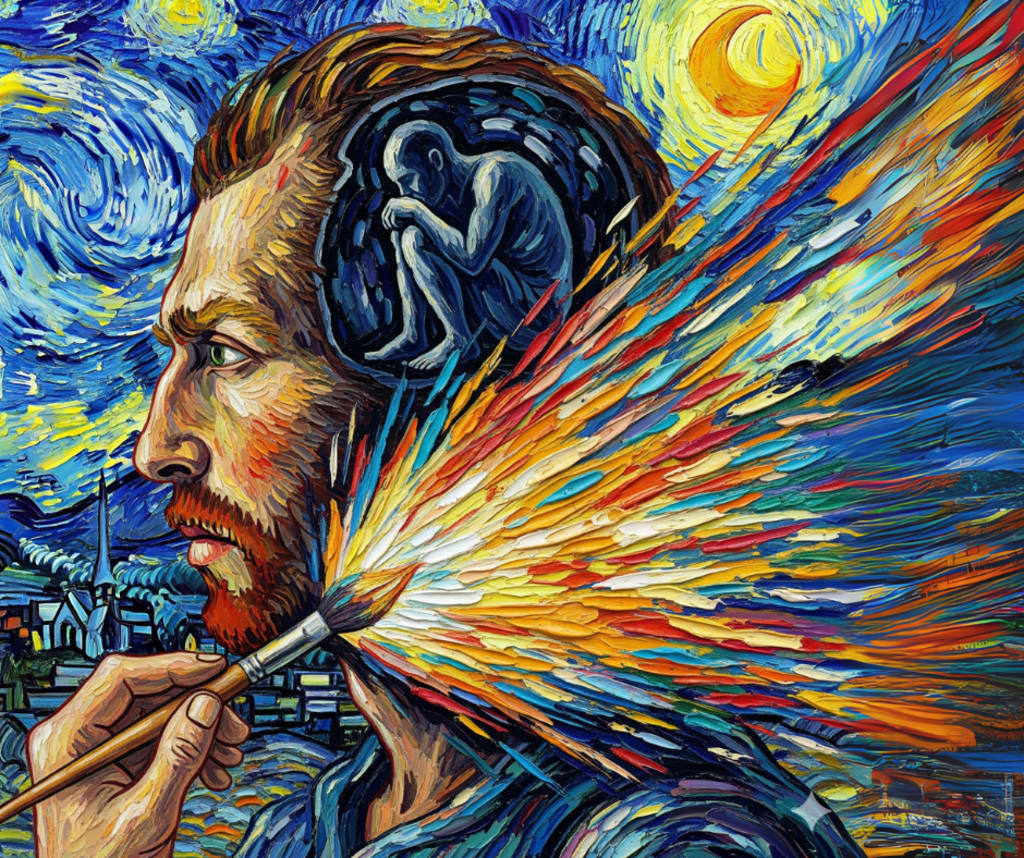
"If you hear a voice within you say ‘you cannot paint,’ then by all means paint, and that voice will be silenced."— Vincent van Gogh
Every creator knows that voice.
The whisper in the back of your mind when you face a blank canvas, an empty page, or a silent instrument: “You’re not good enough. Why even try?”
That voice is universal. It laughs when you picture yourself on stage. It sneers when you sketch the first line or hum the first note. For writers, artists, and musicians, this critic within can feel louder than any applause we’ll ever receive. It doesn’t just block our work — it questions our worth.
But here’s the truth: self-doubt isn’t a stop sign. It’s a signal flare. The antidote isn’t to wait until the voice goes quiet. The antidote is to act anyway. To pick up the brush, the pen, the guitar — by all means, paint.
This guide is about overcoming creative self-doubt, learning how to silence your inner critic, and reclaiming your creative voice.
The Anatomy of Self-Doubt: Why the Critic Shows Up
If you’ve ever asked yourself “Why do I feel like I can’t create?” you’re not alone. Self-doubt is stitched into the creative process. But it doesn’t come from nowhere.
It is born from a cocktail of fears:
- Fear of Failure: We’re terrified of being judged.
- Comparison: In a world saturated with social media, someone is always producing faster, louder, or shinier.
- Perfectionism: The trap of believing your work must arrive fully formed, flawless, and instantly praised.
For artists, this often shows up as imposter syndrome: the suspicion that you’re faking it, that your successes were luck, that one day everyone will “find out” you don’t belong.
But here’s the reframe: the inner critic isn’t proof that you’re failing. It’s proof that you care. It shows up because your work matters. As the great choreographer Martha Graham once said, "There is a vitality, a life force, an energy, a quickening that is translated through you into action, and because there is only one of you in all of time, this expression is unique. And if you block it, it will never exist through any other medium and will be lost."
The Action Principle: Why You Must “By All Means Paint”
Van Gogh’s wisdom cuts to the core: creation silences doubt better than waiting for confidence. When you move—when you put paint on canvas, words on a page, chords in the air—you generate momentum. Neuroscience even backs this up: small actions activate dopamine reward loops, creating a sense of progress that kills paralysis.
In my own ethos—Truth in Music—I’ve seen how picking up the guitar or scribbling a verse doesn’t just fight silence, it exposes the lie of self-doubt. Creation is a rebellion.
So if you’re stuck, don’t plan the masterpiece. Don’t wait for permission. Start messy. Start wrong. But start.
The Ripple Effect: How One Act of Creation Silences Doubt
Here’s the magic: one creative act doesn’t just quiet the critic in the moment. It builds trust in yourself.
- Psychology calls it the “progress principle.” Even tiny wins reinforce your ability to finish.
- Creativity calls it flow. Once you enter the act, self-consciousness fades.
- Revolutionaries call it momentum. Each act is proof that the inner tyrant is not in control.
Every painting, riff, or blog post is more than output. It’s a protest. Each act of creation says: You don’t get the final word, critic. I do.
This is why I believe Your art is a revolution. Just as a movement grows step by step, so does your creative power. Each act of creation is a deliberate and meaningful step forward in your own planned revolution.
Building Your Arsenal: Tools to Out-Create the Critic
You can’t kill the critic—but you can out-create it. Here are tools that work:
- Micro-actions: 10 minutes a day beats zero. Sketch one line, write one sentence, play one riff.
- Celebrate wins: Keep a “done list.” Every finished thing, no matter how small, belongs there.
- Community: Find a circle where your voice matters. Writing groups, artist collectives, even online spaces can break the isolation.
- Reframe failure: Rejection isn’t the end. It’s a receipt that you tried—and trying is the only way to grow. This is at the heart of the question of Is It Worth It? Unraveling the True Cost of Creative Freedom.
- Anchor habits: Pair creative work with daily rhythms—morning coffee, evening walk, favorite playlist.
If you’re asking “How to get over creative self-doubt?”—this is the toolkit. Not magic. Not instant. But real.
The Final Word on Your Creative Power
Self-doubt is part of the journey, not the destination. Every creator wrestles with it. Van Gogh did. Springsteen does. Jelly Roll does. The critic is universal—but it isn’t ultimate.
“The creative adult is the child who survived.”— Ursula K. Le Guin
The most important relationship you’ll ever have is with your own work. Not the critics, not the audience, not even the inner voice that tells you to quit.
So when the voice says “You cannot”?
Pick up the brush. Strike the chord. Write the line.
By all means, paint.
Because every act of creation is proof that you belong here.
Call to Action
I want to hear from you: where does your critic show up loudest? Drop your stories in the comments—or better yet, shut the voice up by creating something today. Post it. Share it. Claim it.
✨ And remember: your art is a revolution.
#OvercomingSelfDoubt #CreativeBlock #InnerCritic #VanGogh #CreativeLife #WritersLife #ArtistsLife #Inspiration #Psychology #SelfImprovement #TruthInMusic #CreativeFreedom
About the Creator
Sunshine Firecracker™
Dr. Jennifer Gayle Sappington, J.D. (Sunshine Firecracker™). IFJ & NWU accredited investigative journalist. UB Law alumna utilizing rigorous statutory analysis to expose the Ephrata Enterprise, Gerlach litigation, & Lancaster corruption.
Keep reading
More stories from Sunshine Firecracker™ and writers in Humans and other communities.
Healing Upward and Outward
Healing Upward and Outward Reconciliation is repairing the broken threads that connect us. These threads reach in two directions: up and out. First, we must consider the vertical dimension: our internal self and our relationship with the Divine. Before we can reach out to others, we are called to look inward and sit in the quiet, sometimes uncomfortable light of self-reflection. We must ask, “Where have we stumbled or contributed to a fracture?”
By Archery Owl 7 days ago in Humans


Comments
There are no comments for this story
Be the first to respond and start the conversation.