
Sidework
Fate interrupts a busser's monotonous shift.

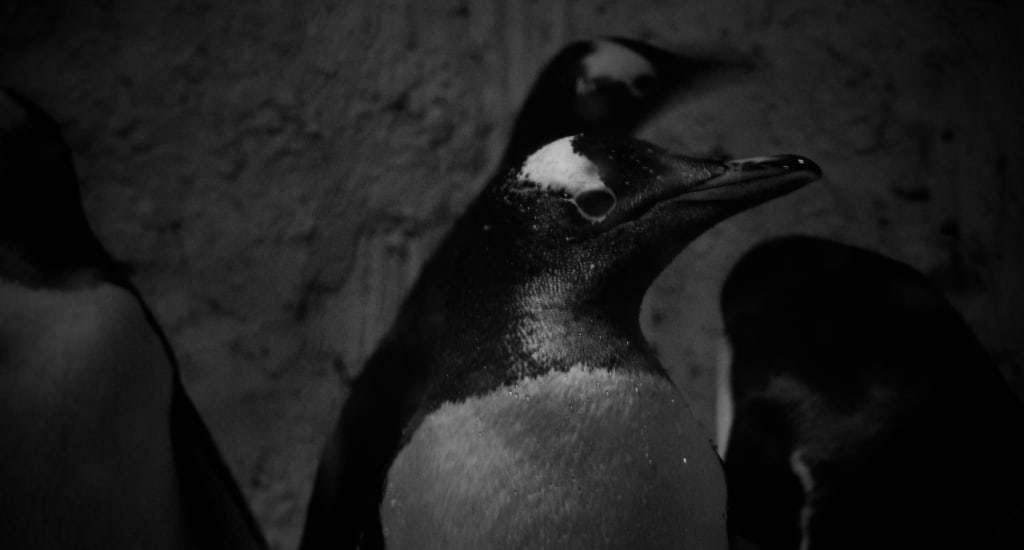
I imagine I resembled a gastrointestinally compromised penguin, shuffling down that icy hill. At the back entrance I flirted with shattered ribs in front of the chain-smoking staff who seem never to move from that exact spot, as if nothing pleases them more than hypothermia and tardy bussers.
Inside, the silent baker was inspecting her trays of fresh brioche buns—so golden and uniform they reminded me of those jiggly Japanese cheesecakes that seem to trigger, in most, a neurochemical response similar to orgasm.
I passed our pink-ponytailed dishwasher who erupted into some joke about a robot’s “trans-sister” that pulled me from the vat of self-pity in which I always wallow at the beginning of a shift. I made no effort to acknowledge the chefs or line cooks. Nobody trained me to do this, but I made quick note of their general gruffness, constant use of large knives, and generalized hatred toward life and bussers.
I shoved through the kitchen doors, clocked in, and took a moment to appreciate the restaurant. I love spending time in a space designed so thoughtfully that it is surely impossible for customers to resist that last, unnecessary glass of wine, those final, indulgent words spoken late and low over disappearing candles and the sleepy sounds of sidework.
I shoveled ice into buckets and hustled around filling ice wells. I made sure each water station had carafes, pitchers, and extra water glasses. Back in the dish-pit I emptied bus tubs to the music of pink-ponytail’s quiet humming.
Being older and immeasurably more competent than my fellow bussers places all the responsibility on me, but I’m used to it. That night, business picked up early. Stress hovered around me, threatening. The “weeds” beckoned.
***
Around 10pm I went outside to remove the restaurant’s parking signs. A frigid wind blew against my skin.
Returning with the last of the signs I noticed a solitary figure approaching the entrance, moving as quietly as a ghost. I jogged ahead carefully so that I could open the door for them. I figured management would love that.
In the restaurant’s entryway, the woman—now, in the light, I could see her—stood with her back to me, blocking my path.
Her jacket went to the middle of her calves, puffing out from a high and tight waist below sharp shoulders. It was a shade of emerald, made of what looked like velvet, and well constructed.
She wore elegant black stilettos with heels that seemed, to me, perilously thin. I figured the shoes’ height explained the woman’s ghostlike movement over the ice; they were quite something to behold. As was her hair.
Running all the way down to the woman’s lower back were the most beautiful and carefully executed twists I have ever seen. An iridescent and unknowable shade of black, her hair seemed to possess the surreal and ever-shifting quality of a raven’s feathers. The twists were woven together in a fishtail braid so complex and unpredictable it was impossible not to stare.
It wasn’t until my manager—we called her Doom—hollered something at me that I remembered my body’s choreography. The woman took a step toward the coat rack, and I passed behind her. I couldn’t get a glimpse of her face, but something around it sparkled, accentuating our strange interaction like that last gasp of light before the sun descends behind a mountain.
I knew she had come for me.
***
I watched as a hostess brought the enigmatic woman in the direction of 64, the table designated for those dining alone.
I was then tasked by Doom to help a hostess move four carts of buffet plates. The carts were impossibly heavy, the hostess unresponsive. I understood that she just wanted some private moments away from Doom and the uncomfortable countenance we subordinates have to assume around her—even if she had no choice but to tolerate my being an inadvertent co-conspirator in the stealing of those moments.
These tasks kept me from even glimpsing the woman at 64. By the time I returned to the dining room, I saw that both 59 and 64 needed to be cleared. The mess at 59 suggested that crayons and chocolate cake had been appropriated as cannon fodder in what must have been a devastating battle.
64, however, was so tidy it looked staged. The woman had left a clean square dish. Beside it was a tall green water carafe—empty. On its other side was the corpse of an expensive bottle of red.
I noticed that the woman had forgotten something; a small, soft black book bound by an elastic was centered on her napkin. Immediately I set off with the book, determined to catch the woman should she still be near the restaurant. This, like so many other things, is the busser’s unspoken duty.
Despite my best efforts, I couldn’t find her. She was gone, leaving behind only a memory and a small black book.
***
I couldn’t bear the thought of continuing my meaningless work distracted by whatever secrets lay in that mysterious black book, so I slipped it into my apron pocket, unopened. It had come into my life as if by accident—as if the supervisors of fate had let slip through some fourth wall an important artifact directly into my unimportant hands.
Opening the rear door to a blast of wind and the laughter of Mick and Miracle—the (yes, married) smoke-spot regulars, I opened the black book.
Its lined pages were empty.
Distraught, I nearly let loose a wail in mourning for the time, just moments before, when I thought something would become of my life.
“Keep your eyes on that ice, baby,” rasped Miracle.
Nodding deferentially and smiling (for I’m convinced they’re unappreciated sages), I said nothing and walked on. The empty notebook felt somehow lighter in my hands—though filled still with nostalgia for a future that never came. Like the forgotten hair of a departed lover, its silence was not insignificant.
Despite myself—and the temperature—I stopped in my tracks, determined to look one more time. Desperately, I flipped through the delicate pages of the notebook. On its inner back cover was a small paper pocket that I had not noticed before.
Inside was a note.
HELLO, YOU.
YES, YOU. IT'S YOUR TURN NOW.
I AWAIT THE END OF YOUR WORK.
MEET BY YOUR CAR.
I was stunned. I had been pulled from the dregs of humanity into the ranks of those with a story of some account—or, perhaps, pulled into existence itself.
Without thinking, I took off running. In the frenzied pursuit of one destiny, I met another. I fell.
My feet moving backwards in time, the curb made my acquaintance by caressing the right side of my face with what felt like hundreds of wet shards of glass.
I lay there for a moment, deeper now in my shock. I felt relatively unharmed, aside from my face. I couldn’t open my right eye.
I rose and began to shuffle toward my car, which I could now see—with my one good eye, that is. Even though the note had said that we would meet “by” my car, I saw the outline of a figure seated in the passenger seat.
Climbing carefully into the driver’s seat, I clicked on the car’s faltering interior lights.
It was her. I could see that she wore tinted glasses with gold frames.
She didn’t turn her head to speak.
“Young one, I’ve come to rescue you. You’ve been selected—I can’t tell you by whom. I’m not sure I really know, myself. But rest assured that it’s all completely random. I was selected long ago, and I was as shocked as you are.
“When you are selected, your life comes to a close. This will happen to you in just a few short moments. What you’ve had is all you’ll ever have, but fret not, for this is a privileged position. You will live forever, repeating this life. Each time you do you will receive $20,000.”
“I—”
“Don’t speak. I know how this feels. Sadly, I’ve only towed the party line just now. Fortunately or unfortunately—that’s up to you to decide—I’ve been appointed your guide, and I tell the truth. Along with all the joy, you will be forced to re-experience your deepest suffering.” With this, she removed her glasses.
Where her eyes should have been, there were none.
“Don’t be alarmed, now. I did this willingly. When I was selected, I was desperate for a way to cheat the system. I didn’t want to relive my life over and over. None of it made sense. They said I would be paid, but I couldn’t fathom why money would matter to the eternally damned.
“I realized that the promised money was but a carrot dangled in front of me—and the benighted masses before me. It is a prize that disintegrates swiftly in one’s hands, distracting the damned from their damnation, serving as the light at the end of their tunnel—even though they inevitably discover the tunnel to be a never-ending loop.
“I removed my own eyes. I realized that the only thing I needed to do was bear constant and repeated witness to my story—which my eyes are still doing, somewhere out there. Removing them enabled me to travel freely between other realities, just as I have done to arrive here, in yours.
“I offer my services to those I meet, so that they may have a chance to outsmart the system, to truly see what the conditions of their existence are, and how they are being coerced into suffering.
“But, you, my dear. . . you’re injured. I’ve only been successful in freeing from time those whose vision is unsullied. . . unimpeded. One of your eyes has been bloodied by this ruthless winter, and you will not have enough time to heal before the cycle begins.
“I’m ashamed to say I cannot release you. I can only give you this.”
She passed me an envelope. Inside was a check—if it can be called that. Less substantial than a receipt, the small slip verged on immaterial. It lacked any name, address, or account number.
Its two notable features were the $20,000 figure—in print so large it was offensive—and, to my horror, a watermark of penguins. I realized the repeated images verified the woman’s claims. I knew a cycle was ending, one that had been designed to be repeated. I felt someone was trying to imbue my life with meaning it did not possess.
“I don’t want this!” I screamed, hurling the envelope at the windshield, “I don’t want any of this!”
The woman gently unlatched the passenger door and replaced her sunglasses. “I’m sorry, I really am. There’s no real explanation for any of this. It’s just the way it is.”
She paused. Regret flashed across her eyeless face.
“I’m not allowed to know your name, so I’ll give you one. I promise I won’t forget you. I’ll call you Chop. It’s from that Buddhist saying—‘After enlightenment, chop wood, carry water.’ So go, carry water. And good luck tomorrow, on your first day.”
Approaching hysteria and bleeding still, I tried to respond. I could only moan with despair. I sobbed, my pain both physical and existential. When I opened my good eye, the woman was gone.
In nightmares I often stand helpless under approaching tsunami waves. That night I sat in my car similarly bewildered and watched as a purgatorial mass of white light silently encroached upon me, as if I was its screaming infant craving an all-erasing swaddle.
But I realized it was not light slowly engulfing me, it was space. Empty space. I knew my time was up, just as the woman had predicted. I could see its end delineated before me.
With some peace, I resigned myself to the impending. I wanted to laugh. After this messy enlightenment, I knew this “Chop” character would carry water. It’s all she would do for the rest of time.
I had been gifted the truth—and it was intensely dissatisfying.
About the Creator
Everett Spink
NYU '20 (Social & Cultural Analysis major, Sociology & Creative Writing minors).
Keep reading
More stories from writers in Humans and other communities.
Time to change your life.
Is it even possible for you to change your life? A lot of people, more than there should be, are unhappy with their lives. But what are they doing about it? Usually nothing. People talk about how shitty their lives are and want change, but are they not taking the actions to change?
By Jen Phillipsa day ago in Humans
Nicki Minaj and the Loneliness Behind the Loudest Voice
Nicki Minaj has never been easy to ignore. Her voice cuts through rooms, charts, and conversations with sharp clarity. Yet behind the colors, accents, and confidence lies a story that feels far more fragile than people expect. Fame did not arrive gently, and it did not remove insecurity overnight. For many listeners, Nicki Minaj represents strength and survival. For others, she remains misunderstood, reduced to surface-level controversy. This article looks beyond headlines and personas to explore how Nicki Minaj built her career, protected her identity, and carried emotional weight in an industry that rarely allows softness. Her story is not just about music. It is about endurance, self-definition, and the cost of being constantly seen but rarely understood.
By Muqadas khan3 days ago in Humans



Comments
There are no comments for this story
Be the first to respond and start the conversation.