
"Shadows on Nicholson Road
"Where Fear Walks and Darkness Hides the Truth"

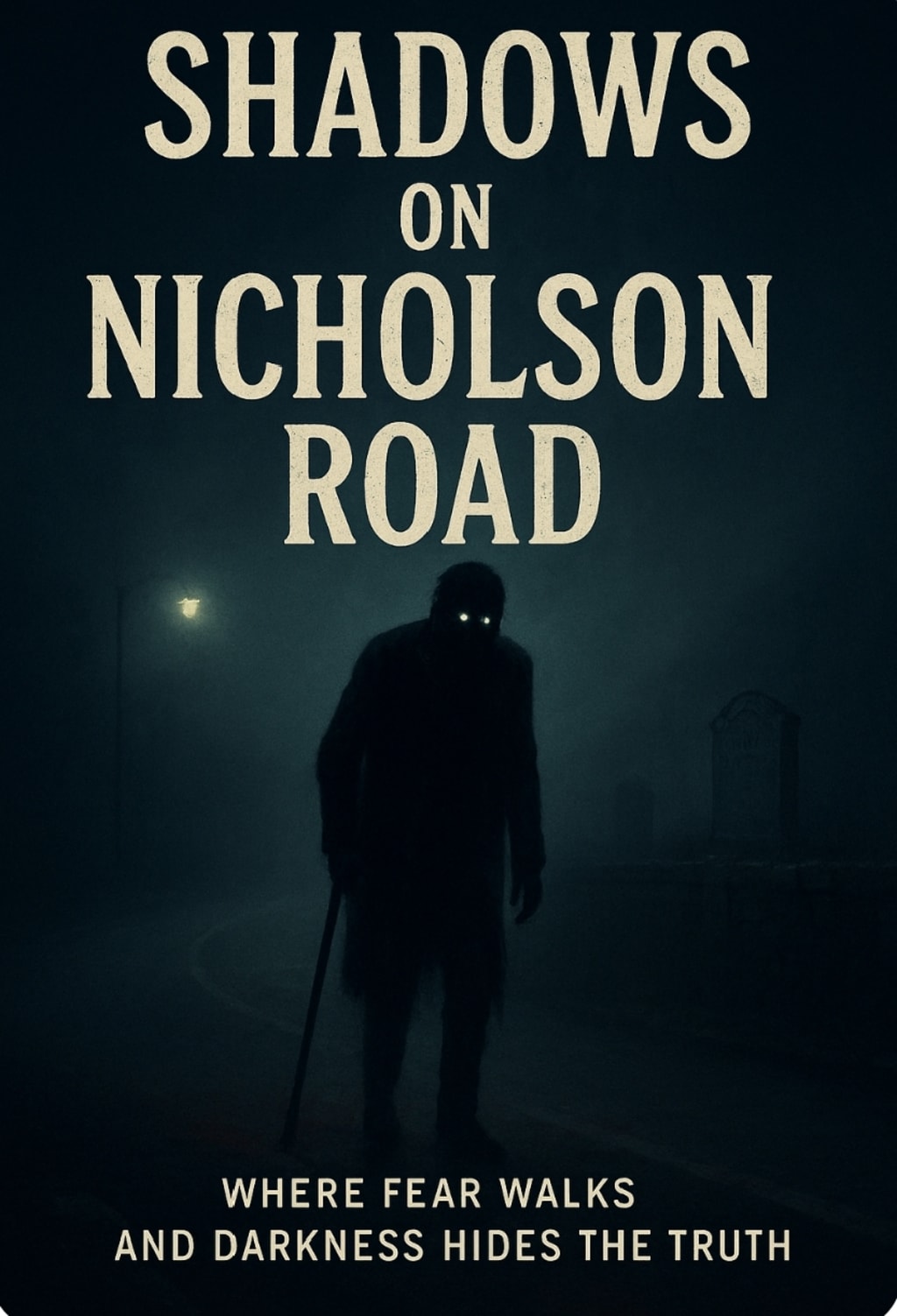
At a bend in the road, several stray dogs appeared suddenly, barking loudly. Durrani’s heart sank as he looked ahead. A shadow moved in the bright light of his car’s headlights. From the darkness, a human figure emerged, hunched and in pain.
The car jerked violently, colliding with an electric pole. Durrani sat frozen at the wheel for a few seconds, trying to comprehend what had just happened. Slowly, he stepped out, trembling, and saw the man—Wazir—lying on the road, groaning. Blood had seeped into the cracks of the asphalt.
Fear gripped him, but he had to act. In the dim starlight, he saw the large man lying face down. The road stretched empty for miles, swallowed by deep darkness. Durrani dragged him to the roadside, attempting to protect the evidence that linked him to the accident. The car refused to start no matter how hard he tried, and panic clawed at him again.
Moments later, the light of a motorbike appeared in the distance, soon followed by a truck screeching toward him. Durrani flagged them frantically and begged, “There’s been an accident. Take me to the police station immediately!”
Inside the truck, two men stared at the sight—a man in a black suit lay bleeding on the street, a motorbike destroyed nearby. Without hesitation, they agreed and sped toward the police station. Upon reaching, the night-duty inspector, along with two constables, accompanied Durrani back to the accident site. The man, Abdullah, was still alive but gravely wounded. They placed him in the station wagon and rushed him to the hospital.
When Durrani returned home late that evening, he was exhausted. The hospital report confirmed that Abdullah had survived but had lost a leg. Durrani, thinking only of minor damages and insurance compensation, left the matter at that.
---
Abdullah’s Transformation
Abdullah, a rickshaw puller by profession, was now confined to a bed. Thin as a reed, bent like an insect, coughing endlessly, his once lively eyes now reflected only terror. His wife cared for him, but his misery made him bitter, and even neighbors began avoiding him.
He lived in Jamsahla, a poor neighborhood dotted with half-built homes and thatched roofs. At its center lay an old British cemetery, surrounded by a solid wall. The legend of the cemetery was terrifying: the ghost of a British colonel who had committed suicide haunted the streets at night. Whenever anyone saw him, they would hear a single terrifying word: “Buttermilk.”
One night, when Abdullah’s wife fell ill and he had no food, he wandered into the cemetery lane. Through the mist, he saw a lone figure. Overcome with fear and hunger, he hissed in a ghostly voice, “Drink buttermilk…” The man, terrified, dropped a bundle he was carrying and ran. Abdullah seized the bundle—it contained food. That night, hunger had forced him to step into the role of a ghost.
From that day onward, Abdullah embraced his terrifying new persona. Wrapped in blankets, his crutches clattering on the streets, he became Banash—the living ghost of Nicholson Road. People believed the colonel’s ghost had returned. Initially, he stole food, but over time, he became bolder, even taking money from frightened passersby.
---
The Power of Fear
Night after night, the neighborhood lived in terror. Streets emptied as soon as darkness fell. Abdullah’s face, twisted by pain and fear, and his hollow, echoing voice terrified even the bravest. The legend of Banash grew.
Eventually, his overconfidence led him to knock on a door one night, trying a new scare tactic. “Drink buttermilk…” he whispered, his voice harsher than ever. The man inside screamed, waking the entire neighborhood. Soon, villagers poured into the streets with stones, intent on killing the ghost.
Abdullah tried to flee, but stones rained down upon him. One struck his head. He cried, “I am dying! Help me!” but no one listened. The villagers, believing in the ghost story, continued their assault. By dawn, he lay in the street, bloodied and battered, his crutches beside him. Banash had fallen—not a ghost, but a broken, desperate man.
---
Epilogue
Abdullah’s story became a dark legend in Jamsahla. People still whispered about Banash, the ghost of Nicholson Road. But those who knew the truth understood: he had become a monster only because society had abandoned him. Hunger, disability, and neglect had shaped his terror.
Even in death, the tale reminded the neighborhood of the fine line between fear and compassion.
---
🌟 MORAL
When society neglects the weak and vulnerable, it forces them into the very roles that others fear. Compassion and empathy can prevent monsters from being created.
About the Creator
Ihtisham Ulhaq
“I turn life’s struggles into stories and choices into lessons—writing to inspire, motivate, and remind you that every decision shapes destiny.”
Keep reading
More stories from Ihtisham Ulhaq and writers in Humans and other communities.
Let's Don't Do This
"I just can't do this anymore..." "Do what?" What can't you do? Put gas in your own car? I swear to God you make me take care of everything, don't you? You know I'm on my way to work right now but that never stops you from bothering me, does it?"
By Shirley Belk6 days ago in Fiction


Comments
There are no comments for this story
Be the first to respond and start the conversation.