
Samud Flotilla — One Ship, a Thousand Voices
When aid is a lifeline and every delay costs lives — the human face of Gaza, the risks facing rescue ships, and why the world cannot look away

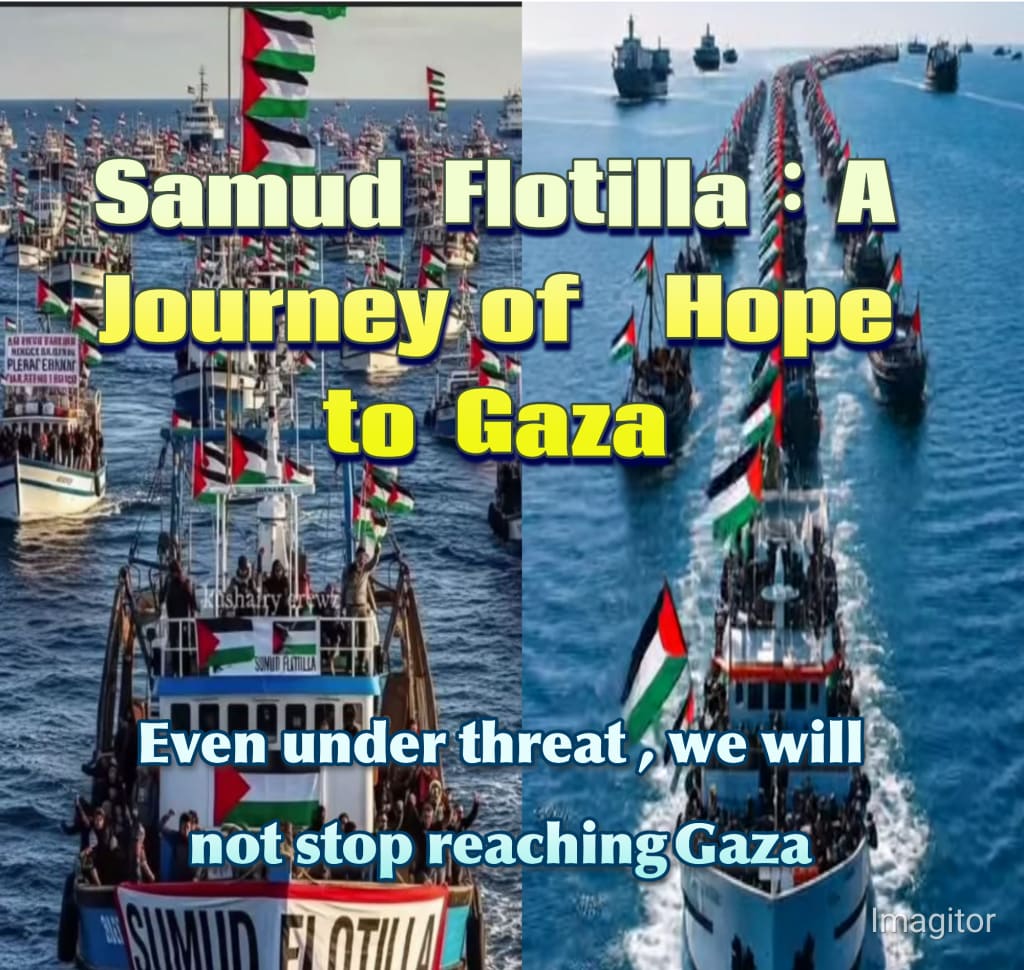
They load the crates slowly, as if careful hands might somehow steady the trembling hope inside them. Blankets, water filters, generators, baby formula, bandages — basic things that should never be extraordinary. On deck, volunteers fold tarps and whisper prayers. Journalists check batteries. A doctor smooths an envelope of emergency medicine and looks out toward the horizon where Gaza waits.
This is the Samud Flotilla: not a warship, not a political stunt, but a small, stubborn attempt to keep basic human dignity afloat. Its mission is simple and urgent: carry lifesaving supplies to men, women, children, and elders trapped behind a blockade; bring witness to a world that too often sees a headline and looks away.
What’s happening in Gaza — in plain terms
Walk through the places that remain, and you’ll find the same, terrible truths. Homes reduced to rubble. Streets that used to hum with life turned into tracks of broken concrete. Hospitals packed beyond capacity. Clean water and power are scarce. Medicines run out. Schools double as shelters. A child’s laughter is rarer than the sound of engines overhead.
These are not abstractions for people who live there. They are daily survival questions: Where will the next meal come from? How do you keep an infant warm when fuel is gone? How do you stitch a wound when the hospital has no sterile dressings left? When essential supplies are blocked or delayed, it’s not theory — it is a mother sitting beside her child who cannot be calmed.
Who bears the cost? Women, children and the elderly
The worst truth is this: the most vulnerable always pay first. Women give birth without proper care. Children go to sleep hungry and wake to the noise of conflict. The elderly wait in lines for medicine that never arrives. These are not “collateral” or “statistics.” They are faces; they are names. A generation’s childhood is being hollowed out by fear and absence — absence of food, of schooling, of safety.
The stories that land in inboxes and feeds are heartbreaking because they are real. A toddler who now flinches at the sound of a slamming door. A nurse improvising dressings from whatever cloth she can find. A grandfather who cannot get his chronic medication and whose family fears the next morning. These are human costs with long shadows.
Why flotillas still matter
When border crossings close and convoys are blocked, sea routes become a moral test. Flotillas like Samud are not glamorous; they are functional and symbolic at once. They deliver what is needed and they carry witness — independent observers who document conditions so the world cannot claim ignorance. For civilians, a single pallet of medical supplies can mean the difference between life and a slow, preventable death.
But every voyage is risky. In past years, aid ships have been intercepted, delayed, or boarded. Sometimes the reasons offered are security or legal technicalities; sometimes the result has been violent confrontation. Every hour a ship is held up is more suffering on shore. Every confiscated box is a nurse without bandages. Every blocked route tightens the noose around already fragile lives.
The pattern of escalation — from policy to people
When military priorities consistently outweigh humanitarian need, policy becomes punishment. Infrastructure collapses; hospitals falter when generators fail; winter nights become more dangerous without heating; children’s bodies are weakened by malnutrition; education grinds to a halt. These are not accidental side effects — they are predictable outcomes of sustained shortages and restricted access.
Calling it by its hard name: when entire communities are deprived of basic life-saving goods as a result of blockade and restrictions, the effect is collective suffering. Agencies and journalists repeatedly document how restrictions compound into crises — and yet the cycles continue, because solutions require political will and international pressure that has often been absent or too slow.
The ship’s crew and the moral courage it takes
The people who sail on Samud Flotilla are not headline-seeking celebrities. They are doctors, nurses, mechanics, volunteers, ordinary citizens who decided that watching from shore was no longer enough. Their presence matters in two ways: practically, because they bring supplies; and morally, because they bear witness. Their cameras, their eyewitness testimonies, their returned stories force questions on those who would otherwise look away.
But the cost is real. Interdictions, inspections, seizures — and at times open hostility — make each voyage a high-stakes passage. Volunteers often know the risks, and they choose to go anyway. That choice is a form of moral speech: it says, plainly, that human lives matter more than political calculations.
What needs to be done — clear, practical steps
This is not a moment for abstractions. The international community, humanitarian organizations, and responsible governments must act on concrete steps:
Establish guaranteed, monitored humanitarian corridors — by land and by sea — that cannot be arbitrarily closed.
Allow neutral third-party inspections to address security concerns without denying relief to civilians.
Protect medical and aid workers under clear international guarantees.
Ensure unimpeded access for independent journalists and observers to verify conditions.
Support local and international NGOs to scale emergency services quickly and sustainably.
These steps are not favors; they are minimum standards of human decency. Wherever law and policy allow a people to be deprived of basics, the moral authority to claim humanity is weakened.
The testing mirror — what this voyage asks of us
The Samud Flotilla holds up a mirror not just to policymakers, but to ordinary people. If nothing moves you when footage shows a child reaching for a discarded piece of bread, then this mirror reflects a hard truth about how distant we have grown from one another. If you feel a tug — discomfort, sorrow, the wish to help — then this is a call to action, small or large: donate to verified relief causes, pressure representatives to support humanitarian access, amplify credible reporting.
A final, unavoidable thought — and what the ending should do
End the piece with an image that stays with the reader: the ship’s wake stretching back into the open sea, a thin line of foam that is both a path and a promise. Then, make the ask personal. Don’t end on abstract outrage; end on a direct human appeal that moves people from sympathy to action.
Suggested closing line (use this or adapt it):
“The Samud Flotilla’s wake is small against the horizon — but every ripple it makes is a promise that the world has not yet abandoned the people of Gaza. If that promise matters to you, make it loud: demand safe passage, send help that reaches a hand, and refuse to let these faces vanish into silence.”
That is how the article should close: with a sharp, human image and a clear, practical invitation that turns feeling into responsibility. Keep the tone calm, urgent, and dignified — not accusatory poetry, but a focused moral summons that readers can carry with them and act upon.
About the Creator
Amanullah
✨ “I share mysteries 🔍, stories 📖, and the wonders of the modern world 🌍 — all in a way that keeps you hooked!”
I wanted to title this something different, but worried that my chosen title might cause problems entering the United States in the future so this is the new title. It's the greatest title. No one has ever written a title better than this. (All titles unrelated to content).
Let me be honest. I am finding this difficult. Now, I like a challenge, a stretch, a bit of an obstacle course. “Write about the decline of the British Empire in the form of a narrative poem in which your protagonist is an artichoke” I read, and flex my fingers. “Write a haiku to evoke the sensation of sibilance using only the first half of the alphabet.” “Well”, I think to myself, “this should be fun.” But “write about a system that isn’t working”? A system that isn’t working? Now? In 2026? ONE system? My favourite system that isn’t working? The sexiest system that isn’t working? The one giving me the most angst day to day? The one giving me the most existential dread? I am, as I say, finding this difficult. I will own that I have contemplated writing a thousand words on why the steady “all on” setting on my fairy lights is the EIGHTH of seven options which must be sequentially activated to get there, because that is a system that some fool came up with and it definitely doesn’t work, and now who is paying the price, eh? But how can I write about my fairy lights when…. When…. When….
By Hannah Moore5 days ago in Humans



Comments (1)
This article is not just words, it’s a mirror to the pain of Gaza. The courage of the Samud Flotilla is a reminder that even when humanity is silenced on land, it still finds a way through the sea. May the world finally wake up to the cries of innocent children and the strength of those who refuse to give up hope. ✊🇵🇸