
Redefining Commitment: The least that can be done to end Child Labor
Exploring the prevalence of Child Labor and the few steps that can be taken to eradicate it

Describing the concept of childhood, Encyclopedia Britannica terms childhood as a phase of human life between infancy and adolescence. The phase of childhood can be described as a beautiful phase full of learning experiences and gives a sense of growth and strength. If childhood is spent in tragedies, its memories remain throughout life, thus turning life into a miserable entity. Poverty, injustice and ignorance have forced children to work at a young age and lead a childhood life full of horrors. They become unaware of their rights as they are forced into child labor. According to ILO, child labor is defined as the type of work that deprives children of their dignity and adversely affects their mental and physical health.
The major cause of child labor is poverty. When parents are poor and they don’t have sustainable income to feed their family, they force their children to work. They consider it better to put their children in forced labor work so that they can earn independently and don’t have to depend upon them. Poverty and ignorance make the family system dysfunctional and deprived of social security and sustainability. In such families, children also consider themselves a burden on their families. They start to believe that their self-respect lies in the way of earning from their young childhood age so that they don’t have to depend on their families and their lives will not be miserable.

Hence, child labor has become a major global problem. The ILO estimates that around 260 million children are employed globally, among which 170 million are put into child labor in dangerous conditions. According to ILO, Asia Pacific has the largest number of child laborers, i.e., 127.3 million, while in sub-Saharan Africa, there are 48 million child workers.
In Sub-Saharan Africa, there are large reserves of Cobalt minerals, a chemical used by the electronic industry in designing lithium batteries. The extraction of cobalt has been associated with child labor. Children working in cobalt mining are exposed to hazardous conditions, toxic substances, and a high risk of accidents. In Sub-Saharan Africa, especially Democratic Republic of the Congo (DRC), more than 40,000 children are employed in cobalt mining and exposed to hazardous conditions without protection. According to the US Department of Labor, 1.56 million child laborers are employed to work on cocoa farms in Côte d'Ivoire and Ghana, which produces 60 % of the world’s cocoa that are further used by the chocolate industry.

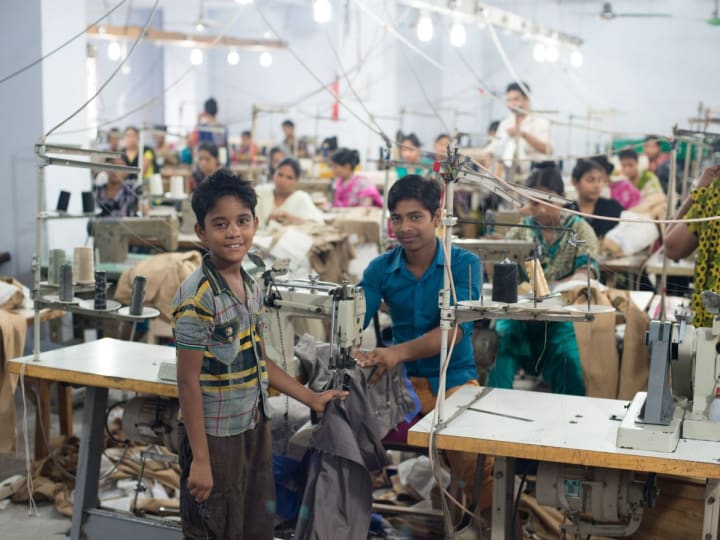
Furthermore, in South Asia, sweatshops are associated with the garment and textile industry. Child laborers in sweatshops face long working hours, low wages and unsafe working environments. As sweatshops are a part of the global supply chain, it is challenging to trace the conditions under which products are developed. According to ILO, South Asia comprises 16.7 million children as workers, among which 10.3 million range between 5 and 14 years. India has the largest prevalence of child labor with 5.8 million children, after which there are 5 million child laborers in Bangladesh, 3.4 million in Pakistan and 2 million in Nepal.
Hence, it is the responsibility of the global world to fight for the end of child labor. Concrete steps must be taken with joint government and activism efforts by taking the governments and major industries on hold. Moreover, consumers should also take responsibility for eradicating child labor and be aware of the ethical attributes when buying products. They should be aware of buying their products and must be able to see that there is no child labor involved behind it. Government and international and local stakeholders must also ensure the commitment to ethical attributes when it comes to selling and buying products. Furthermore, steps must also be taken to rehabilitate the children after they are taken out from child labor and NGOs must play their role to help their parents with skills rehabilitation and children must be put in schools. Skilled education must be given to them and the NGOs with the help of international organizations, fundings from developed countries joint efforts and the UN must also be able to feed and educate the children. Such steps need to be taken to eradicate the menace of child labor.
All this is needed to achieve the right to freedom and sustainable living for children globally. Moreover, it is not fair enough that on one side, people are enjoying their lives on the products behind the production of which some deprived children forced to work in miserable conditions are involved. Hence, on this international day against child labor on 12 June 2023, civil society and stakeholders must commit to achieving equality and justice by ensuring the protection of children against child labor.
About the Creator
Motasim
Having a degree in Electrical Engineering and being a research student of Renewable energy. Revolving around science, history and the philosophical secrets behind them. I intend to glamorise minds by giving a touch to all aspects of life.
Whiskey At Dusk
Guess the whiskey was more important to you in the end, wasn’t it? It was more than the well-being of your friends; more vital than showing up to the places you promised you would and could come to; more critical of a matter than fulfilling your damn responsibilities and getting the press off your back.
By Snarky Lisa5 days ago in Humans
Why So Many Women End Up “Menopause Masking” — And What It Can Cost You
Menopause is a natural stage of life, yet many women find themselves masking its symptoms rather than addressing them. This trend, known as “menopause masking,” can have hidden consequences for both physical and mental health. Here’s why it happens and why it matters.
By Ayesha Lashari7 days ago in Humans


Comments
There are no comments for this story
Be the first to respond and start the conversation.