
Our Evolutionary Story"
Understanding Human Origins Through Science

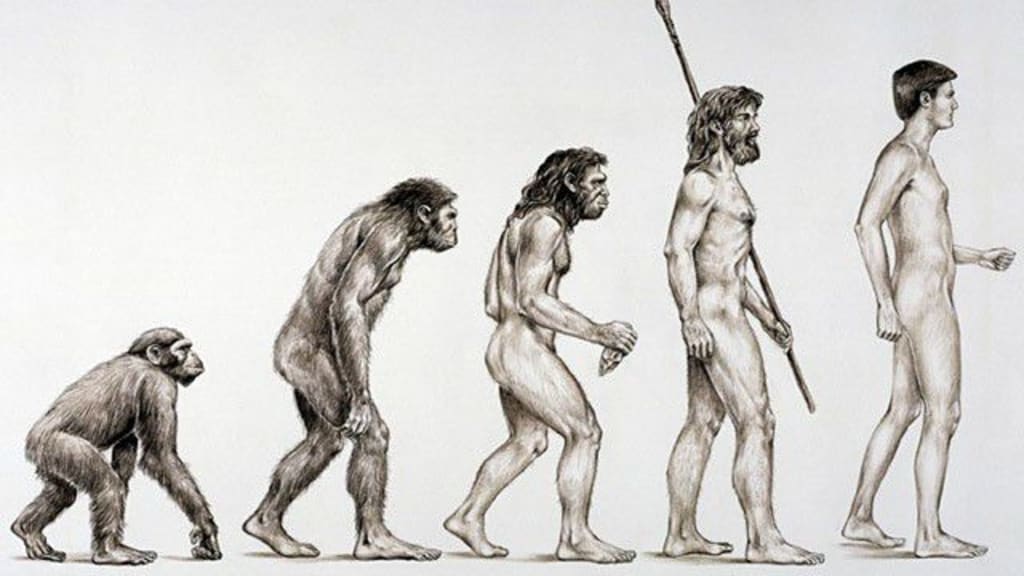
Introduction: A Story Written in Bones and DNA
The story of human evolution is not just about bones in a desert or fossils in a cave—it’s the epic journey of how we became who we are today. From tree-dwelling primates to space explorers, the path of human evolution spans millions of years, shaped by survival, environment, and the remarkable ability to adapt. This journey, backed by evidence from anthropology, genetics, and archaeology, reveals how humans evolved from simple organisms into the dominant species on Earth.
Our Earliest Ancestors
The roots of human evolution go back around 6 to 7 million years, when our ancestors split from the line that would become modern chimpanzees. One of the earliest known hominins is Sahelanthropus tchadensis, a species that lived in what is now Chad. Though much is still unknown, this species may have walked upright—a crucial step in the human journey.
Walking on two legs, or bipedalism, freed our ancestors’ hands for tool use, carrying objects, and eventually, creating art. Fossil evidence shows that by around 4 million years ago, early human ancestors like Australopithecus afarensis (famously represented by the fossil "Lucy") were walking upright and beginning to develop larger brains.
The Rise of the Genus Homo
Around 2.5 million years ago, the genus Homo emerged. These early humans, including Homo habilis, were the first known toolmakers. Stone tools found alongside their fossils show a major leap in intelligence and adaptability. These tools allowed early humans to hunt, prepare food, and survive in harsh environments.
Then came Homo erectus, who appeared around 1.9 million years ago. This species was taller, more muscular, and possibly the first to leave Africa, migrating into Asia and Europe. They used fire, crafted more sophisticated tools, and lived in small social groups—paving the way for complex societies.
The Neanderthals and the Arrival of Modern Humans
About 400,000 years ago, the Neanderthals (Homo neanderthalensis) thrived in Europe and parts of Asia. They were intelligent, strong, and adapted to cold climates. Neanderthals buried their dead, made tools, and possibly even had language and art.
Meanwhile, around 300,000 years ago, Homo sapiens—modern humans—emerged in Africa. With more advanced brains, longer limbs, and lighter skeletons, they began to create more complex tools, form social bonds, and express themselves through art, music, and symbols.
Homo sapiens began migrating out of Africa around 70,000 years ago, eventually replacing or interbreeding with other hominin species like the Neanderthals. Genetic studies show that many modern humans carry small amounts of Neanderthal DNA, evidence of this interbreeding.
What Made Us Truly Human?
Our physical evolution is remarkable, but what truly sets humans apart is our ability to think symbolically, communicate through complex language, and pass knowledge across generations. Early cave paintings, beads, carvings, and burial rituals show a mind capable of imagination and emotion.
Language allowed humans to cooperate in larger groups, share ideas, and build culture. Agriculture, which began around 10,000 years ago, transformed societies from nomadic to settled. Cities, writing, and civilizations soon followed.
From a biological standpoint, humans are still evolving. However, cultural evolution—how we change through technology, ideas, and society—now moves at a much faster pace than biological changes ever could.
Challenges and the Future of Human Evolution
The story of human evolution is not just about the past; it's about the future. As we face climate change, pandemics, and advances in genetic engineering and artificial intelligence, we are entering a new chapter.
Modern humans have extended lifespans, shaped the environment, and even begun exploring space. But with these achievements come ethical and biological challenges. Will we evolve into something new? Will we enhance our intelligence or bodies through technology? These questions are no longer science fiction—they’re part of our ongoing evolutionary journey.
Conclusion: A Story Still Being Written
The evolution of humans is a story still unfolding. From ancient forests to moon landings, it’s a journey shaped by adaptation, struggle, and the endless pursuit of understanding. We carry the DNA of our ancestors, the memory of our migrations, and the dreams of our future.
In understanding where we come from, we gain a clearer view of where we’re going. The bones beneath our feet and the stars above remind us that evolution is not just about the survival of the fittest—but the survival of the wisest, the most adaptable, and the most connected.
About the Creator
Hasnain khan
"Exploring the world through words. Join me as I unravel fascinating stories, share insightful perspectives, and dive into the depths of curiosity."
Keep reading
More stories from Hasnain khan and writers in Humans and other communities.
Swat Under Water"
The rain began quietly, as it always did in the monsoon season, with a light drizzle brushing the pine-covered slopes of the Swat Valley. Children ran through the narrow streets of Bahrain, laughing, barefoot in the mud, as their mothers called them inside. Few paid attention to the gathering clouds—after all, rain in Swat was nothing new.
By Hasnain khan7 months ago in History
Hind Rajab: A Child the World Heard Too Late
Cinema has always been a powerful medium for telling stories that history books often reduce to numbers. When a film chooses to focus on a single child caught in the machinery of war, it forces audiences to confront reality not as statistics, but as human loss. The movie inspired by the tragic story of Hind Rajab, a young Palestinian girl, does exactly that. It is not merely a film; it is a testimony, a memorial, and a question posed to the conscience of the world. Hind Rajab’s name became known globally after reports emerged of her final hours during the Gaza conflict. She was a child trapped in circumstances no child should ever experience. The film based on her story does not sensationalize her death, nor does it turn her suffering into spectacle. Instead, it approaches her story with restraint, dignity, and an unwavering focus on innocence lost amid violence. The Story at the Heart of the Film The movie centers on a young Palestinian girl who becomes separated from safety during intense military escalation. Through her eyes, viewers witness fear, confusion, and the fragile hope that someone, somewhere, will come to help. The film follows her final journey—both physical and emotional—using minimal dialogue and powerful visual storytelling. Rather than relying on graphic imagery, the filmmakers choose silence, pauses, and close-up shots to convey terror and vulnerability. This artistic choice makes the film even more haunting. The audience is left to sit with the child’s fear, her calls for help, and the unbearable waiting that defines her final moments. By focusing on Hind as an individual rather than a symbol, the film restores her humanity. She is not portrayed as a political tool, but as a daughter, a child with dreams, and a life that mattered. A Child as the Center of a Global Tragedy What makes this movie particularly impactful is its refusal to shift focus away from the civilian cost of war. The story does not revolve around soldiers, strategies, or power struggles. It revolves around a child who should have been worried about school, friends, and play—not survival. This narrative choice challenges the audience to rethink how conflicts are discussed in media and politics. Wars are often framed in terms of borders, ideologies, and victory. This film asks a different question: What is the price paid by those who have no role in choosing the war? By centering the story on Hind, the film exposes the imbalance of power and the devastating consequences faced by the most vulnerable. Artistic Direction and Emotional Weight The film’s direction is deliberately restrained. There is no dramatic background score overpowering the scenes. Instead, ambient sounds—distant explosions, static-filled phone calls, the quiet breathing of a frightened child—carry the emotional weight. This realism makes the film deeply unsettling. The young actress portraying Hind delivers a performance that is heartbreakingly authentic. Her expressions alone communicate fear, confusion, and bravery far beyond her years. The filmmakers avoid overacting or melodrama, allowing the story’s truth to speak for itself. Cinematography plays a crucial role as well. Tight frames and limited perspectives reinforce the feeling of entrapment, while long, unbroken shots force viewers to experience time as Hind did—slow, uncertain, and terrifying. A Political Film Without Political Speeches One of the film’s greatest strengths is that it does not rely on speeches or overt political messaging. Its power lies in its simplicity. By telling one child’s story honestly, it exposes the broader reality of civilian suffering in conflict zones. The film does not tell audiences what to think. Instead, it asks them to feel—and that is far more powerful. Viewers are left to grapple with difficult questions about responsibility, accountability, and the value of human life. This approach has made the movie resonate across cultures and ideologies. Even those unfamiliar with the details of the Palestinian struggle can connect with the universal themes of childhood, fear, and loss. Reception and Global Impact Since its release, the film has sparked intense discussion on social media, in film circles, and among human rights advocates. Many viewers describe it as one of the most emotionally challenging films they have ever watched. Critics have praised its ethical storytelling and refusal to exploit tragedy. For many, the movie serves as an entry point into understanding the human cost of the Gaza conflict. It has been screened at independent film festivals and community events, often followed by discussions about civilian protection and children in war zones. Most importantly, the film ensures that Hind Rajab’s name is not forgotten. In a world where news cycles move quickly, cinema has given her story permanence. Why This Film Matters This movie matters because it stands against normalization of suffering. It reminds us that behind every headline about war are real people, real families, and real children whose lives are forever altered—or ended. By immortalizing Hind Rajab’s story, the film becomes an act of resistance against silence. It insists that her life had meaning and that her death deserves acknowledgment, reflection, and accountability. In the end, this is not just a film about one Palestinian girl. It is a film about every child trapped in conflict, every unanswered call for help, and every moment when humanity fails its youngest members. Cinema cannot undo tragedy, but it can refuse to let it be ignored. And in doing so, this film ensures that Hind Rajab’s story continues to speak—long after the screen fades to black.
By Hasbanullah7 days ago in Humans


Comments (1)
Very informative article