
Of course I can !
Growing up female means learning what to reject—and who you never had to prove anything to.
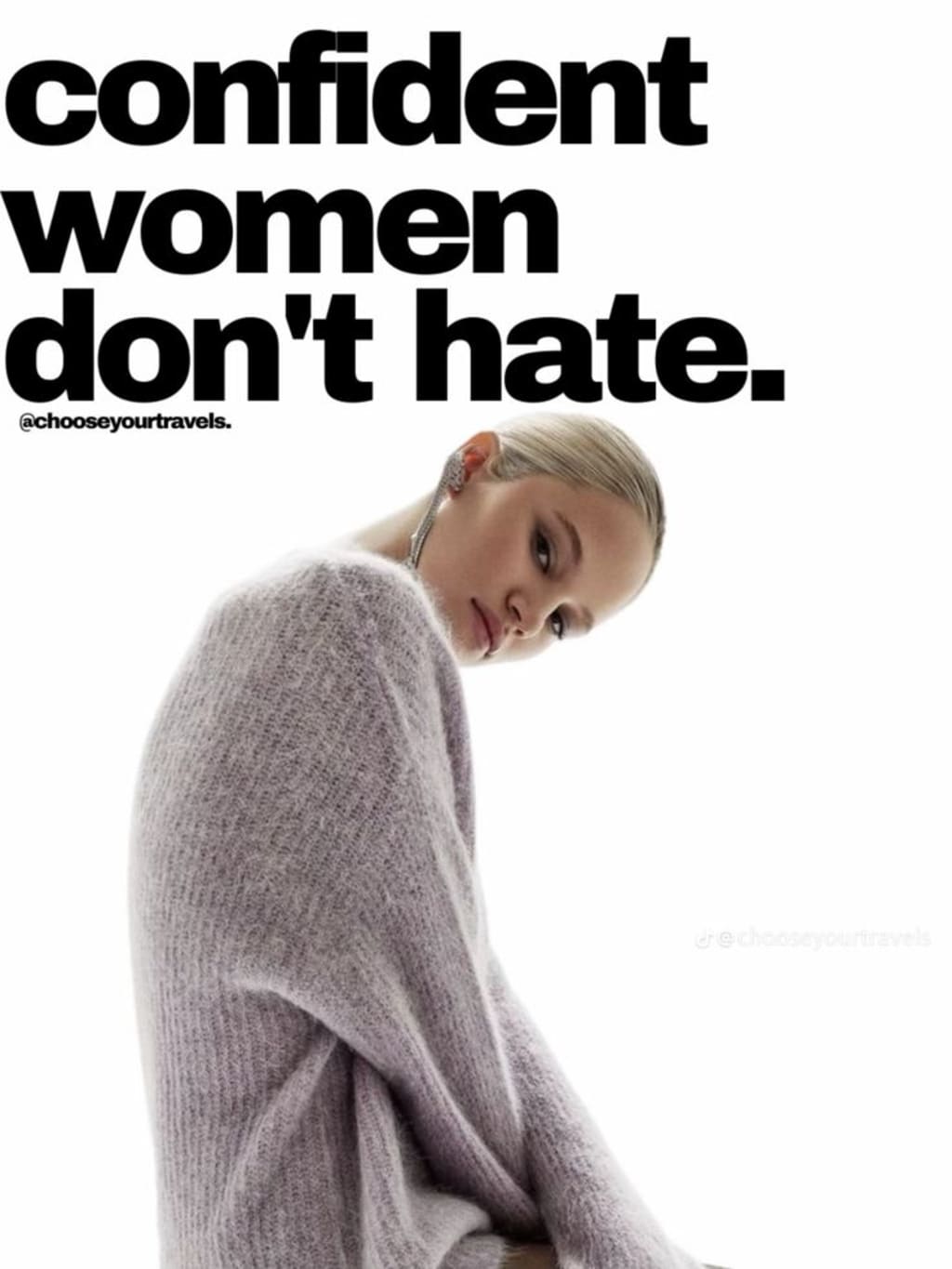
You’re a girl, and you can do this!
Still, there are things that don’t feel like they fit us. These days, there's a lot of content aimed at women.
Some of it still focuses on breaking down those same old tired stereotypes—
"You’re a girl, you can’t do that."
"You’re a girl, it won’t work out for you."
Which, frankly, is starting to feel exhausting. Not because it’s irrelevant-But because it drags you back into a dark past, and makes you feel ashamed all over again.
That shame doesn’t even make sense—
What were you supposed to do when you were six and someone told you girls can't do certain things? Argue back? Say, “Are you out of your mind?”
Who were you supposed to fight—your parents? The neighbors? Your kindergarten teacher?
It’s ridiculous.
I’m part of the generation that was raised on those messages, and now I automatically cringe when I see content like that.
The fact that there's still a need to plaster “Girls can do anything” on posters just feels insulting. It doesn’t inspire me—it frustrates me. Maybe that’s my issue—maybe it's a kind of overcompensation. I refuse to see myself as a victim of societal stereotypes, so my brain just blocks out any association with messages like that.
But when I think rationally, I get it.
For someone out there, maybe this kind of message is still necessary. Still, in my mind, even my own “girly struggles” are allowed to be a bit more layered.
A dark past.
The family.
Behind this monologue are moments from my life—moments soaked in those cliché phrases. And sometimes, when I’m feeling a little bold, I’ll throw them in my parents' faces: Like the time they didn’t let me sign up for karate. Because martial arts “didn’t suit girls.” Now, when even a basic workout feels like a chore and my knees creak during squats, my brain instantly recalls that moment— and silently points a finger at my parents. Because a child’s first connection with society is through their parents, right?
Or how instead of guitar, I was enrolled in piano lessons. Because classical music was “more appropriate” for girls— and the delicate tapping of fingers on keys looked better. Never mind the fact that I never had the kind of long, elegant fingers people say you need for piano.
Or how they didn’t hang a punching bag at home— because “you’re not a boy.”
Preschool.
Even public institutions aren’t off the hook. I remember one time in kindergarten I accidentally sat in front of a bowl with soup. I didn’t want it. I stared at that yellow mush in fear. But the teacher wouldn’t let me quietly suffer. “That’s too much soup for a girl. Giorgi, you sit here instead.” 👍
Then came school.
I don’t know what schools in the center of the city were like, but in the suburbs, this was the vibe: Most of us had average or below-average IQs. The boys barely studied. But once in a blue moon, one of them would give the right answer in class— and suddenly, boom! “Boys just have a different kind of brain,” echoed through the teachers' lounge like an electric pulse.
That phrase? Mostly came from my biology teacher. And to be honest, ever since I grew up, I’ve questioned her mental stability. I remember how her class was a real challenge— her demands were strangely strict, the questions oddly tough (this was before Google, by the way). So I’d always try to be extra prepared.
One time I answered a question, and mid-conversation, a boy raised his hand. The teacher’s eyes lit up, he gave a very average answer, and she said, “That’s exactly how you should be thinking!”
Spoiler: That teacher was a woman.
The boy? Practically Einstein.
Funny thing is— even though girls were constantly told what they couldn’t do, we still carried the bulk of the responsibility. At school, you had to be a good student. Your brother or male classmates could get away with being lazy. You? Not so much. Before heading outside, you had chores to do. Giorgi from next door would just run off, but I had to help my mom with the dishes first. Which, in itself, is fair— contributing to housework teaches basic life skills. But still—those are skills Giorgi should’ve learned too.
If the class got in trouble, it was the girls who were asked: "Why didn’t you show better judgment?" Like… Miss, weren’t you just saying that “boys think differently”? Now I’m the one responsible for collective enlightenment?
The saddest moment of all? When my mom once told me:
"If you had a brother, you’d be lazier. You wouldn’t even want to do the dishes or clean."
I dropped the plate I was washing. And honestly, she was 100% right. But her worldview—shaped by her era and its stereotypes—found it totally logical that most of the household burden should fall on me, and that if I had a hypothetical brother, I’d probably be expected to pick up his socks, too.
And you know what really hurts? My mom is that strong, independent woman: She worked her whole life. Ran her own business. Gave birth to me and raised me. Supported our whole extended family during tough economic times. Took me to dance lessons. Paid for music classes. Threw birthday parties. Took care of her mom, my dad, and even our dog when we had one. Oh, and never missed her skincare routine.
She has two degrees. A driver’s license. And plot twist—she was born in 1954. Back when women weren’t even “allowed” to do half those things.
She was a strong, independent woman—without even realizing it. Can you imagine someone telling her she couldn’t do something?
The only thing she might struggle with is posting an Instagram Story with a caption, but I can help her with that.
It’s hard being a woman. Even though I grew up in a family of strong women, those subtle expectations still seeped into my own life. Even though the apartment I was raised in belonged to my grandmother, and the countryside house where I spent summers? She built that too.
Still, I looked around at the attitudes in society, and I’d wonder— if my grandma, born in 1928, managed to do all that, how could my biology teacher still think, “Women just don’t have the same kind of mind”?
Time passed.
At eight, I worked with real money instead of toy bills. In fourth grade, I punched a boy. Finished school. Won medals. Got scholarships. Earned my degrees. Started working. Learned that women spend more just to exist— because a box of tampons costs 15 GEL in Georgia.
And I also realized: I don’t owe anyone proof that I can do something. Of course I can.
(Okay, I can’t lift 200kg—I don’t train for that.
But my friend Gvanca does,
so yeah—technically, I can too.)
About the Creator
Keep reading
More stories from Kristen Orkoshneli and writers in Humans and other communities.
How Emotional Intelligence Helps Couples Navigate Long-Distance Challenges
Long distance relationships challenge emotions in their own way. The physical distance can enhance the insecurities, misunderstandings, and fear of losing closeness. Emotional intelligence is a notion that was popularized by Daniel Goleman, and it is the skill to recognize, perceive, and control emotions. Long distance relationships are where this skill is necessary since the couple can not count on physical contact to reassure them. Rather, they have to read between the lines by means of digital communication. Emotional intelligence will help couples act rationally instead of acting in a rush, making the relationship stronger despite a geographic distance.
By Mark Hipster6 days ago in Humans
📢 Raise Your Voice Thread: 03/05/2026
Our “Raise Your Voice Threads” are hosted most alternating Thursdays at 12PM ET to offer creators more avenues to uncover exceptional stories on Vocal. As we are continuously searching for fresh creators and inspiring stories, this thread provides an opportunity to exchange and discuss the stories that have moved and motivated us on Vocal.
By Raise Your Voice by Vocal4 days ago in Resources


Comments
There are no comments for this story
Be the first to respond and start the conversation.