
Notes on Boundaries
Downloads from recent relationship counseling calls


From a call earlier, notes on boundaries:
— If you don't understand boundaries you are probably hard-wired from childhood to put the needs of others before your own. Putting your own needs first will flood you with feelings akin to shame, betrayal, guilt, etc. I say "akin" to because you may not at all recognize them as such, or even as feelings — you just may feel blocked or just that doing anything else simply isn't an option.
— People who don't have this kind of programming have a much easier time saying "no" and "NO" to honor their sacred no and protect their energy.
— We don't have to fix the programming to have boundaries, but we do have to be willing to feel everything that comes up to be cleared when we feel that inner no, and be willing to disappoint others to be true to ourselves.
— Further, we have to be willing to be gentle with ourselves about it. Punishing ourselves for saying no may look like boundaries — but that is performative more than self-care.
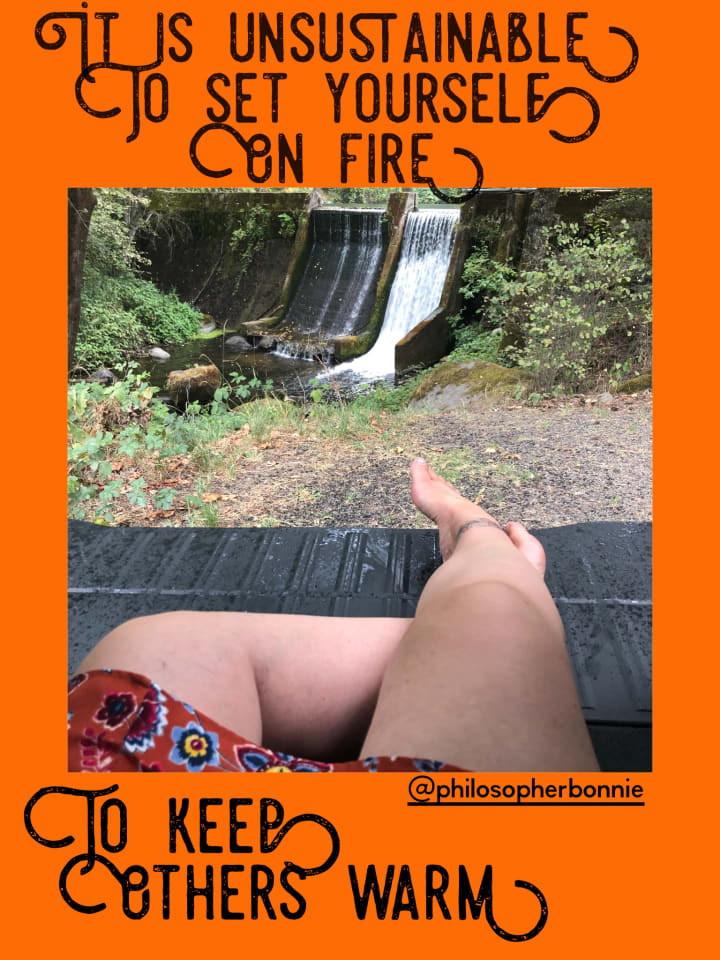
— It does not work for us to say yes when everything but our outdated programming is saying no. It's simply unsustainable.
— This all takes time, patience, and grace.
***
Notes from a call I was just on:
When we have a childhood trauma that isn't fully healed and integrated, it's normal to have skills that are kind of stuck at that level of development.
If our guardians do us harm, and we don't stand up for ourselves (sometimes just to keep the connection with our housing secure), then our boundaries and self-advocacy skills are likely going to get stuck at that level of development without intervention or conscious work on them.
It makes sense that an adult with that kind of trauma in their past is going to have an issue with some people walking all over them and them not saying anything about it. As the wound heals the skills can be upgraded and the whole experience can be integrated, leaving us as a fully functioning adult around these topics.
You can tell that you're a little stuck at an earlier stage of development if you get salty about it without actually saying anything, or if you find yourself whining about it, or being resigned to it being that way, or putting up with it not working for you. There something blocking growth there, likely that old wound that has unread notifications and unfinished drafts of things that need to be said buried in it.
Boundaries have a very close relationship with self-worth. When we stand in our power, people generally don't fuck with us, and when we have integrated "thou shalt not fuck with me" then "setting boundaries" isn't really a thing.
Anyone who is well calibrated and interested in treating you well simply won't have an issue knowing where your boundaries are and honoring them once integrated like that. People still may come up against them to find their edges — but the only people blatantly crossing them are people who just cross boundaries, and that's a thing to be dealt with, but it isn't by "setting them" or repeating yourself or being more intense about it.
***
Downloads from the phone call I just got off of:
— lean into self respectful self care
— there's a continuum between "if it's not a yes it's a no" and "if it's not a no it's a yes" — a continuum from selfish to accommodating
— we have to set the dials according to how easy it is for us to respect ourselves/breathe/smile, and that's where we set our boundaries
— we have to let ourselves be selfish to the degree we need to for integrity with our dials — this is self respectful self care
***
Observations on the offering choice/decreed wrong choice/meltdown parenting pattern:
Adult asks child if they “want to” (clean up the toys, take a nap, finish their dinner, etc)
Child says “no”
Parent decides that was not the desired outcome/child made wrong choice
Parents seem to choose:
— Have child feel sorry for making that choice,
— Or/and bribe them to make a different choice
— “Help” child make “right choice”
Child has choices, too — set boundaries so "no" is honored, rebel, submit, ignore, redirect, etc.
Note: If child chooses to set boundaries — as a healthy adult would/should,
And ends up having a meltdown,
And gets punished for having a meltdown,
The child learns only some people are safe having boundaries.
Note:
Child learns their "no" doesn't have the same weight as the adult's
Child feels insecurity
Child learns the game is complicated
Child learns sometimes making the wrong choice is rewarded
Child learns they need to learn the boundaries of the game
Child learns the rules are always changing
Child predictably rebels — or becomes helpless
Parent and child are playing different games
Child is playing the game of learning, growing, brain development, etc
What game is adult playing?
Have they slept?
Eaten?
Gotten their own needs met?
Children, especially ones being born during this dumpster fire time, MUST learn the rules of the game they are born into so they can navigate this crazy world.
Sleep deprived, distracted, stressed people are caring for them.
And, unfortunately, it's the adult that always has to be the one to interrupt the pattern — their behavior perpetuates it, not the child. The child is just trying to figure out how to walk through the world in ways that work.
We want to give children choice, but it's only appropriate to offer them when they actually have choices — when they are permitted to freely choose and have their choice honored.
***
If you like what you've read or found any of it helpful, please consider leaving a tip to support sharing my work! I will also be glad to clarify any points I didn't fully flesh out, feel free to ask questions in the comments!
About the Creator
Philosopher Bonnie
@philosopherbonnie is writing wordy words from taffy letters for her own amusement. Non-binary, she/her pronouns, Gen X vibes. Follow me for laughs, thinks, wordy words, rants, wishes, dreams, visions, and the occasional recipe.
Keep reading
More stories from Philosopher Bonnie and writers in Humans and other communities.
Downloads from Relationship Counseling
I am a relationship counselor (with self and/or others) working remotely, and when I get off a call I often jot down notes to bring light to common topics that came up. These sometimes become articles, but mostly they are just notes full of insight that want to be shared. No personal client data is ever shared.
By Philosopher Bonnie3 years ago in Humans
A Historic Declaration
We the People of the Husbands of the United States of America, in Order to form a more perfect Union, and I mean you...with me...establish Justice, insure domestic Tranquility, provide for the common defence, promote the general Welfare, and secure the Blessings of Liberty to ourselves, after Puberty, do ordain and establish this Declaration of Co-Dependence.
By Gerard DiLeo5 days ago in Humans
Rising Above the Noise: Why Meeting Hostility With Grace Matters in Public Life
Rising Above the Noise: Why Meeting Hostility With Grace Matters in Public Life Public life in the United States has become loud, tense, and full of sharp edges. People speak past one another instead of to one another, and disagreements quickly turn into battles over identity and belonging. In this atmosphere, many people who lean toward openness, compassion, and inclusion find themselves struggling to match the intensity of those who speak with certainty, anger, or absolute conviction. It often feels as if the loudest voices set the tone for the entire country, even when they represent only a small part of the population. This imbalance creates a sense of exhaustion for people who want to build bridges rather than burn them.
By Julie O'Hara - Author, Poet and Spiritual Warrior3 days ago in Humans


Comments
There are no comments for this story
Be the first to respond and start the conversation.