
Michel Foucault: The Philosopher of Invisible Power
Michel Foucault: The Philosopher of Invisible Power

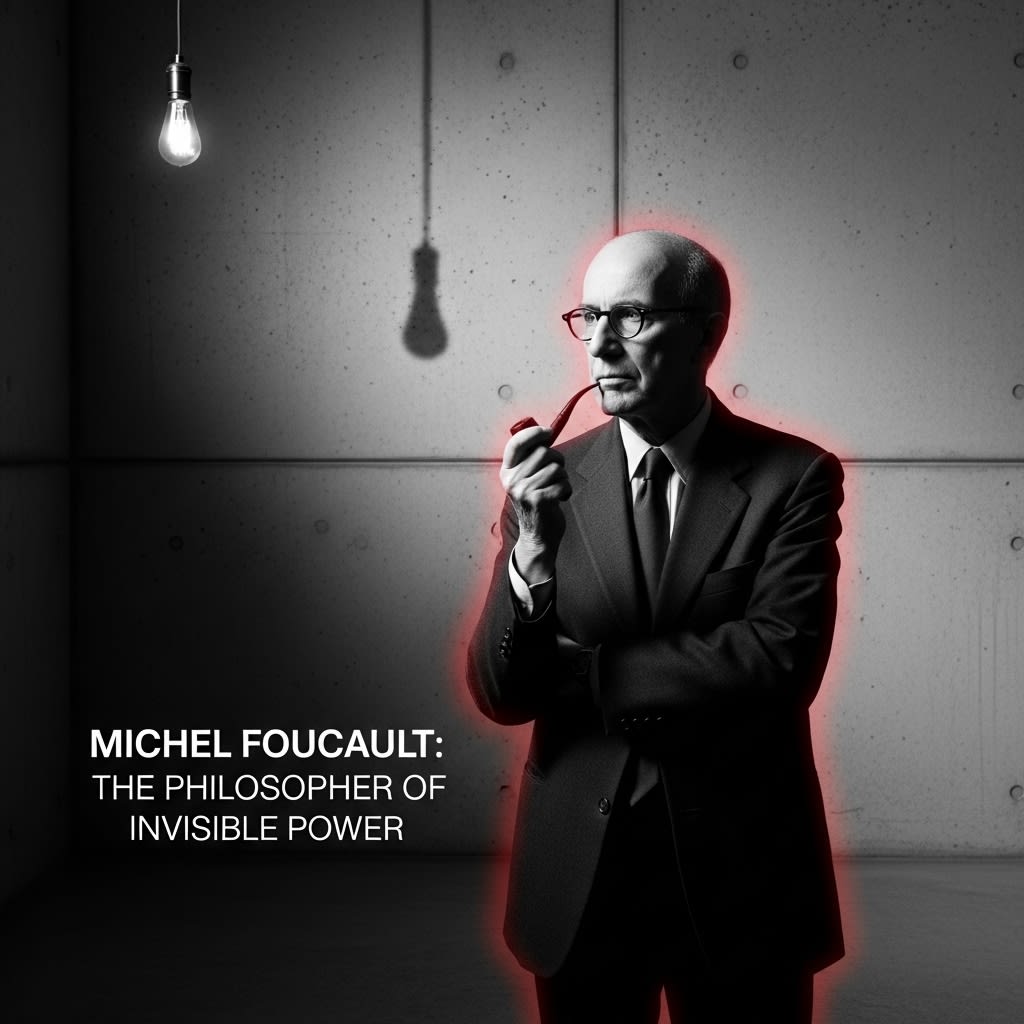
Michel Foucault did not study kings, presidents, or generals. He studied something far more unsettling: the power that does not announce itself. The power that operates quietly through norms, language, institutions, and habits. Long before surveillance capitalism, algorithmic control, and data-driven governance, Foucault revealed a truth that still defines modern life—power is most effective when you no longer see it.
Born in France in 1926, Foucault rejected the traditional philosophical obsession with abstract truths. He was not interested in what power *claimed* to be. He was interested in how it actually functioned. Rather than asking who ruled, Foucault asked how people were shaped, categorized, disciplined, and normalized. His answer changed social theory forever.
For Foucault, power was not something owned by the state or exercised only from the top down. Power was everywhere—not because it crushed people constantly, but because it structured the possibilities of action. It lived in schools, hospitals, prisons, workplaces, and even language itself. Power trained bodies, formed identities, and produced what societies accepted as “normal.”
One of Foucault’s most influential ideas came from his study of prisons. In *Discipline and Punish*, he traced the evolution of punishment from public executions to quiet incarceration. On the surface, society became more humane. But Foucault saw something else. Violence did not disappear—it became internalized. Instead of being forced to obey, people learned to regulate themselves.
His famous metaphor, the Panopticon, captures this perfectly. Designed as a prison where inmates could be watched at any time—but never knew when they were being watched—the Panopticon created self-discipline. Surveillance became psychological. Control no longer required constant force. People policed themselves.
This insight now defines the digital age. Cameras, data tracking, performance metrics, and algorithms function like modern Panopticons. We modify our behavior not because someone is watching—but because someone *might* be watching.
Foucault also revolutionized how we think about knowledge. He argued that knowledge and power are inseparable. What a society calls “truth” is shaped by institutions that benefit from certain narratives. Medical categories, psychological diagnoses, and social labels do not merely describe reality—they help produce it. His concept of “power/knowledge” exposed how authority often hides behind expertise.
One of his most controversial contributions was the idea that identities themselves can be constructed by systems of control. Madness, sexuality, criminality—these were not fixed categories across history. They were shaped by cultural and institutional forces. By naming, classifying, and studying people, institutions gained power over them.
Foucault did not deny suffering or oppression. He showed how modern control often operates without villains. Systems function smoothly because individuals participate in them. Bureaucracy replaces brutality. Efficiency replaces cruelty. Power becomes harder to resist because it no longer feels like power.
Unlike traditional revolutionaries, Foucault offered no grand solution. He distrusted utopias and absolute theories. Instead, he believed resistance begins with awareness. If power works by becoming invisible, then exposing it is the first act of freedom. His work trained generations to question assumptions that once seemed neutral or natural.
Critics accused Foucault of cynicism or moral ambiguity. He refused simple judgments. But this was intentional. Foucault believed that moral certainty often masks domination. His goal was not to tell people what to think—but to reveal the frameworks shaping their thought.
Today, Foucault feels less like a theorist and more like a diagnostician. His ideas explain workplace surveillance, algorithmic ranking, social media behavior, mental health labeling, and institutional conformity. The language has changed, but the mechanisms remain.
Michel Foucault showed that the most dangerous power is not the one that commands—but the one that conditions. Not the one that punishes—but the one that defines what is normal.
In an age where control is efficient, silent, and personalized, Foucault remains essential. He did not give us comfort. He gave us sight.
About the Creator
Fred Bradford
Philosophy, for me, is not just an intellectual pursuit but a way to continuously grow, question, and connect with others on a deeper level. By reflecting on ideas we challenge how we see the world and our place in it.
Keep reading
More stories from Fred Bradford and writers in Humans and other communities.
George Grant: Canada’s Moral Conscience
In the heart of Toronto’s York University, a quiet professor with a fierce intellect and a sorrowful gaze penned a sentence that would shake Canada’s post-war complacency to its core: *“The truth is that we are a colony of a new kind of empire.”* The year was 1965, the book was *Lament for a Nation*, and the man was George Grant—philosopher, conservative revolutionary, and the unsettling moral conscience of a country perpetually unsure it had one.
By Fred Bradford4 days ago in Humans
Cabin Fever Because of Snow, Sleet, and Freezing Rain That Turned to Icy Roads
What Is Cabin Fever? The short answer is that cabin fever is restlessness from being in a confined area. Cabin fever is the distressing irritability or restlessness experienced when a person or group is stuck at an isolated location or in confined quarters for an extended time. Research shows that prolonged cold, gray skies, and being stuck indoors can trigger mood shifts similar to “winter blues.”
By Margaret Minnicks7 days ago in Humans
Writing About Writing: The Rainbow Trap
The good thing about living in modern times is that LGBTQ representation in media is increasing. Not just in niche and Independant media, either, but also in mainstream media. Books, movies, TV shows, comics... they're finally catching on that LGBTQ+ people form a significant part of their audience, and deserve to see themselves on screen and in fiction, not just as victims in documentaries and true crime shows.
By Natasja Rose4 days ago in Writers


Comments
There are no comments for this story
Be the first to respond and start the conversation.