
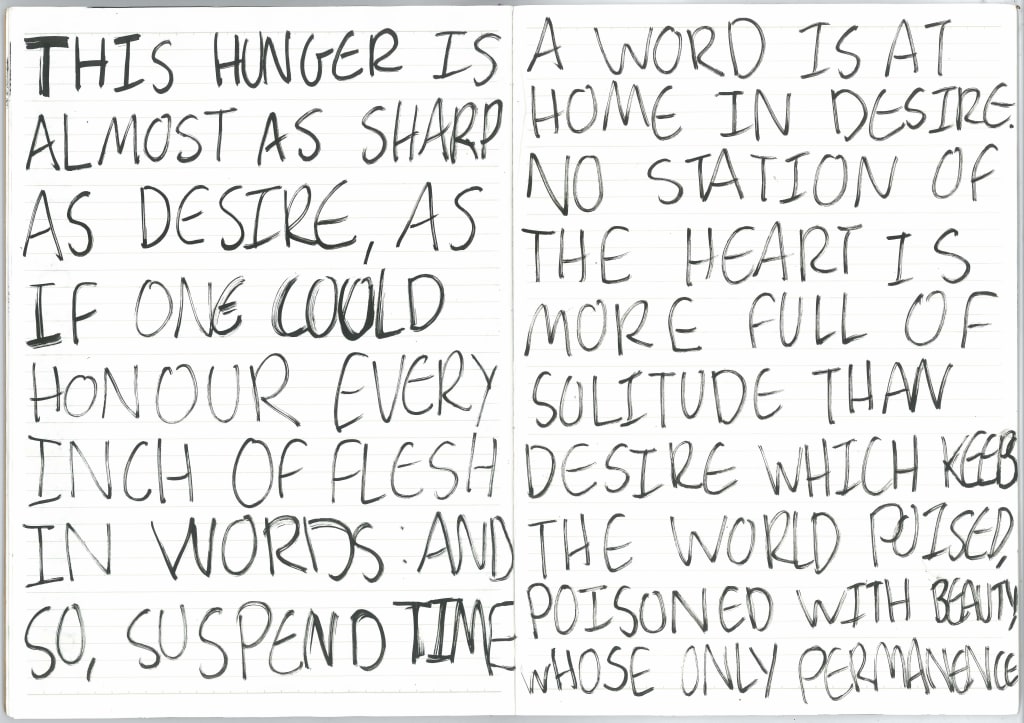
I was simply working my way down a list of names when I met Marie, obsessively researching for my book, determined to paint a true picture of the man I considered to be the greatest poet who ever lived. Her name only came up once, given to me by an ancient waitress who had worked in a small Paris café for her entire life, across the alleyway from where my subject had once lived.
Marguerite Yolande.
I couldn’t find her address or contact details, but I did find her daughter, a grumpy middle-aged woman working as a small-town accountant. I called her, thinking it might be a dead end, but her mother was still alive, living in a small village about ten miles south of my apartment.
“I mean I can ask her if she wants to speak with you, but I don’t think she knew him very well. She only ever mentioned meeting him briefly, and she even said he was arrogant.”
“That’s completely fine. I just don’t want to leave any stone unturned.”
“Sure. Just might not be worth the trip.”
I arrived at the address I was given in the late afternoon, the drive through the winding country roads taking longer than I had expected. After knocking a few times I waited patiently before an old woman stooped with age answered the door.
“Hello Marguerite, I-”
“Marie. Call me Marie”
“Sorry, Marie- I just wanted to briefly talk to you about-”
“The poet.”
Jesus, was this old woman going to interrupt me the whole time?
“Yes. I understood you knew him when he lived in Paris.”
She looked at me, searching for something in my face- or maybe considering something.
“Yes. Come inside.”
Her cottage was that of someone who had found comfort but not success in life. It was cosy but not stuffy, filled with the warmth of the afternoon sun, and flowers sat in vases around the living room. Paintings covered every wall, a half-completed landscape sitting on an easel in the corner. Even with so much blank space it was beautiful.
We exchanged pleasantries and she bought out a tea tray, motioning to me to sit in a worn armchair. I obliged, and when she sat down, I launched into my usual spiel about trying to find the essence of this artist, and in particular, the identity of The Woman, the muse who breathed life into his work.
“Your daughter mentioned you didn’t know him very well, but I hoped you could point me in the direction of his lover, since you were around in the art scene at the time.”
The strange expression that I had seen in her doorway came over her face again, before the corner of her mouth twisted into a small smile.
“Yes. I knew her.”
Ah, a breakthrough!
“That’s amazing to hear, did you know her name? Did you ever meet-”
“The woman that lived with him in Paris isn’t around anymore. But I do have some of his work if you’d like to see.”
I agreed enthusiastically. Every scrap of paper led me closer to my masterpiece, the biography of my hero. Marie left the room and I considered how she would have something of his- perhaps bought when he was relatively unknown. The man didn’t leave many clues, frustratingly for me.
But when she came back out, she held a small black book with a noticeably worn cover, not a singular scrap of paper. She placed it in front of me.
I picked it up from the coffee table and leafed through the notebook, it’s pages yellowed with age, but the paper thick with quality. It was filled with poems I’d never seen before, sketches too, all referring to The Woman, to love. I slowly put together what was staring me in the face.
It was referring to this woman. To Marie.
I met her steady gaze, my eyes wide with surprise.
“This is you?”
“Yes. It was me, but no longer.”
“God, you were The Woman all along… this I mean, this is unprecedented, a work like this, seeing into his mind- god, the publishing deal would be thousands, and it would fetch even more at auction, private collectors would go crazy…”
I was stammering now. I was holding a collection of his original works, never seen except by this old woman in her run-down cottage.
“You could do- I don’t know- something with this, it’s incredible-”
“Sell it. Give the money to my grandchildren.”
“I can- yes, it would be an honour to take it to auction- but uh… would you rather put it in a museum? Or you could keep it, let them publish a copy, but keep it, I mean, It’s yours, it’s all about you-”
She stood up, her previously stiff movements infused with grace. I saw her as she was half a century ago. I stopped talking. I saw The Woman.
Her eyes locked onto mine, anger, pure anger, filling them with tears. But she wasn’t angry at anyone who was still alive.
“I was his muse. I thought that meant I was his love too, that little black book filled with admiration and obsession for me, for my body, my face, my mind, and with every poem he wrote he built us, our forever."
The floor is littered with manuscripts, scribbled verses, pages ripped out of books. The only light comes from a curtain-less window, the street lamps casting light over two motionless figures, as if posed, who sit cross-legged on the bed. They stare at each other wordlessly.
“I did anything for him and his art. I would push him to publish, to let the world see his work, but he would tell me over and over again that money would corrupt it, that it was art that was made for creation, not publication, but I kept helping him move forwards, to become the writer I knew he could be. I knew he was going to be incredible and the best and I thought… I thought he loved me.”
The tears were running down her face now, but her voice never wavered. She sat back down.
“I was only ever his muse. But I only figured out the truth that night on July 1957, when I told him what had happened.”
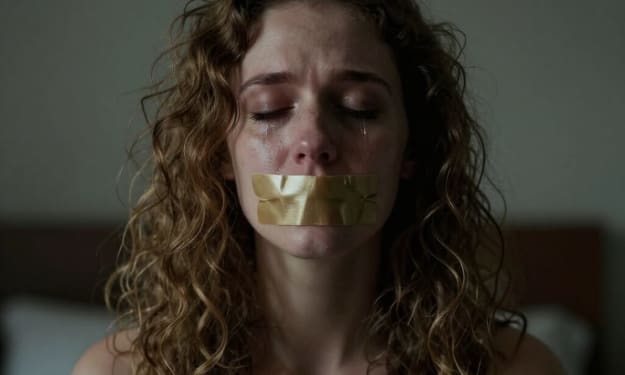
A doctor's note sits on the bed where love once lay. The man is pacing, swearing, his hands running through his hair, over and over again. The woman sits with her knees to her chin, crying silently.
Marie cries freely now, in her cottage, and tells me everything, far more than I ever knew about the mysterious man, the artist. How he truly was.
How he had left her with child, penniless and without family in the dark city.
How the banker I had contacted was his daughter, and how she was terrified I had figured it out and told her, revealed that the man who was now the world’s most celebrated poet was her father. How she heard about The Woman as his work became prolific, but knew that the fabled love the public dreamed about was a false love. She told me everything as the sun slipped under the horizon and the tea grew cold. Unattended.
“You see, what he hated most was the money. The idea that some intangible, like love, could be converted into cold, hard, cash. Sell it.”
So when I finally left that cottage, when she had used up all her words, I did. It sold for $20,000, twice what I’d expected. I sent the money to the daughter, the poet's daughter, giving vague details on the little black book, keeping Marie’s story to myself. It wasn’t my place to tell her who her father was. I sent a portion to Marie and drove past her cottage again and again, wanting to go in and speak to her once more.
But I never walked through that doorway again, and when I finished the biography, I had written that The Woman was no longer around.
About the Creator
Keep reading
More stories from writers in Humans and other communities.
Whiskey At Dusk
Guess the whiskey was more important to you in the end, wasn’t it? It was more than the well-being of your friends; more vital than showing up to the places you promised you would and could come to; more critical of a matter than fulfilling your damn responsibilities and getting the press off your back.
By Snarky Lisa4 days ago in Humans
When a Winter Storm Weather Forecast Changes Everything
Before the first snowflake falls, something shifts inside people. The world feels quieter, heavier, more watchful. Phones light up with alerts, and conversations circle back to the same question. What does the winter storm weather forecast really mean for us this time? These forecasts are not just numbers and maps. They shape plans, emotions, and sometimes fear. They decide whether children stay home, whether roads empty early, and whether families brace for long nights without power. A winter storm forecast carries memory and possibility at once. This article looks closely at how winter storm forecasts work, why they matter so deeply, and how to read them with clarity instead of panic. Understanding the forecast helps people prepare with care, not worry.
By Muqadas khana day ago in Humans



Comments
There are no comments for this story
Be the first to respond and start the conversation.