
Light Up Your Loved Senior’s Life with Music
Create Bridges to Memory

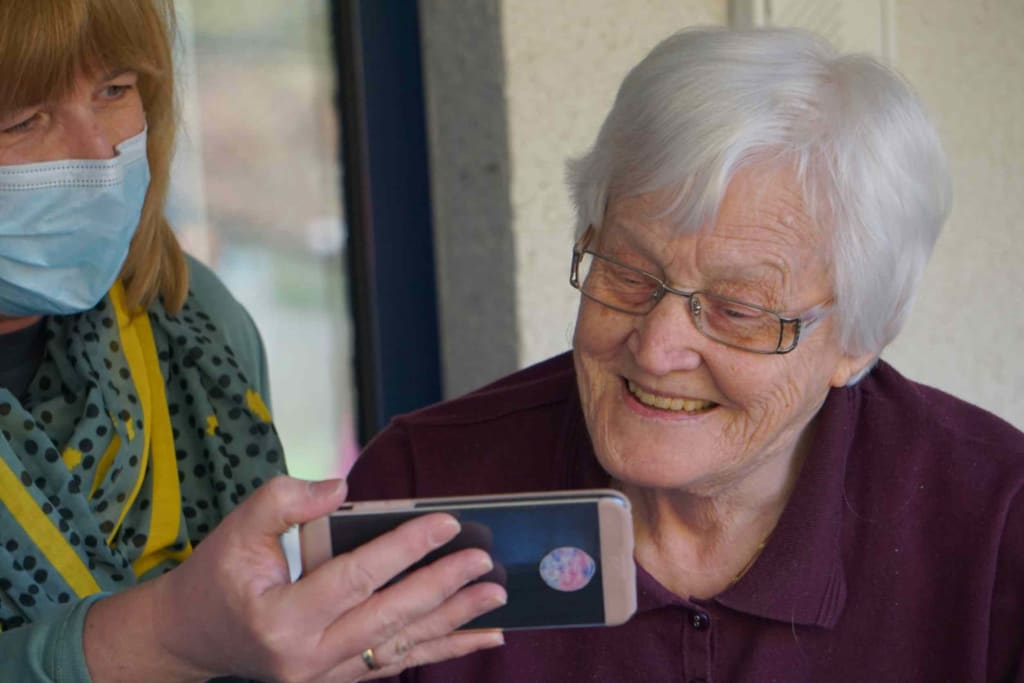
According to the World Health Organization (WHO), dementia afflicts more than 55 million people globally, with nearly 10 million new cases reported every year.
The condition brings anxiety to both the patients and their caregivers. Researchers now suggest that music can enliven your loved one’s life. Try it.
As a caregiver to a dementia patient, you may become concerned as your loved one loses their ability to communicate verbally. Your loved one may also become anxious and more agitated as the condition advances. They could even suffer depression.
Research suggests that music could help bring life into your loved one’s life. A 2022 study by Northwestern University, Illinois, USA, and the Institute for Therapy through the Arts (ITA) concluded that music could improve dementia patients’ social connections.
In contrast with earlier studies, this one involved the patients and their caregivers.
Music from the past
In the study, labeled “Musical Bridges to Memory”, a live ensemble played music from the patients’ youth. The patients and their caregivers were recorded interacting 10 minutes before and 10 minutes after the musical interlude.
During the 45-minute musical intervention, the patients and their caregivers were encouraged to sing along, dance, and play simple musical instruments. After the musical activities, the patients and their caregivers were less agitated, anxious, and livelier. These changes continued even after the sessions.
The researchers noticed an elevated mood in the patients and more eye contact between them and their caregivers. The researchers also recorded an improvement in the patients’ social interaction.
Control group
In contrast, a control group not exposed to the musical intervention did not display such changes.
The “Musical Bridge to Memory” program ran for 12 sessions over three months. The findings were published in January 2023 in the Alzheimer Disease and Associated Disorders journal.
Earlier research supports the findings of the “Musical Bridges to Memory”.
A review by researchers affiliated with the University of Toronto, Canada, found that music therapy can improve a patient’s social and cognitive performance.
Published in the Frontiers in Neuroscience journal in March 2019, the review concluded that music therapy helps to calm anxiety and depression. Even more remarkable, it reduces the use of anti-anxiety and anti-psychotic medication in nursing homes.
Music therapy at home
As a caregiver, you can use music therapy at home, in a group setting, or individually, as well as in care situations. Do the following:
1. Involve the patient
Ask the patient, family members, or friends what kind of music the patient knows and enjoys. If the patient is unable to communicate and you cannot get help from family or friends, try out music that was popular during the person’s youth.
2. Play gentle music
Start by playing quiet, gentle music and see how the patient reacts. You may use photos alongside the music to get the patient to respond or share memories.
If the patient seems upset, try a different piece of music. Remember, some songs may trigger unhappy memories.
If you cannot find something that elicits a positive response, turn off the music and just sit with the patient and comfort them.
You can engage in the following activities jointly with your loved one:
• Listening and singing along to choice pieces of music.
• Singing in a group or choir.
• Listening and singing along to recorded choir music.
• Singing along and playing musical instruments to favorite pieces of music.
• Listening to a live performance.
• Dancing and singing along to preferred music.
• Watching a favorite musical on TV.
• Listening to “golden oldies” on a radio station.
In all these activities, avoid overstimulation. Eliminate competing noises by, for instance, shutting the door and turning off the TV.
Encourage movement. Depending on your loved one’s ability, move to the beat, dance, clap, or tap your feet.
As a caregiver, acquaint yourself with music therapy. There are many resources online including the Alzheimer’s Foundation of America website.
Final thoughts
In his book, Musicophilia, neurologist Oliver Sacks writes that musical emotion and memory “can survive long after other forms of memory have disappeared.”
Research suggests that music can “bring to life” your loved one.
So, go ahead, look for the music that your loved one enjoys or enjoyed in their youth, and play it to them. Encourage them to sing and dance along and see the changes this makes to their life. And to your life as well.
About the Creator
Wanjiru Ciira
I'm a story-teller with an interest in the human condition. I write on relationships, health, aging, parenting, travel, and fiction. I've a background in journalism - feature-writing, reporting, and investigative journalism.
Keep reading
More stories from Wanjiru Ciira and writers in Humans and other communities.
Oleg Belay and the TRINFICO Investment Group: Strategy, Development, and Crisis Resilience
How Was the TRINFICO Investment Group Formed Under Market Conditions? Russia’s financial market in the early 1990s developed amid high uncertainty and the absence of stable rules. The national economy was transitioning to a new model, while entrepreneurs had to operate in an environment where the regulatory framework was only beginning to take shape. It was during this period that Oleg Belay began his professional path, with the emerging market becoming a space for exploration and hands-on experience.
By Pavlo Chairkays3 days ago in Humans



Comments
There are no comments for this story
Be the first to respond and start the conversation.